
Is the Ha Giang Loop Worth It? An Honest Answer
Every traveler who asks this question has already half decided. What they want is permission, or a reason to stop.
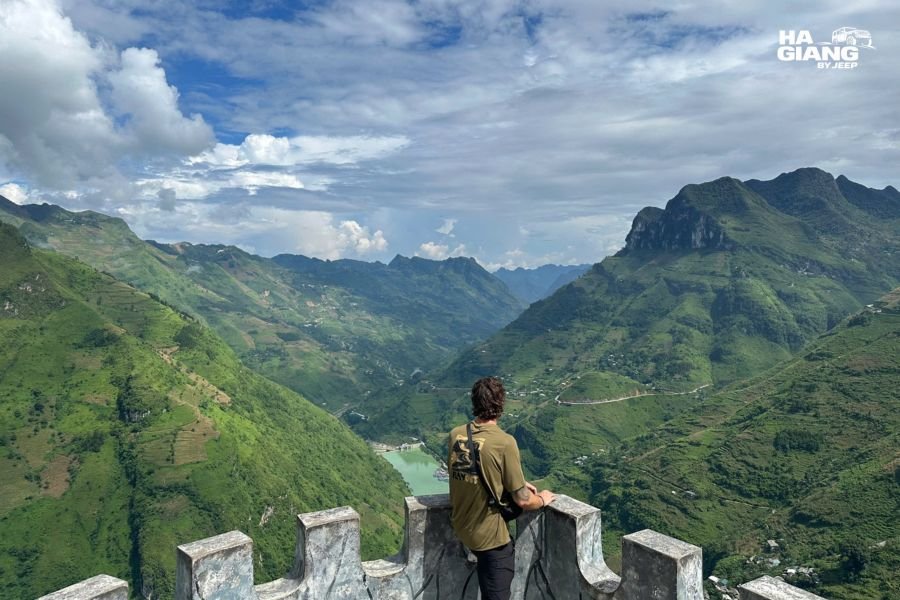
So here is a straight answer rather than a sales pitch. Is the Ha Giang Loop worth it? For most people who go, yes, and genuinely not worth it for a specific minority. The difference between those two groups is almost never about the place. It is about how the trip was put together.
This article covers both. Who loves it, who quietly regrets the whole thing, what the landscape actually delivers, what it does not, and the five decisions that separate a trip people talk about for years from four tiring days in a vehicle.
The Short Answer
Yes, with three conditions attached.
It is worth it if you give it enough days. It is worth it if you travel in a way that matches your own tolerance for discomfort. And it is worth it if you accept that this is a slow region where the point is the road itself, not a checklist of attractions.
Fail any one of those and you can absolutely have a mediocre time in one of the most striking landscapes in Southeast Asia. That happens more often than the highlight reels on social media suggest, and it is almost always avoidable.
The Ha Giang Loop rarely disappoints people. Badly planned trips to Ha Giang disappoint people. Those are different problems with different fixes.
Who the Ha Giang Loop Is Worth It For
Couples
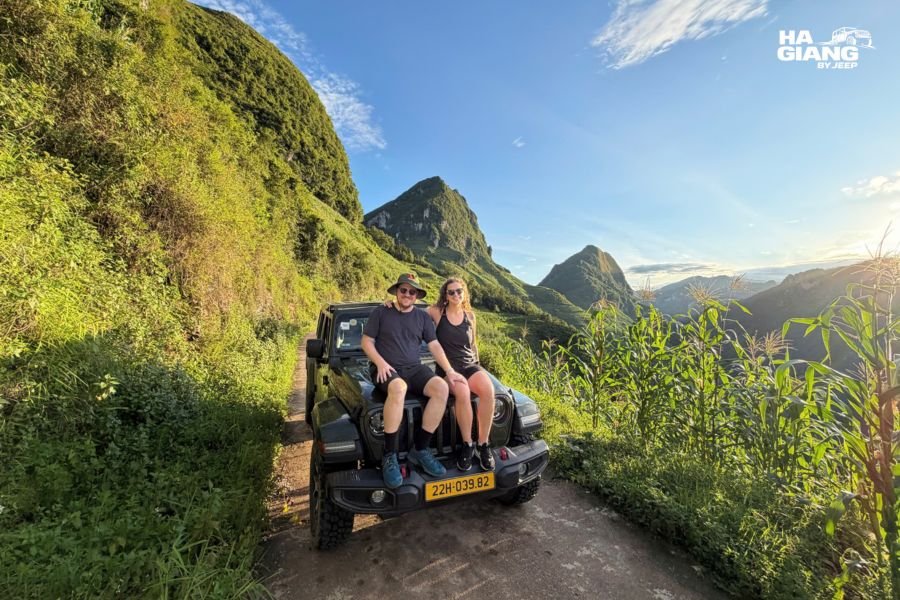
This is the single most common booking we handle, and the reason is simple. The Loop gives you long stretches of shared quiet, a new view around most corners, and evenings in villages where there is very little to do except eat, talk, and go to bed early. If your idea of a good holiday together involves conversation rather than a list of bookings, it lands well.
Families With Children
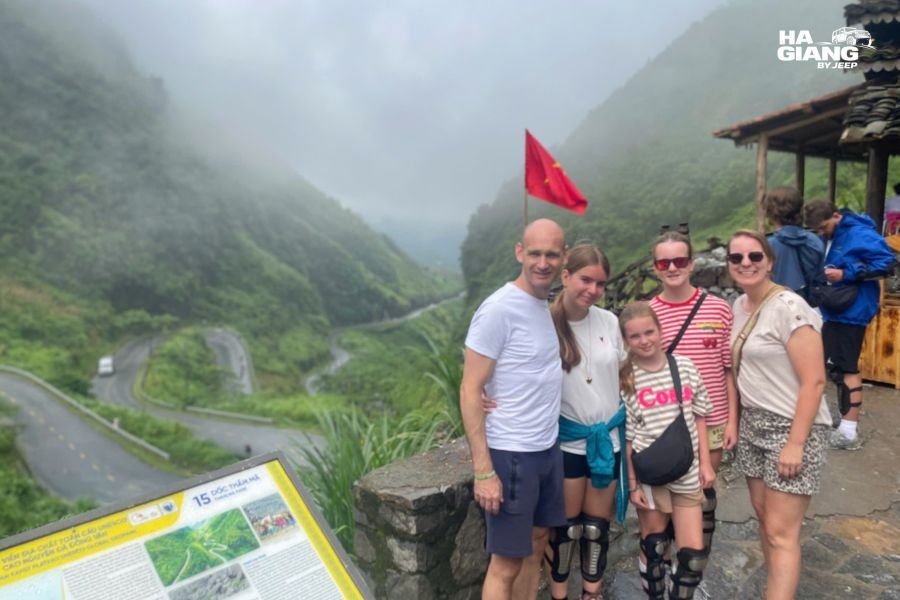
Better than most parents expect, with one caveat: the days need to be built around the children rather than the itinerary. Kids tend to respond to this region strongly. There are buffalo on the road, markets full of things they have never seen, homestay families with children of their own, and a vehicle they can stand up in to look at the view.
The caveat is that long stretches of mountain road with a rigid schedule will test anyone under ten. A private vehicle solves most of this, because you stop when the small person in the back needs to stop. Our guide to jeep tours with families and kids goes into the practical detail.
Travelers in Their 50s, 60s and Beyond
Very much worth it, and this group is consistently the most enthusiastic afterwards. What matters is comfort rather than fitness. The walking on a jeep trip is optional and short. What is not optional is sitting in a vehicle for several hours a day across mountain roads, which is why seat comfort, room to stretch, weather protection and the freedom to stop matter more than anything on a brochure.
A great many people in this age group have been told Ha Giang is not for them. That advice is usually based on a style of travel, not on the place.
Anyone Who Does Not Drive
Worth it, and this is worth saying plainly because a lot of travel writing about Ha Giang assumes you will be operating a vehicle yourself. You do not have to. With a local driver, you spend the whole journey looking outward instead of at the road surface, which is a different trip entirely and, for most people, a better one.
Photographers and Food Travelers
The light here does dramatic things between roughly October and April. Cloud sits in the valleys in the early morning, then lifts. Terraces change colour completely across the year. And the food is regional, specific and cheap. If either of these is your reason to travel, the case is easy.
Who Might Not Enjoy It
An honest answer has to include this part.
People who need a resort standard of accommodation every night. Ha Giang has genuinely comfortable places to stay, and standards have improved a lot. But the best of them are not international hotel chains, and in smaller villages the hot water is temperamental and the walls are thin. If that will ruin your evening, this is not the region for you.
Travelers with a two day window. You can technically see part of the Loop in two days. You will mostly see the inside of a vehicle. Two days here is worse value than three days almost anywhere else in Vietnam.
Anyone who dislikes mountain roads intensely. Not nervousness, which is manageable and extremely common. Actual dread. The roads here are constant switchbacks with drops beside them, and while they are comfortable in a jeep with a driver who does this weekly, they never stop being mountain roads.
Travelers who want a beach and a spa. There is no version of this trip that delivers that, and there is nothing wrong with wanting it.
People who need reliable connectivity every hour. Signal exists in the towns and drops out between them. For most people this turns out to be the best part. For some it is a genuine problem.
What the Landscape Actually Delivers
The honest version, without adjectives doing all the work.
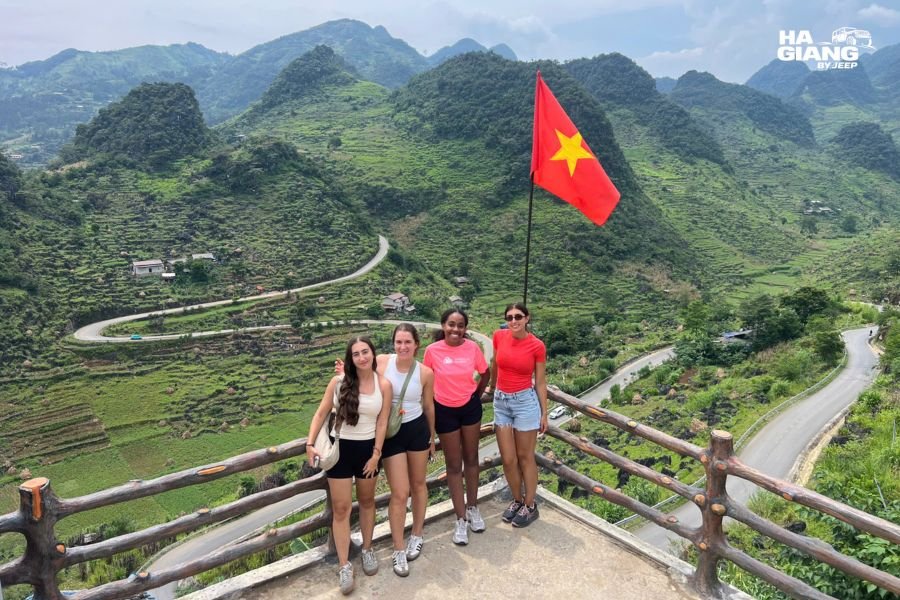
The Dong Van Karst Plateau is a UNESCO Global Geopark, and the reason has nothing to do with tourism. It is a limestone landscape roughly four hundred million years in the making, which above ground looks like a sea of grey stone teeth with terraced corn wedged into every pocket of soil someone could find. It is not pretty in a postcard sense. It is severe, and it goes on for far longer than you expect.
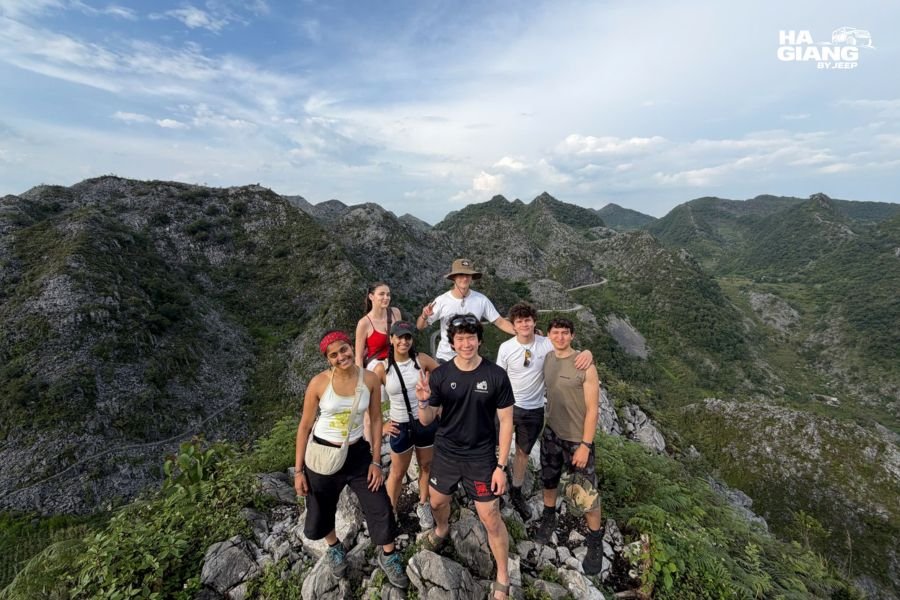
The set pieces earn their reputation:
- Ma Pi Leng Pass, cut into a cliff face above the Nho Que River, regularly listed among the great mountain drives anywhere
- Tu San Canyon, the deepest canyon in Southeast Asia, best seen from water level on a boat trip
- Quan Ba, where the plateau begins and the road starts climbing in earnest
- Lung Cu, the flag tower at the northern edge of the country
- Du Gia, green, low and completely different in character from the stone plateau
What surprises people is the variation. The stretch between Quan Ba and Yen Minh looks nothing like the plateau around Dong Van, which looks nothing like the valleys near Du Gia. Four days is not repetitive here. That is a real thing, not marketing.
See the Ha Giang Loop jeep tours
The Part Nobody Photographs: The People
Ask travelers a year later what they remember and the landscape usually comes second.
This region is home to Hmong, Dao, Tay, Nung, Lo Lo and other communities, many of whom farm slopes that look impossible to farm. You will see women carrying loads up gradients you would struggle to walk empty handed, children walking long distances to school, and markets where people come down from villages hours away to trade, eat and talk.
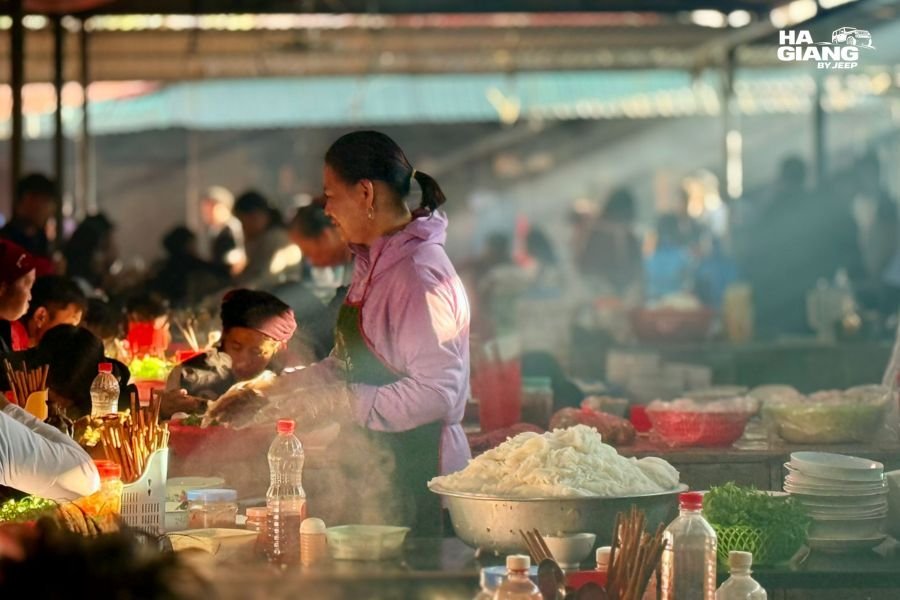
Two things make this land differently depending on how you travel. The first is language. A driver who grew up here can explain what you are looking at and, more importantly, talk to the people you meet. Without that, a market is a photograph. With it, a market is a conversation.
The second is pace. Rushing through a village to reach the next viewpoint on schedule turns people into scenery. Stopping for forty minutes because something is happening does not.
A word on photographs: ask before you take one, especially of children, and take no as an answer. People here are generous and patient with visitors, and that patience is not unlimited.
The Food Alone Makes a Case
This is the most underrated argument for the whole trip.
Northern mountain food is its own cuisine, not a variation on what you ate in Hanoi. Com lam is sticky rice grilled inside bamboo. Thang co is a Hmong dish that people warn you about and that is worth trying once, properly, at a market rather than a restaurant. Banh cuon trung comes with a bowl of broth rather than dipping sauce, which sounds minor and is not. Chao au tau is a bitter, warming porridge you will find in Ha Giang City in the cold months. Shan tuyet tea comes from ancient trees on the slopes around Hoang Su Phi.
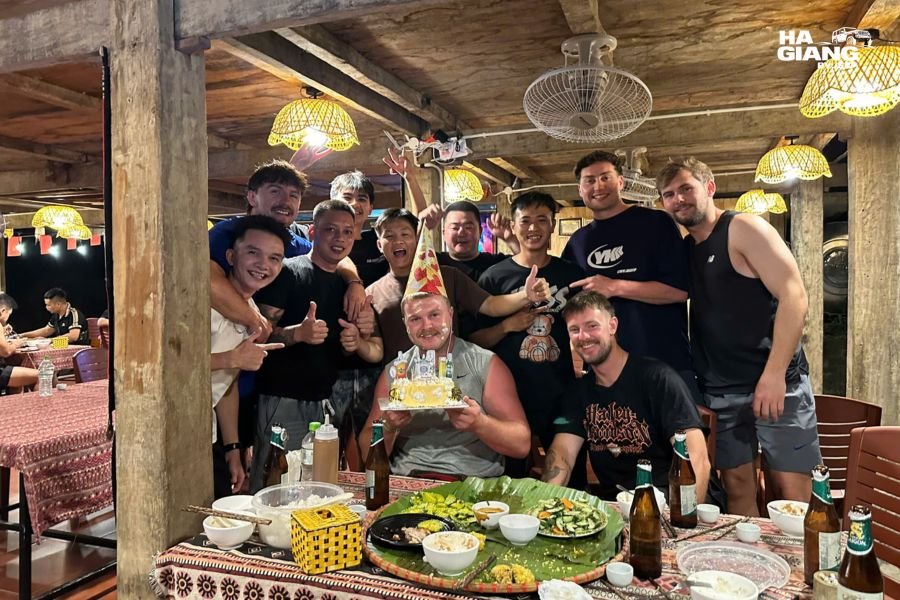
Then there is ruou ngo, the corn wine that appears at homestay dinners. It arrives whether or not anyone asked for it, and refusing entirely is harder than accepting one small glass.
Here is where how you travel quietly changes the day. In a private jeep with your own driver, you stop at any stall, any market, any place with plastic stools and no sign, because there is no schedule to defend and nobody else to consult. And when your host pours the corn wine at dinner, you can say yes, because you are not the one driving in the morning.
For anyone who travels partly to eat, that freedom is the difference between a good trip and a great one. Our Ha Giang food guide covers what to look for and where.
What the Loop Is Not
Expectation management prevents most disappointment, so here is the unvarnished list.
It is not a hiking trip. There is walking available, but the journey happens on the road.
It is not a wilderness experience. This is a lived in, farmed, populated landscape. You will see villages, power lines, construction and traffic. The beauty here coexists with ordinary daily life rather than replacing it.
It is not undiscovered. It was once. Dong Van in high season has plenty of visitors. What remains true is that a few kilometres off the main route, very little has changed, and a driver who knows the area can put you there.
It is not physically demanding, and it is not effortless either. Several hours a day on winding roads is tiring in a way flat driving is not, regardless of how comfortable the vehicle is.
Five Things That Decide Whether It Feels Worth It
When someone comes home unsure whether the Ha Giang Loop was worth it, the cause is almost always one of these five.
1. How Many Days You Give It
The most important variable by a wide margin. Three days works and covers the classic route. Four days is where the trip changes character: you stop watching the clock, you spend two nights in one place, and the villages that a shorter itinerary drives past become the ones you remember. If you can find the fourth day, find it.
2. Private or Shared
A shared vehicle moves at the pace of its slowest morning and stops where the group stops. A private one bends around you. For couples, families and older travelers, this is usually the line where extra cost stops being a cost and becomes the actual product.
3. The Season You Choose
There is no bad month, but there are very different months. Buckwheat flowers in late autumn, water on the terraces in late spring, clear cold air and cloud seas in winter, heavy green and rain in summer. Pick the one that matches what you want to see rather than what is cheapest. The weather by month guide lays out the trade offs.
4. Whether You Are Warm, Dry and Rested
Unglamorous and decisive. The plateau gets genuinely cold from late autumn through winter, and wet weather here is wet. A vehicle with a soft top and heating, a room with working heat, and enough sleep between days are what let you actually use the trip you paid for.

5. Who Is Driving
The most underestimated factor. A driver who grew up on this plateau knows which viewpoint clears when the cloud sits low, which market is running the day you pass, which homestay family is genuinely good, and when to simply stop because the light has done something. That is not a service level. It is the trip.
Worth It Compared With Sapa or Ninh Binh?
The real question for most people is not whether Ha Giang is good. It is whether it beats the alternatives for limited days.
| What it gives you | Who it suits | |
|---|---|---|
| Ha Giang | Remote mountain plateau, minimal mass tourism, road journey as the experience | Travelers who want distance from the tourist circuit and have three days or more |
| Sapa | Dramatic rice terraces, easier access, far more infrastructure and crowds | Shorter trips, travelers who want comfort and convenience close to Hanoi |
| Ninh Binh | Limestone karst on flat ground, boats and bicycles, very close to Hanoi | One or two day additions, travelers avoiding mountain roads entirely |
They are not really competitors. Ninh Binh is a day or two on the way somewhere. Sapa is an easier, busier version of the mountain experience. Ha Giang asks for more time and gives back something the other two cannot: scale, and the feeling of being properly far away.
If you only have two spare days, take Ninh Binh and save Ha Giang for a trip that can hold it.
Is Cao Bang Worth Adding?
If you have five or six days, this is the upgrade most people underuse.
Cao Bang sits east of Ha Giang and belongs to a second UNESCO Global Geopark, Non Nuoc Cao Bang. The landscape changes completely: softer, greener, limestone towers over rice valleys instead of bare stone plateau. Ban Gioc is the headline, a wide waterfall on the border that looks entirely different depending on the season, and around it sit Nguom Ngao Cave, Pac Bo, God's Eye Mountain, Ngoc Con Valley and the 15 step pass.
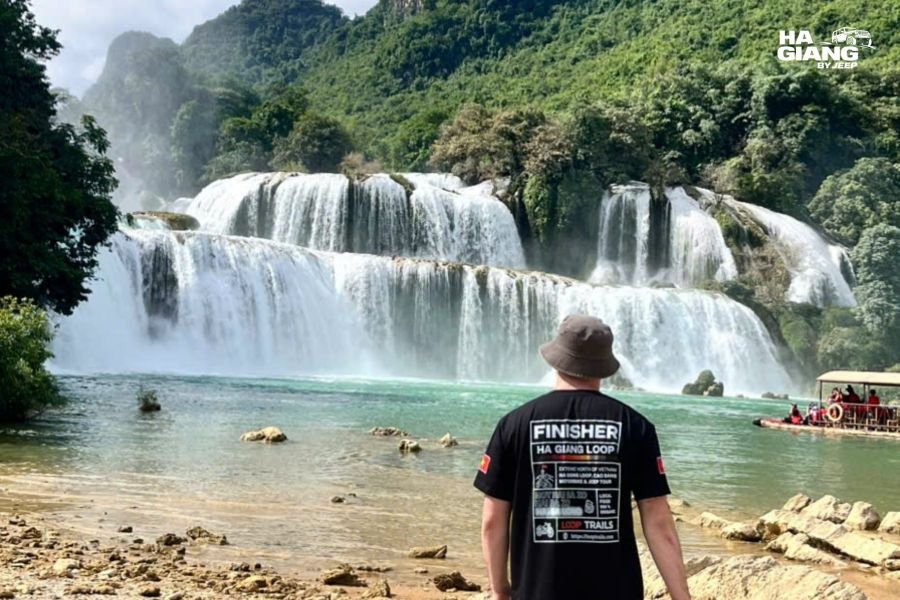
The practical argument: reaching Cao Bang as a separate trip from Hanoi costs you two travel days. Reaching it as a continuation of the Ha Giang route costs you almost none. If Ban Gioc is anywhere on your list, this is the efficient way to do it. Our Ban Gioc Waterfall guide explains how much the season changes the falls.
The Regret We Hear Most Often
It is not the weather, the food, the roads or the accommodation.
It is days. Over and over, guests finish a three days trip and say they wish they had taken four, or finish the Loop and wish they had continued into Cao Bang. Almost nobody says the opposite.
The second most common is having built the trip around covering distance rather than around stopping. People remember the market they spent an hour in. They do not remember the viewpoint they photographed for ninety seconds because the schedule said so.
If you take one practical thing from this article, take that. Plan fewer kilometres and more stops.
Which Ha Giang Jeep Tour Is Right for You?
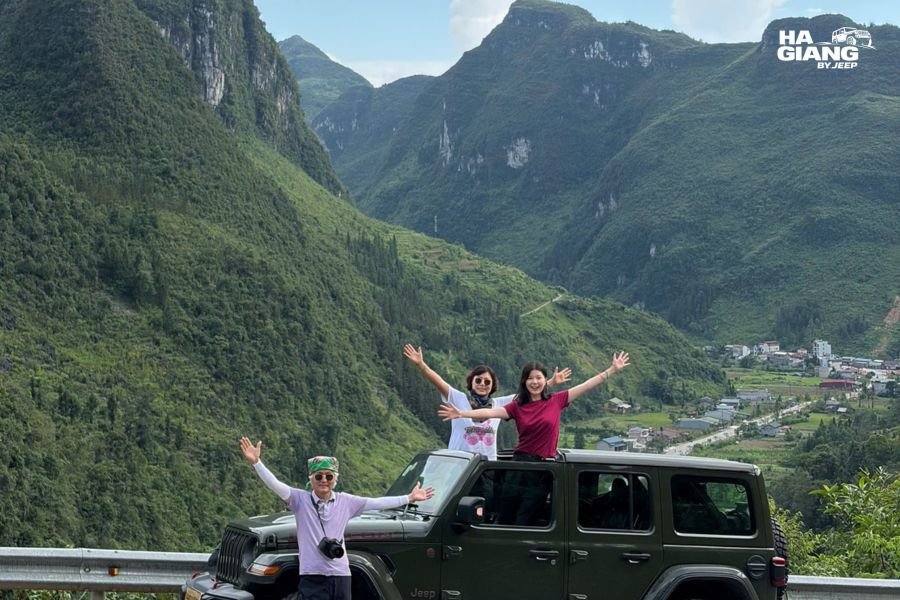
Ha Giang Loop, 3 days if your calendar is fixed. Quan Ba, Yen Minh, Dong Van, Ma Pi Leng, Meo Vac. Full days, everything essential.
Ha Giang Loop, 4 days if you can find one more day. Du Gia, Pho Bang, Sung La, more village time, a slower rhythm. The one we recommend most often, and the answer to the regret above.
Ha Giang and Cao Bang, 5 days if Ban Gioc matters to you. Two Geoparks, two landscapes, one continuous journey ending in Cao Bang.
Ha Giang and Cao Bang, 6 days if you want the whole northeast unhurried, including the quieter corners most itineraries never reach.
Jeep Wrangler Rubicon rental if you are a confident driver, comfortable with mountain roads and Vietnamese traffic, and want the vehicle without the driver.
Not sure? Message us on WhatsApp with your dates and group size. We will tell you honestly, including when a shorter trip or a different region serves you better.
So, Is the Ha Giang Loop Worth It?
Yes, if you give it the days, travel in a way that keeps you comfortable enough to pay attention, and let the road be the point.
No, if you are squeezing it into a gap in the calendar, if a rough night's sleep will define your mood, or if you need everything scheduled and connected.
Most people fall firmly into the first group and do not realise it, because the advice they have read assumed a style of travel that was never going to suit them. The place is not the variable. The trip design is.
If you are still on the fence, tell us your dates, your group and what you want out of it. We have talked people out of trips before when the fit was wrong, and it is a better outcome for everyone than a polite review and a wasted week.
Questions first? Contact us or message +84 938 988 593 on WhatsApp.
Frequently Asked Questions
Yes, provided it sits inside a longer Vietnam trip rather than replacing everything else. It works best as the northern anchor of an itinerary that also includes Hanoi and one or two other regions.
Three days covers the classic route properly. Four days is where most people say the trip became memorable rather than merely impressive. Two days is not enough to justify the journey north.
Yes, and arguably more so. With a local driver you spend the entire journey looking at the landscape rather than the road surface, which is the better version of this trip for most travelers.
It can be, with adjustments. Summer brings heavy green, full waterfalls and fewer visitors, along with rain and occasional road disruption. A covered vehicle and a flexible schedule matter much more in those months.
Very much so. The physical demand is low and the walking is optional. What matters is seat comfort, weather protection and the ability to stop when you want, which is why vehicle choice matters more than fitness.
Different rather than better. Sapa is easier to reach and much busier. Ha Giang is more remote, larger in scale and asks for more days. If you have the time, most travelers who see both prefer Ha Giang.
Ha Giang sees far fewer visitors than Sapa or Ninh Binh, though Dong Van and the main viewpoints are busy in high season. A few kilometres off the main route it thins out very quickly.
The roads are mountain roads and demand respect, which is exactly why an experienced local driver makes the difference. Border zone areas require permits, which reputable operators arrange. Rules can change, so confirm current requirements close to your travel dates.
If Ban Gioc Waterfall interests you at all, yes. Continuing east from Ha Giang costs far less time than reaching Cao Bang separately from Hanoi, and the landscape is genuinely different rather than more of the same.
Not allowing enough days, and building the itinerary around distance rather than stops. Both are easy to fix before you book and impossible to fix once you are on the road.
Ha Giang by Jeep runs private 4x4 tours across the Dong Van Karst Plateau and Non Nuoc Cao Bang Geoparks, with English speaking local drivers and 24/7 support from our office in Ha Giang City. Email booking@hagiangbyjeep.com or WhatsApp +84 862 379 288.