The Ethnic Groups of Ha Giang: Who Lives Here
Travelers usually meet the ethnic groups of Ha Giang before they know anything about them. You stop at a market, buy something from a woman in clothing you have never seen before, and realise you have no idea who you have just been talking to.
This guide is an attempt to give you enough background to be a better guest, without pretending to be more than it is. We run jeep tours. Several of our drivers are from these communities. What follows is what we can say honestly, and where the honest answer is that you should ask someone who actually belongs to a community rather than read about them, this guide says so.
One thing to set the frame. The people you will meet are not an attraction. They are farmers, shopkeepers, teachers, drivers and parents, living in a place that happens to be beautiful, who spend a lot of their week doing things that have nothing to do with you.
What is in this guide
- Why Ha Giang is so diverse
- What "ethnic group" means in Vietnam
- The groups you are most likely to encounter
- A note on subgroups and names
- About the clothing, and why this is not a spotting guide
- Languages in the mountains
- Where daily life is visible
- Homestays and being a guest
- Photography
- Words and framing that land badly
- What is actually changing
- Which jeep tour suits you best
- FAQ
Why Ha Giang Is So Diverse
The geography did it.
Northern Vietnam is a landscape of steep mountains and separated valleys. Historically, communities settled in the valleys and on the slopes that suited how they farmed, movement between them was difficult, and populations stayed distinct over long periods. Different groups also arrived at different times, from different directions, and settled at different altitudes.
That pattern of altitude is the one thing that explains most of what you will see from the road.
- Valley floors and river flats suit wet rice farming, and the communities that farm that way are generally found there.
- Mid slopes hold a mix, with terracing and a combination of crops.
- High plateau and steep upper slopes are where you find communities farming corn in limestone pockets, because that is what grows up there.
This is a broad pattern rather than a rule, and it has plenty of exceptions. But when you notice that the houses change as the road climbs, that is what you are looking at.
Ha Giang is consistently described as one of Vietnam's most ethnically diverse provinces. We are not going to give you a number of groups or a set of population percentages, because those figures come from census work, they get updated, and a jeep company quoting statistics it has not verified is exactly the sort of thing that ends up wrong on the internet for a decade. If you want figures, official Vietnamese sources publish them.
What "Ethnic Group" Means in Vietnam
Worth understanding, because it explains the terminology you will see on signs and in museums.
Vietnam officially recognises 54 ethnic groups. The Kinh are the majority nationally. The other 53 are officially termed ethnic minority groups, and that is the language used in Vietnamese law, government material and interpretive signage.
The official categories are administrative. They are how the state organises a complicated reality. Within any recognised group there can be substantial internal variation in language, dress and practice, and people's own sense of who they are does not always map neatly onto the official list.
The term is normal here. "Ethnic minority" is not a loaded phrase in Vietnamese usage the way some translations sound to English speakers. You will see it everywhere, used neutrally.
What is not normal here. The English words "tribe" and "hill tribe", which older guidebooks and a lot of tour marketing still use. They carry connotations that do not belong to these communities, and they are not how anyone describes themselves. Use "ethnic group", "community", or simply the name of the group.
The Groups You Are Most Likely to Encounter
Short, careful notes. These are starting points for a conversation, not summaries of anyone's identity.
Hmong. The largest group in Ha Giang and the community you are most likely to meet on the plateau. Hmong households farm corn in the limestone country around Dong Van and Meo Vac, and the hemp weaving and indigo textile tradition of the region is largely theirs.
Tay. Generally found in valleys and lower areas, farming wet rice, and associated with wooden stilt houses. If you continue east into Cao Bang, Tay villages are a large part of what you see in the valleys there.
Dao. Present across northern Vietnam in several subgroups, known for distinctive embroidery and for herbal knowledge that has become widely known through herbal bath traditions.
Nung. Found across the northeast, with communities in both Ha Giang and Cao Bang, historically associated with skilled crafts including metalwork.
Giay. Present in a number of valleys in the region.
Lo Lo. A smaller group, with communities in the far north of Ha Giang including around Lung Cu, and known for very distinctive textiles.
Kinh. The national majority, and a normal part of towns like Ha Giang City, in business, administration and services.
And others. There are more, including several smaller groups, and leaving them as a category rather than a list is deliberate: a paragraph each written by a tour company would be worse than nothing.
How to use this section. Do not use it to identify people. Use it so that when your driver mentions a group name, you have a rough sense of what he is talking about, and can ask a better follow up question.
The best cultural guide is the person driving
Several of our drivers grew up in these communities. That turns a village stop from something you watch into a conversation you are part of.
WhatsApp us See the 4 Days LoopA Note on Subgroups and Names
You will encounter names like White Hmong, Black Hmong, Flower Hmong, Red Dao and similar. Some background is useful here.
These names are real and they are used, including by people describing themselves. They generally refer to subgroups distinguished by dialect, clothing and location.
But the naming is messy. Some of these labels originated as descriptions applied from outside rather than names chosen from within. Usage varies by region and by who is speaking. Translations into English add another layer of imprecision, and a label used commonly in one province may not be used at all in the next.
What that means for you. Repeating a subgroup name you read in a guidebook, at a stranger, in a market, is a good way to be wrong. If a person tells you what community they belong to, use their words. Otherwise, do not guess.
The safe approach. Talk about people as people. If the subject comes up naturally in conversation, listen. That is the whole method.
About the Clothing, and Why This Is Not a Spotting Guide
Most articles on this subject are built around a table matching each group to a costume so readers can identify people on sight. This guide is not going to do that, and it is worth saying why.
It turns people into an identification exercise. Standing in a market working out what somebody is, based on their clothes, before you have said a word to them, is not cultural interest. It is birdwatching applied to human beings, and it is visible to the person being watched.
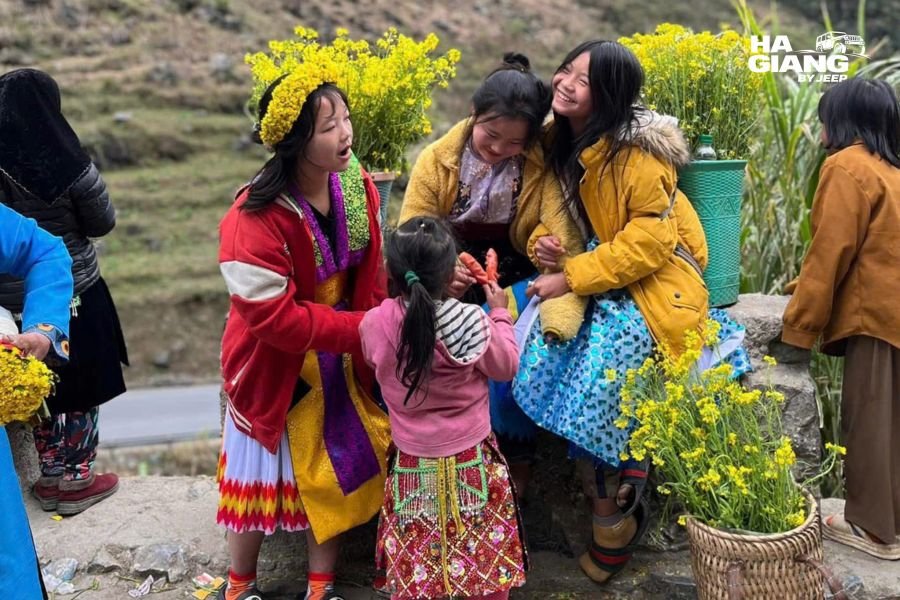
It is frequently wrong. Clothing varies by subgroup, by village, by occasion, by age and by personal choice. Full traditional dress may be worn daily by an older woman, for a festival by her daughter, and rarely by her granddaughter. A confident identification from a guidebook table is often just confident.
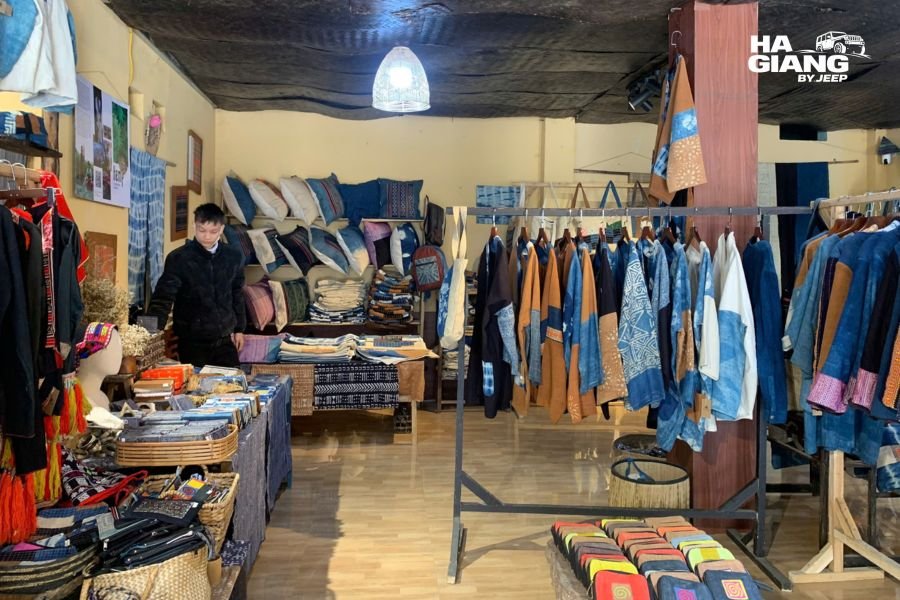
What is genuinely worth knowing. The textiles are extraordinary, they take months of hand work, the patterns carry meaning within the communities that make them, and the skills are being kept alive partly through cooperatives. Our Hmong linen weaving guide covers how the cloth is actually made, stage by stage, which is a far more interesting thing to understand than a colour chart.
The better question. Not "what group is she from" but "what is that piece and how long did it take". The first question you ask about somebody. The second you ask them, through your driver, and you get an answer.
Languages in the Mountains
Vietnamese is the national language, but it is not the first language in many villages here.
Households frequently speak their own language at home, with Vietnamese learned at school and used as the shared language between communities and with the state. Fluency varies a great deal by generation. Younger people who have been through Vietnamese schooling generally speak it comfortably. Older people in remote villages sometimes speak little.
What this means practically. Your carefully practised Vietnamese phrase may land no better than English with an older woman at a market stall. That is not a failure on anyone's part.
Learning a greeting in a local language is one of the best things you can do, and the only reliable way to learn it is from somebody who speaks it. We do not publish phonetic guesses at Hmong, Tay or Dao phrases, because these languages have multiple dialects and competing written systems and a wrong guess can mean something unintended. Ask your driver. Being taught a greeting in the village where you are about to use it is a much better experience than reading one off a page.
Our Vietnamese phrases guide covers the national language, which is still the useful default.
Where Daily Life Is Visible
You do not need an organised cultural programme. Ordinary life is happening beside the road.
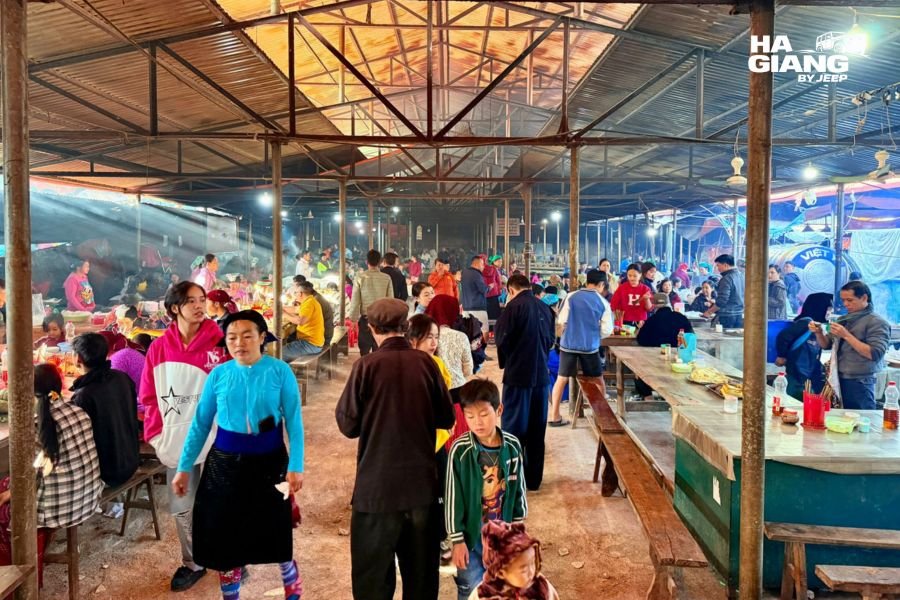
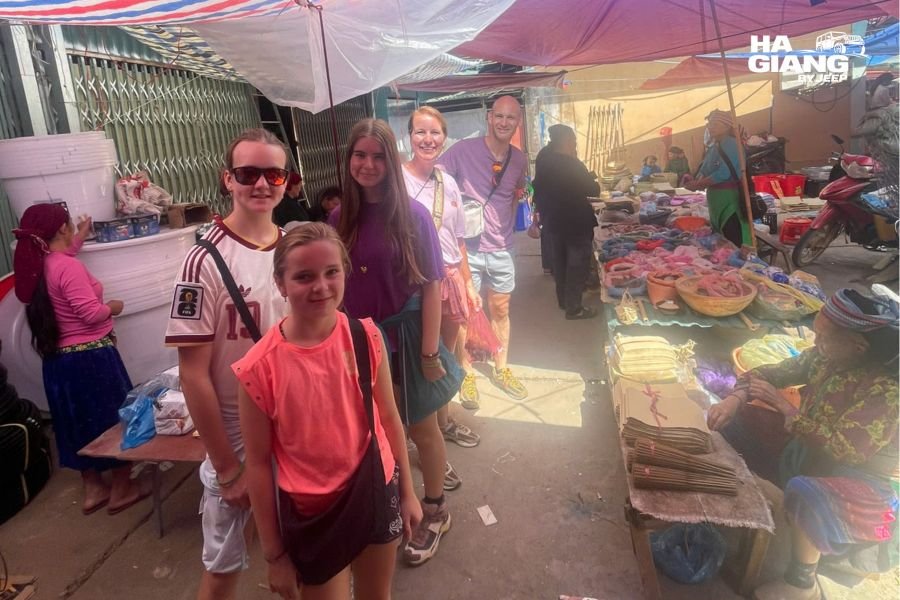
Markets. Dong Van and Meo Vac on Sunday mornings are the big weekly gatherings, and they start very early. Markets are where communities from surrounding villages meet, trade, eat and drink together, and they are the single best place to see the region as it actually functions rather than as it is presented.
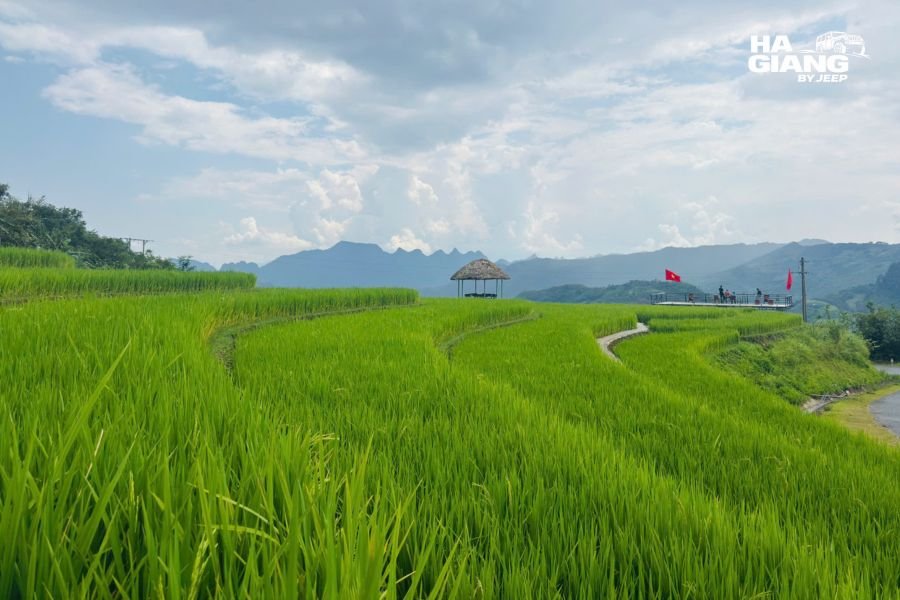
Roadside farming. Corn on the plateau, rice in the valleys, all of it worked by hand and visible from the road.
Villages on the route. Sung La, Pho Bang, Lung Tam, Du Gia and dozens of unnamed hamlets. Passing slowly is enough.
Craft. Weaving, dyeing, blacksmithing, all of it done in and around houses rather than in workshops.
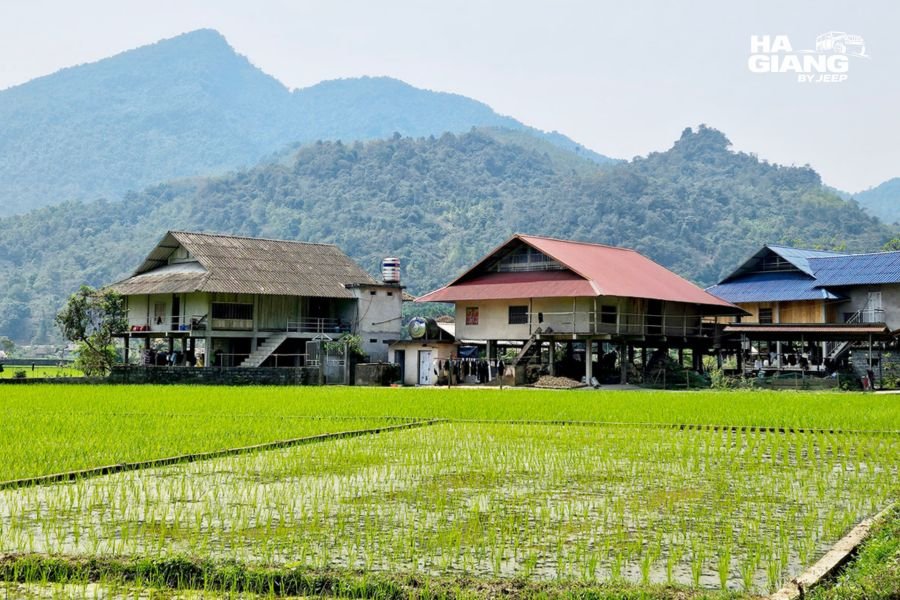
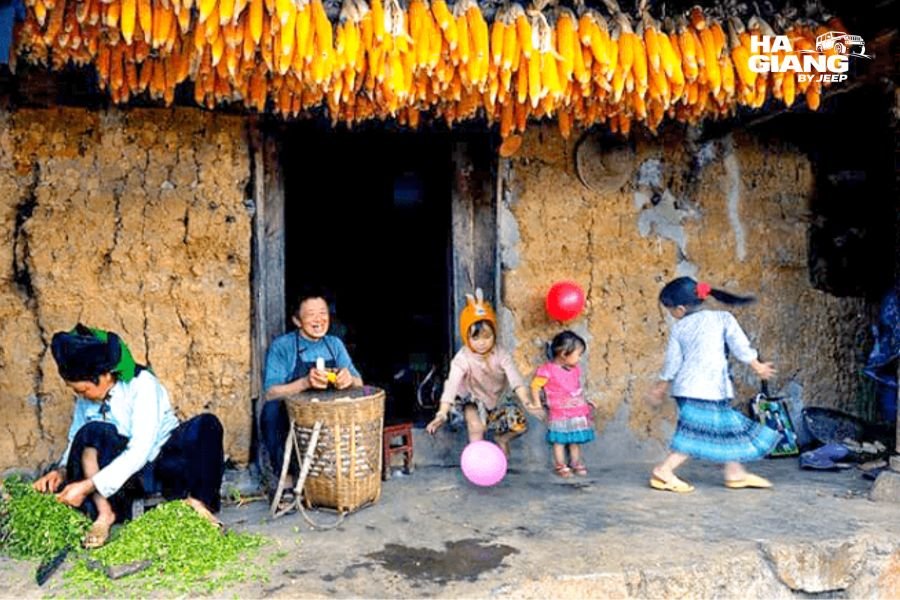
Homes. Stone walled houses on the plateau, wooden stilt houses in the valleys, corn drying under the eaves.
What not to expect. Performances, ceremonies on demand, or anything laid on. If you happen to encounter a wedding, a funeral or a festival, you have encountered somebody's private life, and the correct response is distance and discretion.
Homestays and Being a Guest
A homestay is the most contact most travelers have, and it works best when you understand what it is.
- You are in a family's house. Not a hotel. The building is often the family's actual home with rooms given over to guests.
- Eat what is served, and say so. Ngon quá, roughly ngon wah, means delicious. It gets a better reaction than any other sentence you can produce.
- Expect the host to keep serving you. No rồi, roughly naw zoy, means you are full, and is the accepted way to stop it.
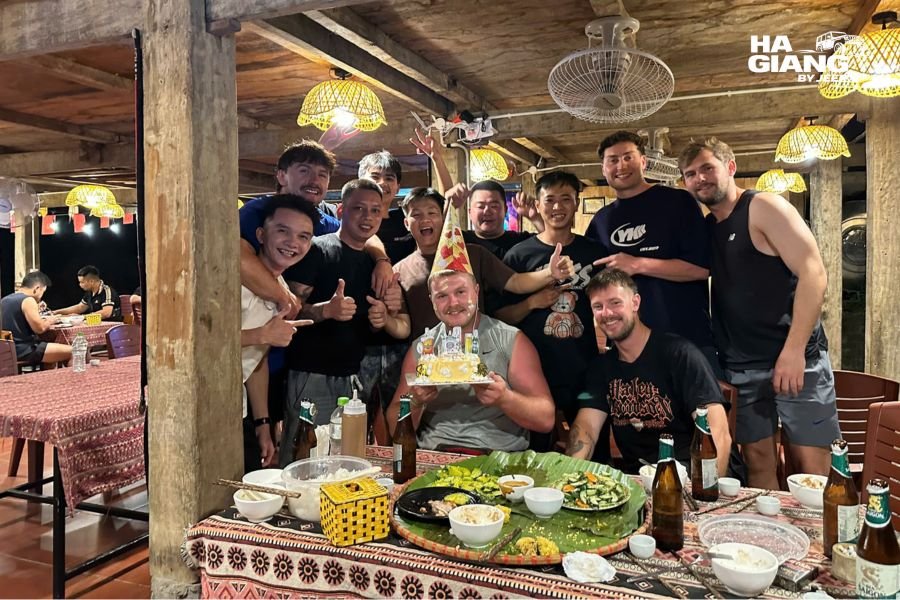
- Drinking is social and optional. Corn wine circulates at dinner. Joining in is welcomed and declining is completely fine. Our corn wine guide covers the etiquette.
- Ask before wandering. Kitchens, altars, upper floors, storage areas. Some parts of a house are not guest space, and in some houses there are areas with religious significance. Ask, do not explore.
- Notice the altar. Many homes have one. Do not photograph it, touch it, or place things on it. If you are unsure about anything in a house, that instinct is worth following.
- Say thank you properly in the morning. Cảm ơn nhiều. It is the right note to leave on.
- Pay attention to who is doing the work. Homestays are usually run by women, often on top of farming and childcare. The tip, the good review and the money you spend are meaningful in a way they are not at a hotel.
Photography
The single area where travelers most often get this wrong.
- Ask first. Always. Chụp ảnh được không, roughly choop ang duc khom. Two seconds. It changes the interaction from taking to sharing.
- Accept a no immediately and cheerfully. No sulking, no long lens from across the road afterwards.
- Older women in traditional dress are photographed constantly, often by people who do not speak to them and walk away afterwards. Do not add to that. If someone agrees, stay a moment. Show them the picture. Say thank you.
- Children need a parent's agreement. Present and agreeing, not a wave from a distance.
- Do not photograph inside homes, at altars, at ceremonies, or in anything that reads as a private moment.
- Do not pay for photographs of people, and do not hand money or sweets to children. Both create dynamics that damage the place for everyone who comes after you, including for the people who live there.
- Landscape is free. Mountains, fields, houses at a distance, a market from across the square. Nobody's permission required, and the wide shots are usually the better photographs anyway.
- Drone rules vary and change. Check locally, and do not fly low over houses regardless of what is permitted.
Words and Framing That Land Badly
A short list, offered plainly.
- "Tribe" and "hill tribe". Outdated, and not how anyone here describes themselves. Say ethnic group, community, or the group's name.
- "Primitive", "untouched", "authentic", "living museum". These describe a fantasy of a place rather than the place. People here have phones, motorbikes, schools and opinions about the internet.
- "Real Vietnam". Ha Giang is not more real than Hanoi. It is a different part of the same country.
- Disappointment at modernity. Concrete houses, solar panels, satellite dishes and factory made clothing are people making their own choices with their own money. A visitor expressing disappointment about that is asking somebody to stay picturesque for their benefit.
- Wearing traditional dress that is not yours. Dressing up in another community's clothing for photographs lands badly, whatever the intention. Buying and wearing a scarf is different from costuming yourself as somebody else.
- Treating a village as a stop on a checklist. People notice. They always notice.
None of this requires special sensitivity. It is the same courtesy you would extend to a farming village at home.
What Is Actually Changing
An honest note, because the romanticised version of this region is not a favour to anyone.
Life on the plateau is hard. Farming corn in limestone pockets is difficult work with limited return. Young people leave for study and for jobs, in the cities and in the industrial zones, as young people do everywhere. Traditional skills like hemp weaving compete with cheap manufactured cloth and take months of labour to produce a scarf.
Tourism has arrived quickly, and it is a genuinely mixed thing. It brings income, which matters. It also brings pressure, changed prices, and a lot of cameras.
- Spend money locally. Homestays, village shops, markets, craft cooperatives. Money that stays in the valley is the version of tourism that works.
- Choose operators who employ local people. Ask. It is a fair question and any honest company will answer it.
- Do not treat the region as a place that should stay unchanged for your benefit. Nobody owes a traveler a preserved way of life.
The most useful thing a visitor can be here is unremarkable: someone who arrived, was pleasant, spent money, took few photographs and left without leaving a mark.
Which Jeep Tour Suits You Best
Contact with the communities of this region is a time question and a language question.
| Option | Village and market contact | Best for |
|---|---|---|
| 3 Days 2 Nights Loop | Two homestay nights, town stops, villages in passing | Short trips, Ma Pi Leng and Dong Van |
| 4 Days 3 Nights Loop | More villages, a craft stop, best chance of a Sunday market | Travelers who want the people, not just the passes |
| 5 Days 4 Nights to Cao Bang | Two provinces, different communities in each | The Loop plus Ban Gioc and the Quay Son valleys |
| 6 Days 5 Nights to Cao Bang | Most time in villages, markets and unplanned stops | The unhurried version across two Geoparks |
| Jeep Wrangler Rubicon rental | You handle every interaction yourself | Confident self drivers |
The honest case for a guided trip on this particular subject is not that it makes anything easier. It is that without translation, a village visit is looking at people. With it, you have a conversation.
Several of our drivers are from communities in this region. They know which house makes what, what a pattern is, when a market runs, and how to ask a question in a way that gets a real answer rather than a polite one. They also know when to leave people alone, which matters just as much.
Travelers almost always report the same thing afterwards. The passes are what they photographed. The conversations are what they remember.
Ask us who you will be travelling with
Tell us your dates and we will tell you which itinerary has room for villages and markets rather than just viewpoints. If you want to know where your driver is from, ask us. We will tell you. Book early once your dates are set, jeep availability is limited and most guests book 1 to 3 months ahead.
WhatsApp us Book now Contact
Frequently Asked Questions
How many ethnic groups live in Ha Giang?
Vietnam officially recognises 54 ethnic groups nationally, and Ha Giang is consistently described as one of the most diverse provinces. We do not publish a count or population figures for the province, since those come from census work and get updated. Official Vietnamese sources publish them.
Which ethnic group is largest in Ha Giang?
The Hmong are the largest group in the province and the community you are most likely to meet on the Dong Van Karst Plateau around Dong Van and Meo Vac.
Should I say tribe or ethnic group?
Ethnic group, community, or the name of the group. "Tribe" and "hill tribe" are outdated terms that are not how people here describe themselves, even though older guidebooks still use them.
Can I tell which group someone belongs to by their clothing?
Not reliably, and it is not a good habit. Clothing varies by subgroup, village, occasion, age and personal choice. Identifying people on sight before speaking to them is visible to the person being looked at.
Do people in Ha Giang speak Vietnamese?
Many households speak their own language at home, with Vietnamese as the shared second language. Fluency varies by generation, and older people in remote villages sometimes speak little Vietnamese.
Can I learn a phrase in a local language?
Ask your driver rather than a written guide. These languages have several dialects and competing written systems, and a phonetic guess from a blog is unreliable. Being taught in the village where you will use it is far better anyway.
Can I photograph people in Ha Giang villages?
Ask first, every time, and accept a no cheerfully. Do not photograph children without a parent agreeing, do not photograph inside homes or at altars, and do not pay for photographs of people.
Is it appropriate to stay in a homestay?
Yes, and it is one of the better ways to spend money in a way that reaches a household directly. You are staying in a family's home, so ask before wandering into parts of the house and follow whatever the family does.
Should I bring gifts for villages or children?
Do not give money or sweets to children. If you want to contribute, spend with the adults running businesses: homestays, shops, market stalls and craft cooperatives.
What should I not say?
Avoid "primitive", "untouched", "living museum" and "the real Vietnam", and avoid expressing disappointment about concrete houses or modern clothing. People here are making their own choices with their own money.
Are the ethnic communities in Cao Bang different?
Cao Bang has its own mix, with Tay and Nung communities prominent in the valleys, so a combined Ha Giang and Cao Bang trip passes through noticeably different areas.
Are your drivers from these communities?
Several of them are. If you want to know where your driver is from, ask us and we will tell you.