
Hmong Culture in Ha Giang: Who Lives on the Plateau and How to Visit Well
Almost everything you find beautiful about this landscape is somebody's workplace.
Hmong culture in Ha Giang is the reason the province looks the way it does. The stone walls, the maize growing out of bare rock, the indigo cloth, the villages on impossible slopes, the markets that fill a square before dawn. None of it is scenery. It is a way of living that has been worked out over generations in a place that does not make farming easy.
Visitors arrive with cameras and a vague sense that the people here are part of the view. This guide is an attempt to replace that with something more useful: what you are actually looking at, and how to be in it without being a nuisance.
One caveat before we start. We drive jeeps. We are not ethnographers, historians or anthropologists, and this page is a visitor's orientation rather than an authoritative account. Where we are not confident, we say so. If you want depth, read academic sources, and if you want the version that matters on the day, ask the person driving you, who grew up in these mountains and will know far more than this page does.
What is in this guide
- Who the Hmong are, briefly and honestly
- Why they live where they live
- Dress, subgroups and the names visitors get wrong
- Hemp, indigo and beeswax: the textiles
- Houses, villages and the Vuong mansion
- Markets are the social system
- Food and drink
- The khen, and music you might actually hear
- Festivals and the calendar
- How to visit well
- What not to do
- Buying textiles so the money reaches the maker
- What your driver knows that this page does not
- Which jeep tour is right for you?
- FAQ
Who the Hmong are, briefly and honestly
The Hmong are one of the largest ethnic groups in Ha Giang and the dominant population across the Dong Van Karst Plateau, which is the part of the province most visitors come to see.
They are not only Vietnamese. Hmong communities live across southern China, Laos, Thailand and Myanmar, with large diaspora populations in the United States, France and Australia. Movement into what is now northern Vietnam happened over a long period across several centuries. Precise dating is a matter for historians and we will not pretend to settle it here.
The Hmong language belongs to the Hmong Mien family, which is entirely separate from Vietnamese. That is worth knowing because it explains something you will notice: in remote villages, Vietnamese may be a second language, and older people in particular may speak little of it. Your driver bridges this constantly and you will not notice it happening.
Ha Giang is also home to Tay, Dao, Lo Lo, Giay, Nung and other communities. This article focuses on the Hmong because they are the group most visitors encounter on the plateau, not because the others matter less.
Why they live where they live
This is the thing to understand, and once you understand it the whole landscape reads differently.
The Dong Van plateau is limestone. It drains. There is very little flat ground and, in many places, very little soil. Wet rice farming, which shaped almost every other landscape in Vietnam, is largely impossible here.
So the crop is maize, and the farming method is one you can see from the road everywhere on the plateau: soil carried by hand into pockets and cracks between the rocks, and maize planted into those pockets. Small plots, scattered across a slope of bare grey stone, each one built rather than found.
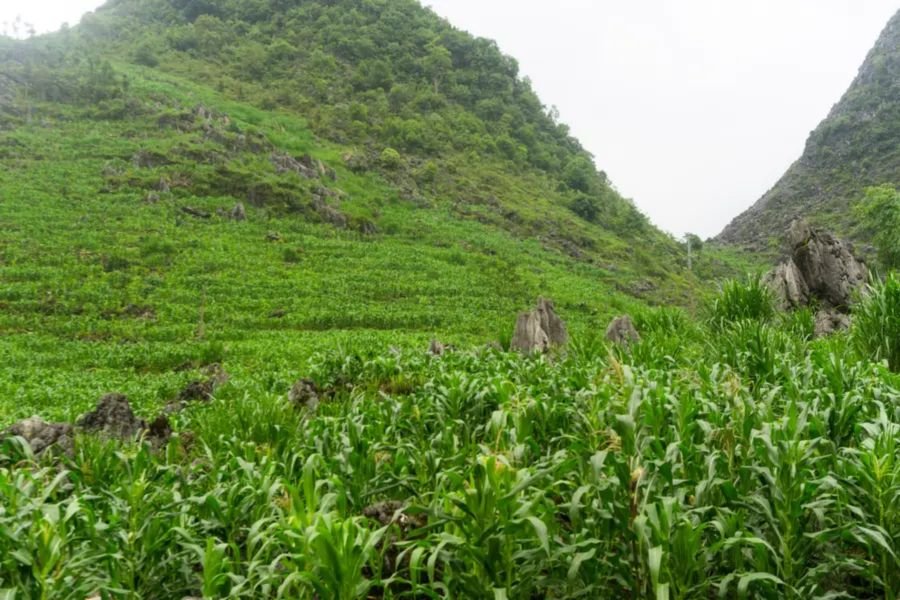
When you photograph that hillside because it looks extraordinary, what you are photographing is generations of labour.
That single fact explains most of the rest of the culture. Maize is the staple, which is why men men, steamed ground maize, is the everyday food rather than rice. Maize is also what corn wine is made from. Livestock matters because animals convert what the land can produce into something tradable. And the market exists because a village growing maize on rock needs somewhere to exchange it for everything else.
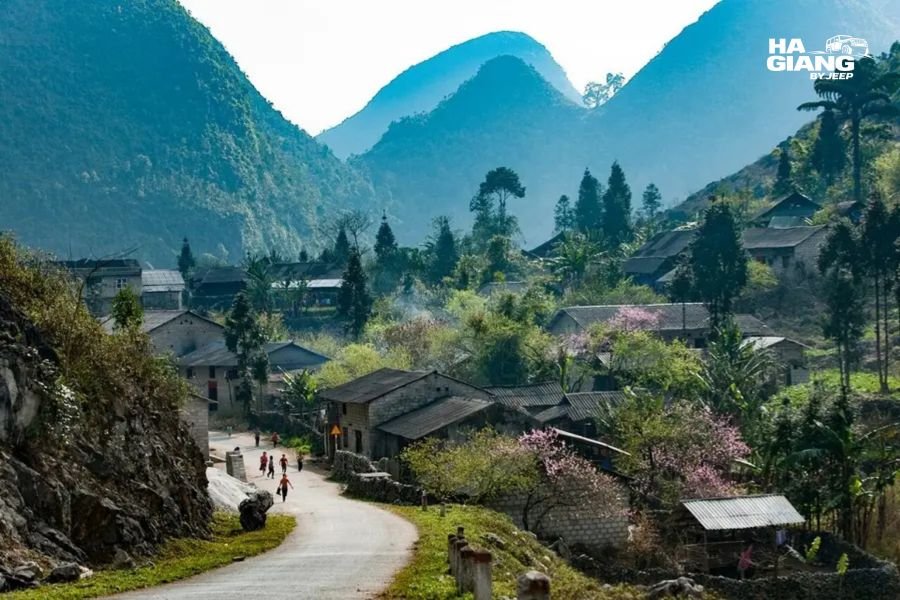
Travelling with a driver who is from here changes what you see
Ours grew up in these mountains and will tell you what is happening in a village, what a house is made of, and why a field is planted the way it is. Tell us you want that kind of trip and we will build the days around villages rather than viewpoints.
Dress, subgroups and the names visitors get wrong
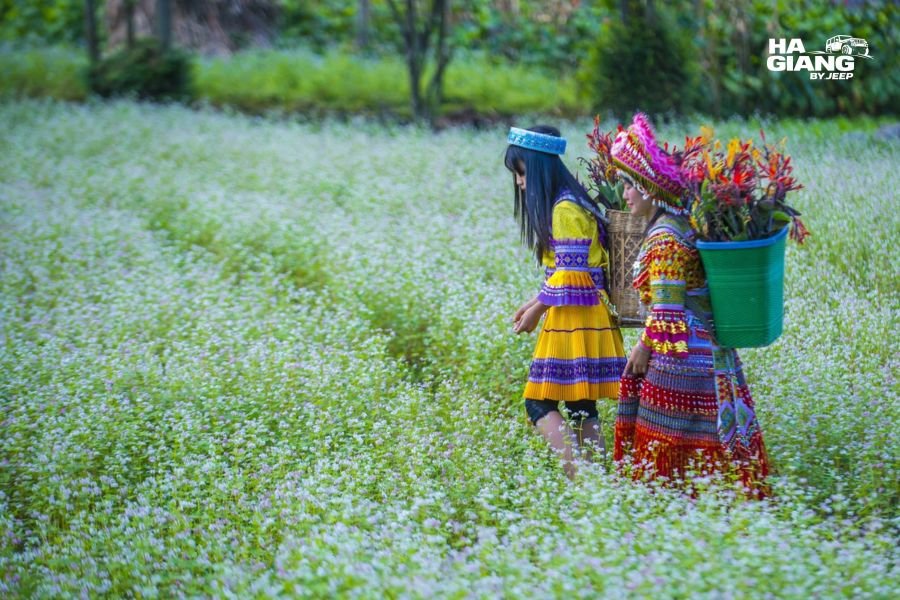
You will hear terms like White Hmong, Black Hmong and Flower Hmong. These labels come mainly from differences in dress and dialect, and they are widely used, including by people describing themselves.
Two things worth knowing before you use them confidently.
They are broad categories, not precise ones. Dress varies by community and by district, and it changes over time like clothing does everywhere. What you see at a market in Dong Van will not match a photograph from thirty years ago and does not need to.
Some of the naming was imposed from outside rather than chosen, and different sources use the terms differently. If you want to know which community you are looking at, ask rather than assume. People are generally happy to tell you and mildly amused by the question.
The everyday reality is more mixed than the guidebook version. At any market you will see full traditional dress, partial traditional dress, and jeans and a fleece, often within one family. All three are Hmong people dressed for a Sunday. The idea that only the first counts as authentic is a visitor's idea, not a local one.
Hemp, indigo and beeswax: the textiles
The most visible and most impressive craft in the province, and the thing most worth spending money on.
Hemp is grown, cut, dried, stripped, split, joined into thread, and spun. The fibre preparation alone takes an enormous amount of time. It is done in stages between other work, and you will see women joining hemp thread by hand while walking, standing at a market or talking to somebody, because it is a task that never quite finishes.
Indigo dyeing is done in vats, with cloth dipped repeatedly over days to build depth of colour. Hands stay stained. If you see somebody with blue hands at a market, that is why.
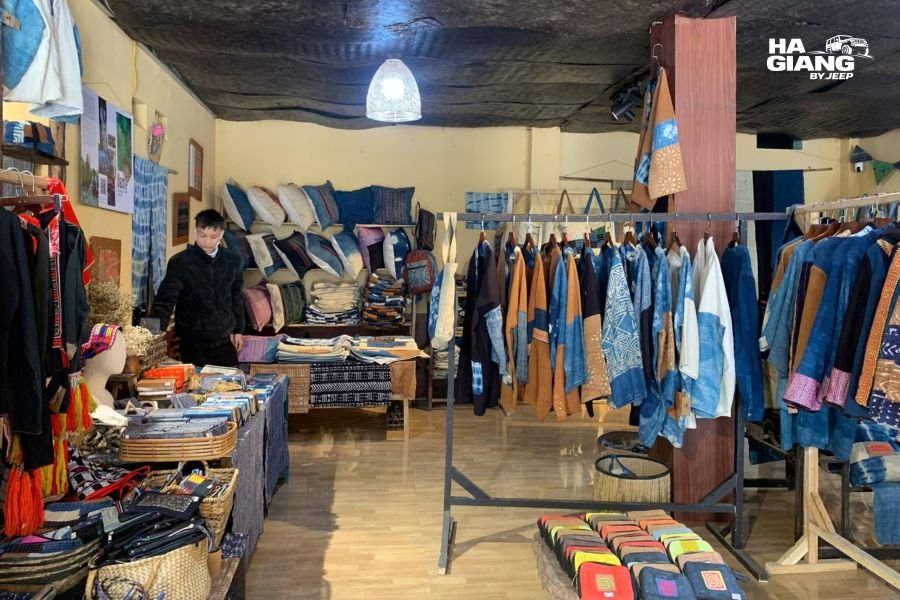
Beeswax batik is the technique that surprises people most. Molten beeswax is drawn onto the cloth freehand with a small metal pen, the cloth is dyed, and the waxed lines resist the dye and stay pale. The patterns are drawn from memory rather than copied from a template, and the results are extraordinary.
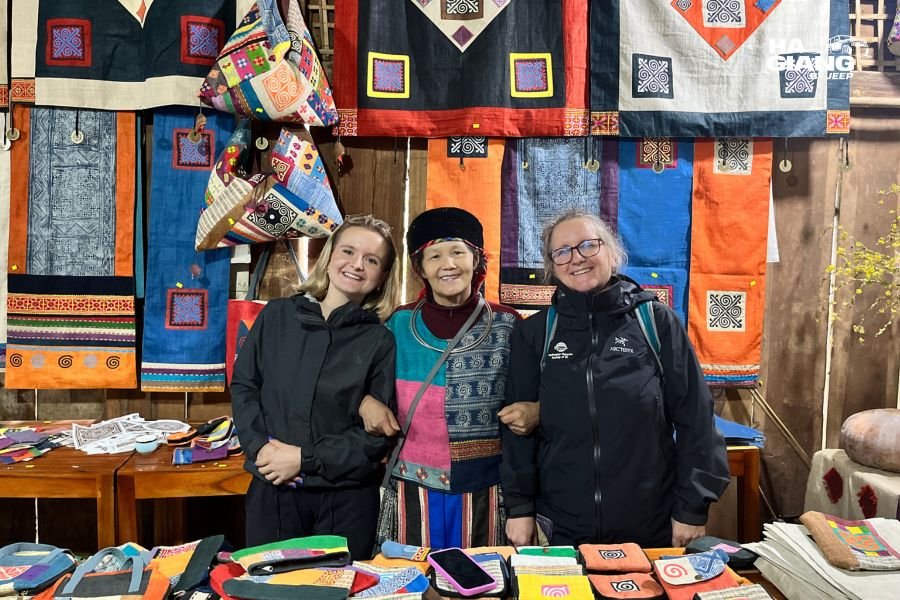
Embroidery and appliqué finish the piece. A single panel on a jacket can represent months of evenings.
Lung Tam, near Quan Ba, is a linen village with a weaving cooperative and it is the easiest place on the loop to see the whole process in one stop. It is indoors, seated, flat to access, and it works well on a wet day or a harsh light hour. It is also a place where buying something puts money directly into the hands of the people who made it.
Houses, villages and the Vuong mansion
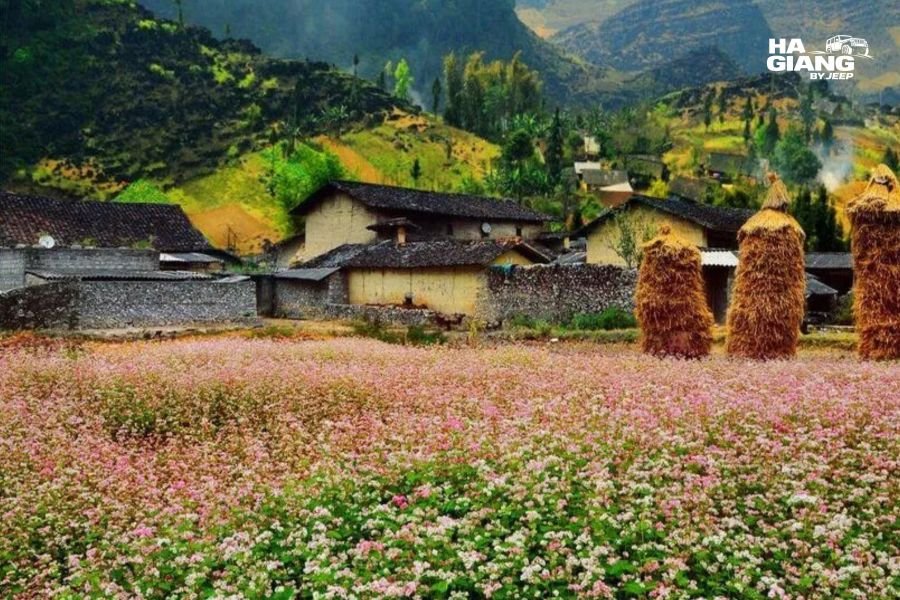
Traditional houses on the plateau are built of rammed earth, thick walls of compacted soil that hold heat in winter and stay cool in summer, under roofs of interlocking tiles. Around them, dry stone walls built from the limestone that is the one material there is a great deal of.
Sung La is the village most itineraries stop at, a bowl of maize fields with old clay walled houses, and it is genuinely lovely. Pho Bang is quieter, a faded former trading town most vehicles drive past.
The Vuong family mansion at Sa Phin is the one built structure on the plateau that everyone should see. Built in the early twentieth century for the Vuong family, Hmong leaders who held considerable power in this region under French colonial administration, it is a walled compound of stone and hardwood with carved detail, set in a valley behind rows of trees.
It is a strange and impressive place, and it complicates the simple story visitors sometimes arrive with, which is that the Hmong were only ever poor subsistence farmers. Power, wealth and politics existed up here too.
Markets are the social system
Not a tourist attraction that happens to be old. The actual infrastructure.
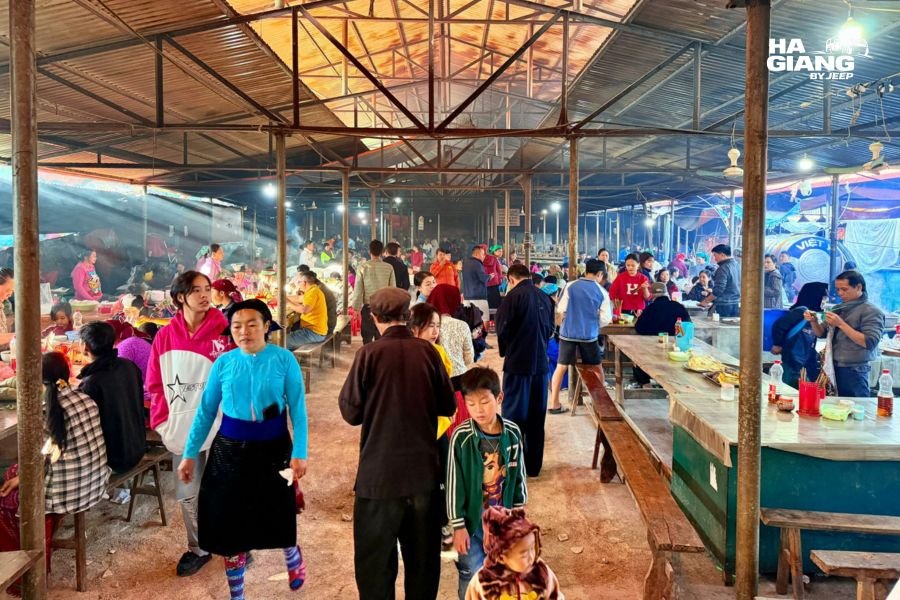
A market brings families down from villages scattered across the limestone to trade livestock, buy salt and thread, eat something hot, drink corn wine and see relatives. It is the commercial system, the news network and the social calendar in one morning.
Dong Van and Meo Vac both hold their main markets on Sunday morning. Several smaller village markets run on the lunar animal day cycle instead, which means they shift backward relative to the calendar week. Our market days guide explains how that works and which ones you can rely on.
If you only do one thing on a Ha Giang trip that is not looking at a mountain, make it a market morning. Arrive early. It is over by late morning.
Food and drink
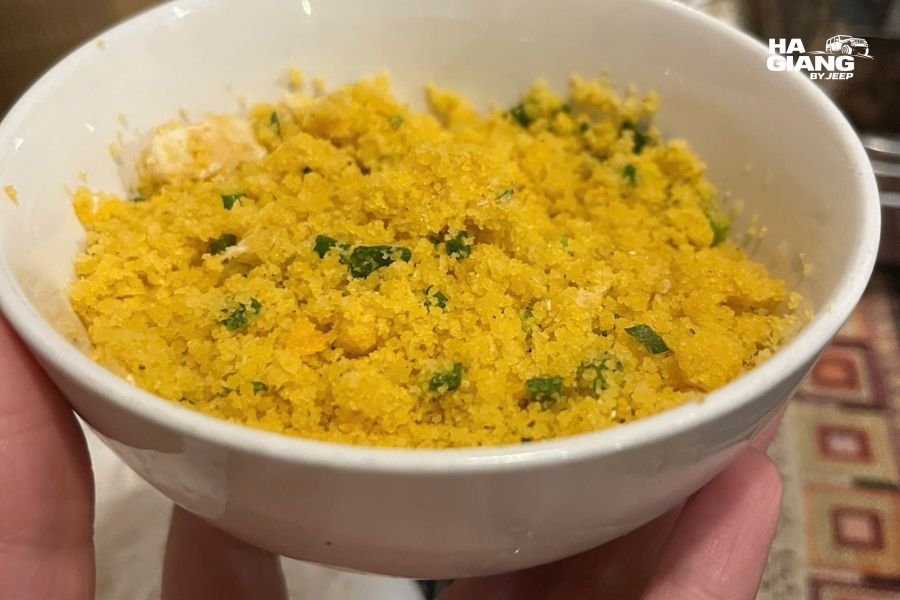
Men men is the staple: maize, ground and steamed, dry and slightly sweet, usually eaten with a soup to soften it. Not a highlight dish and not meant to be. Eating a bowl of it while looking at maize planted in rock outside tells you more than any viewpoint.
Thang co is the market stew, simmered in a wide pan all morning, traditionally made with horse and using the whole animal including offal. Try it at a market where it belongs. Plenty of visitors do not finish the bowl, which is a normal reaction and nobody minds.
Ruou ngo, corn wine, is distilled in villages and poured at homestay dinners and market tables. Toasting is the social form. It is stronger than it tastes.
Our food guide covers the regional dishes properly, including one that comes with a genuine safety note.
The khen, and music you might actually hear
The khen is the signature Hmong instrument: a set of pipes fitted into a wooden wind chamber, played by blowing and drawing, often while moving or dancing. It has a reedy, layered, slightly unearthly sound.
It is played at festivals, weddings and funerals, and sometimes at markets. It is not a performance laid on for visitors, which means you may hear it or you may not, and asking for it to be played for you is the wrong move. If you hear it, stop and listen.
Festivals and the calendar
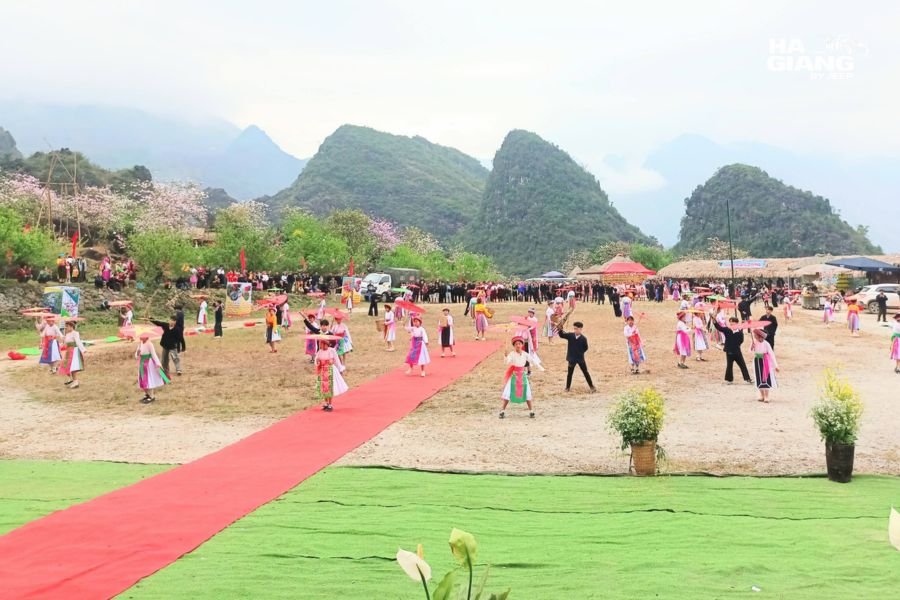
Hmong communities keep a calendar that does not line up with the Vietnamese national one. New year has traditionally been marked at the end of the harvest cycle, which generally falls earlier than Vietnamese Tet, and there are spring festivals including Gau Tao.
We are not going to publish dates. They follow lunar reckoning, they vary between communities, and a fixed date on a tour company blog would be wrong somewhere. If your travel dates might overlap with something, ask us and we will check locally rather than guess.
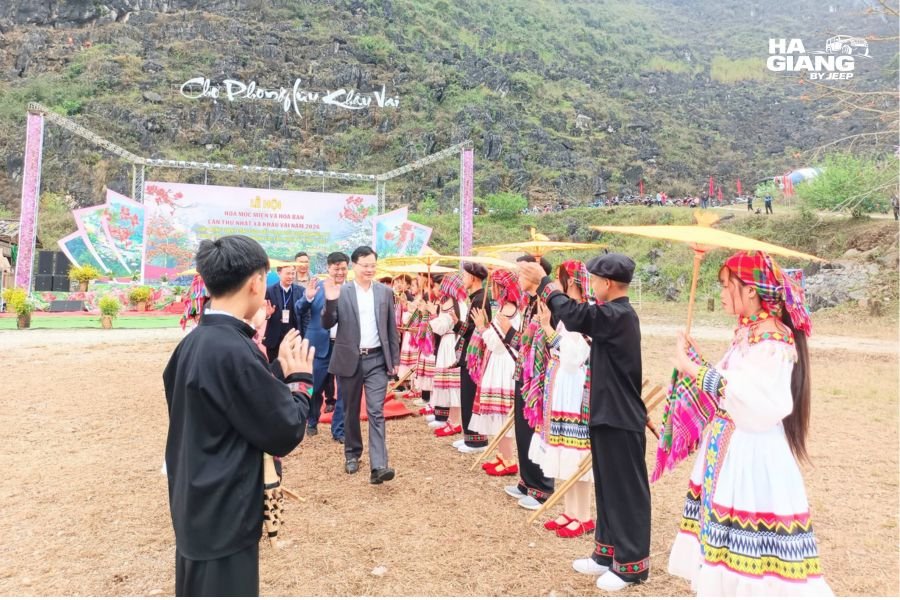
Khau Vai Market near Meo Vac, once a year in spring, is the gathering most visitors have heard of. Ask us for the date in your travel year.
How to visit well
The practical part. None of this is complicated and all of it is noticed.
- Ask before photographing anyone. A gesture at the camera and a raised eyebrow works in any language. Your driver can ask properly in seconds.
- Never photograph children without a parent's agreement. No exceptions.
- Do not hand money or sweets to children. It creates an expectation for every visitor after you and it is not a good thing to leave in a village.
- Learn hello and thank you. In Vietnamese at minimum, and ask your driver for the Hmong words. The bar is low and the return is high.
- Buy something at markets. A scarf, a bag of tea, lunch. It is the simplest way to leave money where you are standing.
- Take your shoes off where your hosts do.
- Dress modestly in villages, at the Vuong mansion and at any site of significance.
- Show people the photograph you just took. It turns a transaction into an exchange.
- Accept the tea. Refusing hospitality is a bigger deal than being slightly behind schedule.
- Move out of the way at markets. You are the only person there who is not trying to get something done.
What not to do
- Do not treat traditional dress as costume. People wear it because they wear it, not for your frame.
- Do not walk into a house or a courtyard uninvited. The gate being open is not an invitation.
- Do not photograph inside a home or at a shrine without being asked in.
- Do not bargain hard over textiles. The amounts you would save are small to you and not small to somebody who spent three months on the piece.
- Do not use the word primitive, in any of its polite disguises. Farming maize in limestone at altitude is not simple living. It is a highly refined solution to a very hard problem.
- Do not photograph poverty as an aesthetic. If you would not take the picture at home, do not take it here.
- Do not ask for the khen to be played, or for anyone to dress up, or for anything to be staged for you.
- Do not repeat things you read on the internet as fact to people who live here. Including things on this page.
Buying textiles so the money reaches the maker
Worth doing properly, because textiles are the main way visitor money enters these communities directly.
Buy from the person who made it where you can. At a market, that is usually the woman sitting behind the cloth. At Lung Tam, the cooperative structure means the makers are the sellers.
Expect hemp to cost more than cotton, and handwork to cost more than machine work. If a piece is surprisingly cheap for its complexity, it may be machine printed rather than batiked, or industrially dyed rather than indigo. Neither is a scandal and both have a place, but know which you are buying.
Ask what it is and how it was made. People are generally pleased to be asked and your driver can translate. You will also learn to tell the difference within about ten minutes.
Do not haggle a handmade piece down hard. Mild negotiation is normal. Grinding somebody down over the equivalent of a coffee is not.
We do not publish price guidance because market prices move constantly and a stale figure would only make you argue for the wrong number.
What your driver knows that this page does not
The most useful thing in this guide is the instruction to stop relying on it.
Our drivers grew up in these mountains. They know which village a house style belongs to, what is being planted and why, which market is on and which is not, what the crowd at the roadside is gathered for, and how to ask a question without it landing wrong. They also know when the answer is complicated, which a blog post is structurally bad at conveying.
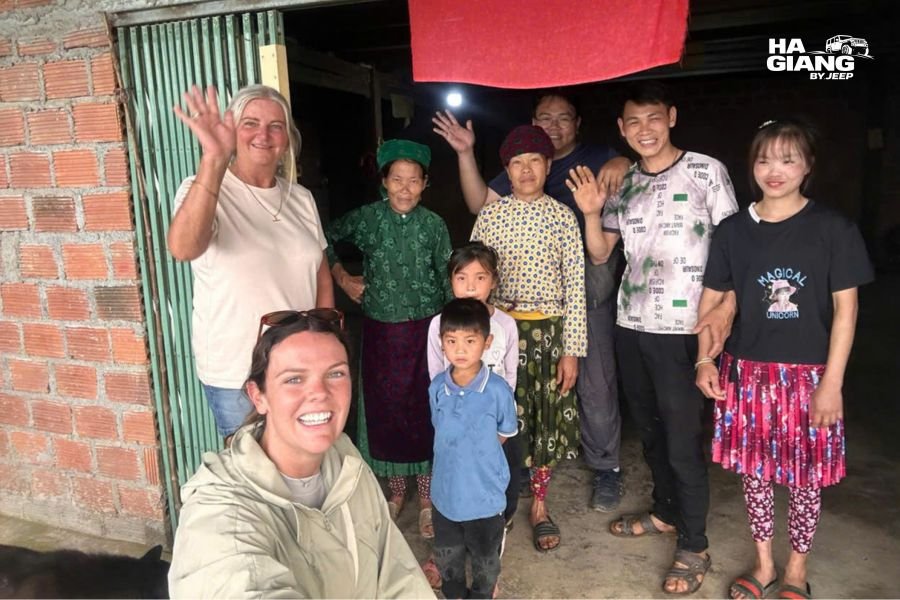
Ask them things. A four day trip is a lot of hours in a vehicle with somebody who knows the answers, and the guests who get the most out of Ha Giang are almost always the ones who treated the drive as a conversation rather than transport.
That, more than any viewpoint, is what a private vehicle actually buys you here.
Want a trip built around villages and people rather than photo stops?
Tell us your dates and say that is what you are after. We will route you through the villages, time it around a market morning, and make sure there is space in the days to stop and talk. Email booking@hagiangbyjeep.com if you prefer.
Which jeep tour is right for you?
Ha Giang Loop, 4 days 3 nights. The one to book if the culture is what draws you. Four days is what makes room for Lung Tam, the Vuong mansion, Sung La, Pho Bang and a market morning without any of them being a rushed stop. See the 4 days tour
Ha Giang Loop, 3 days 2 nights. Covers the classic loop and the main villages. Workable, and you will be choosing between stops rather than doing all of them. See the 3 days tour
Ha Giang and Cao Bang, 5 days 4 nights. Continues east into Cao Bang, where Tay and Nung communities are more prominent and the landscape and the culture both shift. Finishes at Ban Gioc Waterfall. See the 5 days tour
Ha Giang and Cao Bang, 6 days 5 nights. The longest and slowest, through Bao Lac and the 15 level pass. The most time in villages of any itinerary we run. The Cao Bang Loop guide covers the eastern half. See the 6 days tour
Jeep Wrangler Rubicon rental. 5,000,000 VND per day for the vehicle, about $192, for confident drivers. Worth being honest that self driving costs you the interpreter and the local knowledge, which on this particular subject is most of the value. Requirements for foreign drivers in Vietnam can change, so check the current rules. See rental details
If you are photographing people here, read the photography guide, which covers consent and the portraits that feel extractive. If this is your first trip to Vietnam, the first time visitors guide covers where the north fits in a wider itinerary.
Hmong culture in Ha Giang FAQ
Who are the Hmong people of Ha Giang?
The Hmong are the largest ethnic group across the Dong Van Karst Plateau, the part of Ha Giang most visitors travel to. Hmong communities also live in southern China, Laos, Thailand and Myanmar, with large diaspora populations abroad. Their language belongs to the Hmong Mien family and is unrelated to Vietnamese.
Why do the Hmong grow maize instead of rice in Ha Giang?
The plateau is limestone, which drains, and there is very little flat ground or soil. Wet rice farming is largely impossible. Maize is planted into pockets of soil carried by hand into cracks between the rocks, which is why the hillsides look the way they do.
What is men men?
Steamed ground maize, the everyday Hmong staple on the plateau. Dry and slightly sweet, usually served with a soup to soften it. It is the direct result of maize being the crop the land can support.
What are Hmong textiles made from?
Hemp, grown and processed by hand, then dyed with indigo. The patterned cloth is often made with beeswax batik, where molten wax is drawn onto the fabric freehand before dyeing so the waxed lines resist the colour. Embroidery and appliqué finish the piece.
Where can I see Hmong weaving in Ha Giang?
Lung Tam linen village near Quan Ba is the easiest stop, with a weaving cooperative where you can see the whole process. It is indoors, seated and flat to access, which also makes it a good option on a wet day.
Is it acceptable to photograph Hmong people?
With permission, yes, and most people are relaxed about it. Ask with a gesture or have your driver ask, and never photograph children without a parent's agreement. Do not hand out money or sweets for photographs.
What is the Vuong family mansion?
A walled compound of stone and hardwood at Sa Phin, built in the early twentieth century for the Vuong family, Hmong leaders who held significant power in the region under French colonial administration. It is the most impressive built structure on the plateau.
What is a khen?
The signature Hmong instrument, a set of pipes fitted into a wooden wind chamber, played while moving or dancing. You may hear it at festivals, weddings or occasionally at markets. It is not performed for visitors, so do not ask for it.
When are Hmong festivals in Ha Giang?
They follow lunar reckoning and vary between communities, so we do not publish dates. Hmong new year has traditionally been marked at the end of the harvest cycle, generally earlier than Vietnamese Tet. Send us your travel dates and we will check locally.
What should I buy, and how do I know it is handmade?
Hemp and indigo textiles, bought from the person who made them where possible. Handwork costs more than machine work, so a complex piece at a surprisingly low price is probably machine printed or industrially dyed. Ask what it is, people are pleased to be asked.
Are other ethnic groups in Ha Giang?
Yes. Tay, Dao, Lo Lo, Giay, Nung and others live across the province, and Cao Bang to the east has a different mix again. This guide focuses on the Hmong because they are the group most visitors encounter on the plateau.
How do I learn more than a blog post can tell me?
Ask your driver. Ours grew up in these mountains and know what is happening in a village, what is being planted and why, and how to ask a question without it landing wrong. A four day trip is a lot of hours to have that conversation.