
Ha Giang Market Days: Which Markets, Which Mornings, and Why Some Move
Get the timing right and you see the best thing in the province. Get it wrong and you photograph an empty square.
Ha Giang market days are the single most useful thing to understand before you plan a trip up here, and they are also the thing most guides get wrong. Not through carelessness. Through the reasonable but incorrect assumption that a market happening on a Tuesday will happen again the following Tuesday.
Some do. Several do not, and the reason is genuinely interesting.
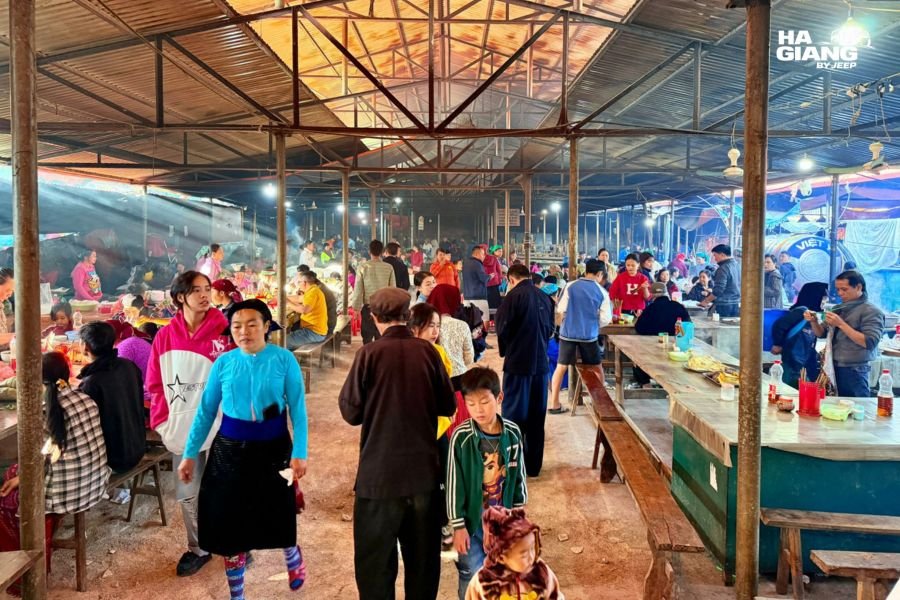
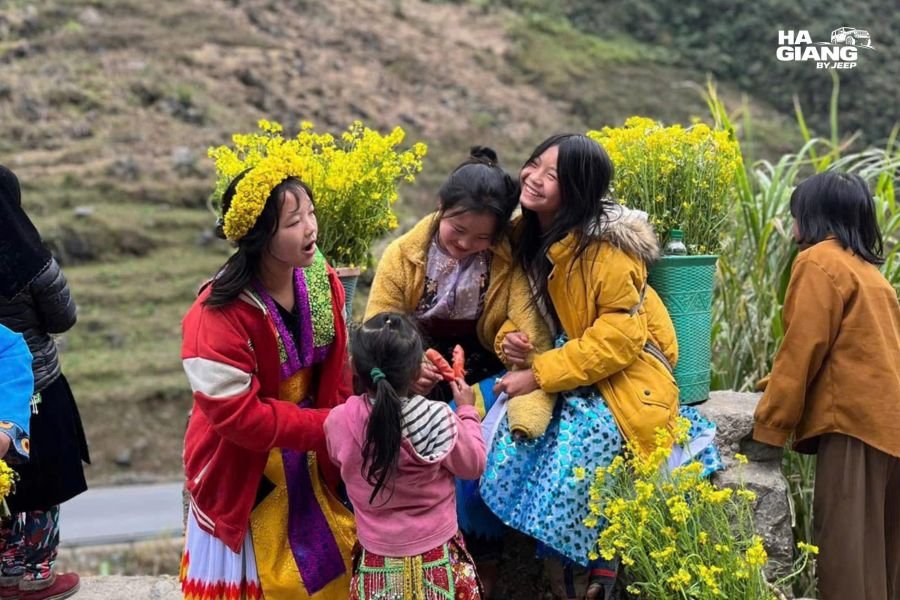
The markets on the Dong Van Karst Plateau are not tourist attractions that happen to be old. They are the actual commercial and social infrastructure of the region, the thing that brings Hmong, Tay, Dao, Lo Lo and Giay families down from villages scattered across the limestone once every few days to trade livestock, buy salt and thread, eat a bowl of something hot, drink corn wine and see people they are related to. Visitors are incidental. That is exactly why they are worth planning around.
What is in this guide
- Why the markets are the best thing in Ha Giang
- The market days you can rely on
- Why there is no clean weekly table
- The markets one by one
- What actually happens at a market
- How to time your trip around one
- What to buy
- How to behave, and how to photograph
- Eating at a market
- Mistakes people make
- Which jeep tour is right for you?
- FAQ
Why the markets are the best thing in Ha Giang
The passes are spectacular and the villages are beautiful, and both will be there whichever day you drive them. A market is the one part of a Ha Giang trip that only exists if you are in the right place on the right morning.
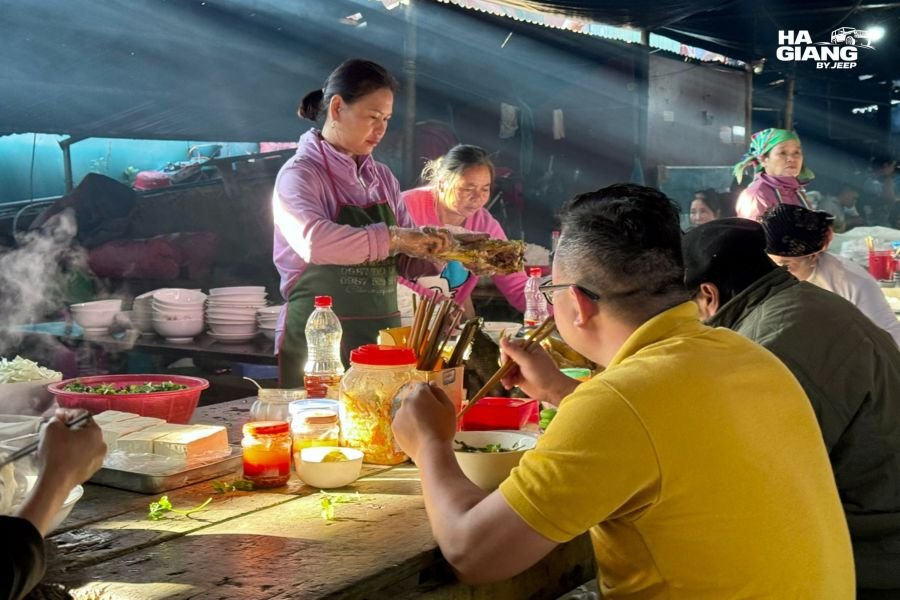
What you get is a few hours inside something completely unstaged: a livestock pen where a buffalo changes hands over a long negotiation, a woman unrolling indigo hemp she wove herself, teenagers in full traditional dress who put it on because everyone does, a pan of thang co that has been simmering since before dawn, and a corner where men who walked two hours to get here are already three toasts into the morning.
Nobody is performing. You are the only person there for whom this is an event.
Guests tell us afterwards that the market morning was the best part of the trip more often than they say it about Ma Pi Leng, which is a striking thing given what Ma Pi Leng looks like.
The market days you can rely on
Three you can plan around with confidence.
| Market | When | Notes |
|---|---|---|
| Dong Van Market | Sunday morning | The largest and best known on the plateau. Sits in the old quarter square. Busiest early, thinning by late morning |
| Meo Vac Market | Sunday morning | The other big Sunday market, at the eastern end of the loop. Strong livestock section |
| Khau Vai Market | Once a year, spring | The famous annual gathering near Meo Vac, on a lunar calendar date so it moves each year. Ask us for the date in your year |
Because Dong Van and Meo Vac both fall on Sunday, you cannot do both properly on the same trip unless you have two Sundays. Pick one. If you are staying in the old quarter, Dong Van is the obvious choice because you walk to it. If your itinerary has you at the eastern end, Meo Vac is less visited and has the stronger animal market.
Why there is no clean weekly table
Here is the part almost nobody explains, and it is the reason you should be suspicious of any site offering you a tidy seven day grid for every village in the province.
Several markets in the Dong Van district area do not run on the seven day week at all. They run on the traditional lunar calendar cycle of animal days, and a market held on a particular animal day recurs every six days rather than every seven.
Six does not divide into seven. So relative to the calendar on your phone, the market shifts backward by a day each week. A village market that lands on a Tuesday this week lands on a Monday next week, then a Sunday, and so on around. Locals call these cho lui, which translates roughly as backward markets.
Villages in this system include Sa Phin, Pho Cao and Lung Phin, among others. Which specific animal day each one uses, and therefore which calendar date it falls on during your particular week, is something we confirm locally rather than from a chart.
This is not us being cagey. It is that publishing a fixed weekday for a market that moves would send you to an empty village square, and we would rather tell you the truth about how the system works and then check the actual dates for you.
Send us your travel dates and we will tell you which markets fall inside them
Our office is in Ha Giang City and our drivers live here, so we check rather than guess, and we build the route around the market rather than hoping one turns up.
The markets one by one
Dong Van Market
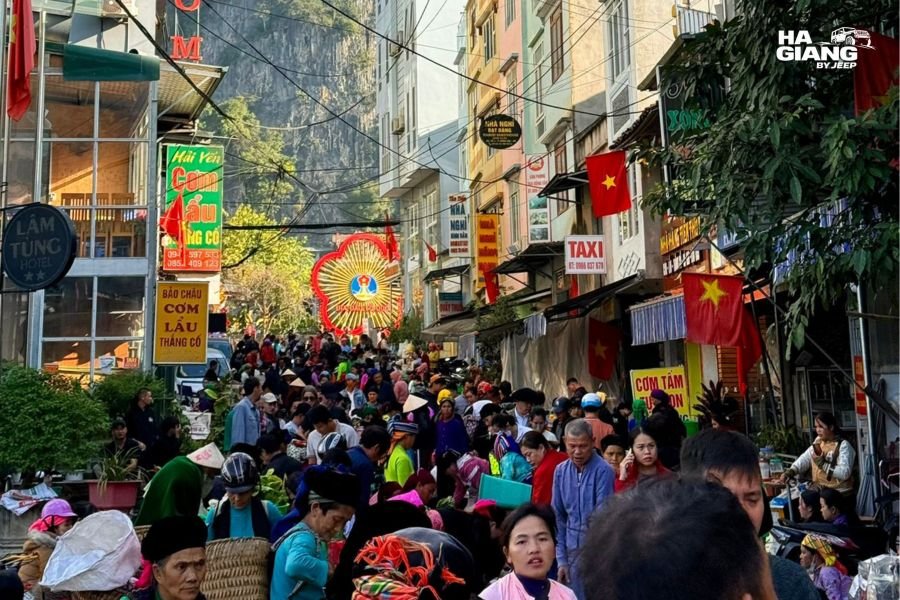
Sunday morning, in and around the old quarter square, under the limestone wall. The biggest on the plateau and the one most visitors see.
Livestock at the edge, textiles and household goods through the middle, food stalls at the back. Get there when it opens rather than at nine, because by mid morning the crowd is thinning and a good part of what you came for has already been traded and carried away.
The great advantage of Dong Van: if you sleep in the old quarter on Saturday night, you walk out of your door into it. No drive, no parking, no timing problem.
Meo Vac Market
Sunday morning, at the eastern end of the loop past Ma Pi Leng. Less visited than Dong Van and, for that reason, several people who have seen both prefer it.
The livestock section is the strongest on the loop. If you have never watched a cattle negotiation conducted mostly through gesture and long silences, this is where to do it.

Khau Vai Market
Once a year, near Meo Vac, on a date set by the lunar calendar in spring.
Traditionally this was a gathering where people who had loved each other but married others could meet once a year without scandal, which is why English sources call it the Love Market. It has grown considerably and now draws large crowds from across the region and beyond, with all the noise and scale that brings.
If your dates fall anywhere near it, rearrange things to be there. If you want to know whether they do, ask us, because the date moves every year and we will look it up properly rather than repeating a figure from an old article.
Sa Phin, Pho Cao, Lung Phin and the smaller village markets
These are the backward markets described above, and they are also the ones worth the detour if the timing works.
They are small. A few dozen stalls, a slope, people arriving on foot with baskets on their backs. Almost no other visitors. The trading is real and unhurried and nobody is selling anything to tourists because there are none.
We cannot tell you which day yours falls on without knowing your dates. We can tell you that if one lands inside your trip, it is worth reordering the itinerary for.
Quan Ba, Yen Minh, Du Gia and Pho Bang
Smaller town and village markets along the loop, useful mainly as opportunistic stops. If your driver knows one is on as you pass, stop. If not, no loss.
Bao Lac, on the Cao Bang side
If you are on one of the longer combo tours heading east, Bao Lac has a market and it sees very few outside visitors. Worth asking about when we plan your route. The Cao Bang Loop guide covers that side of the trip in full.
What actually happens at a market
Four zones, roughly, and they are the same everywhere.
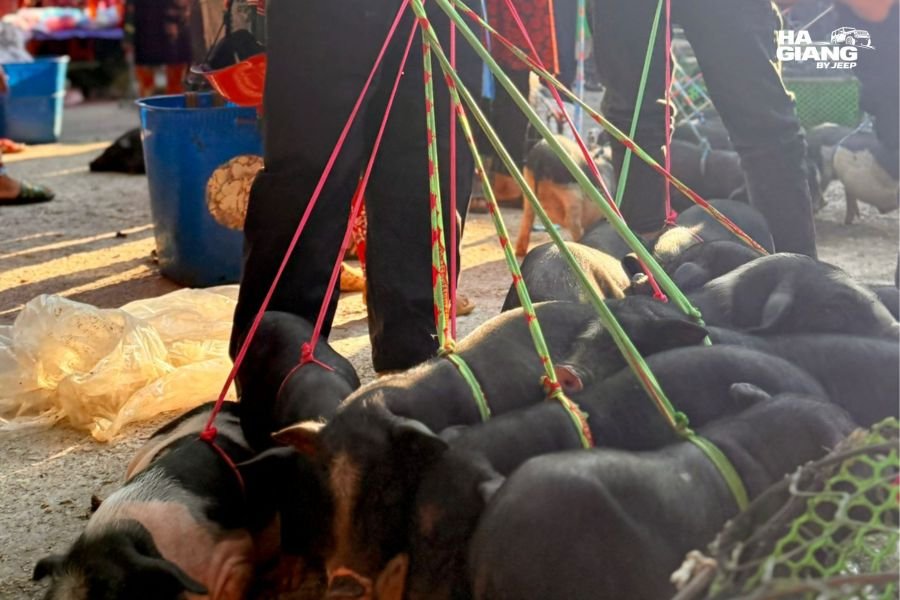
The livestock end. Buffalo, cattle, pigs, dogs, chickens, tethered or in baskets. Loud, muddy, and the most serious commerce happening anywhere on the site. Deals take a long time and involve very little talking.
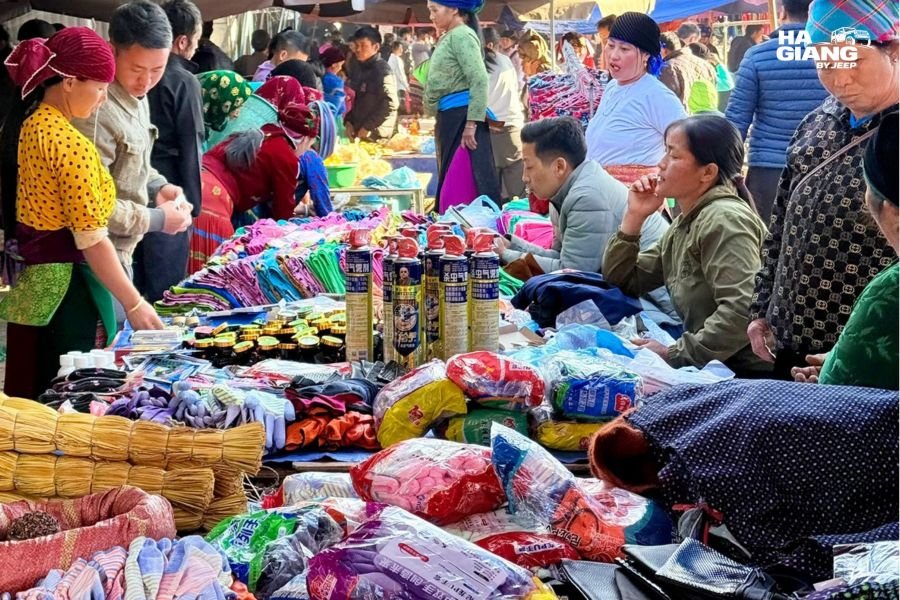
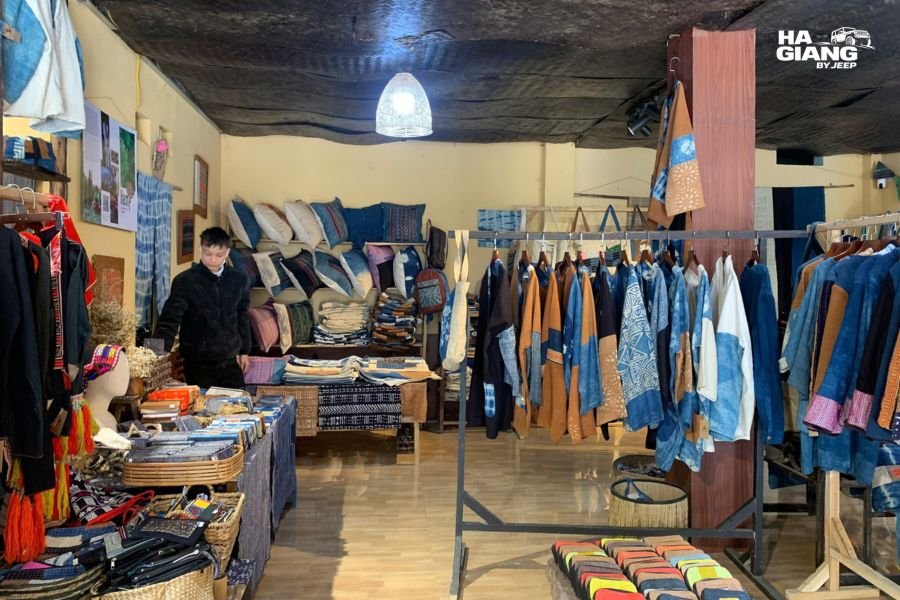
The textile and goods section. Indigo hemp cloth, embroidered panels, ready made clothing, thread, tools, knives, plastic buckets, batteries, salt. Practical shopping alongside craft that took months.
The produce ground. Vegetables, herbs, mountain greens, medicinal roots and bark, mushrooms, honey, spices, laid out on cloth directly on the floor. This is where you see what actually grows up here.
The eating and drinking corner. Pans of thang co over fires, noodle stalls, rice, grilled meat, and a section where corn wine is poured for men who have walked a long way and are in no hurry. By mid morning it is the loudest part of the market and the most fun.
How to time your trip around one
Practical sequencing. This is the whole point of the article.
Rule one: markets are morning events. They start before dawn and are effectively over by late morning. A market you arrive at for lunch is not a market, it is a car park with litter in it.
Rule two: sleep next to it. The best market experience on the loop is staying in Dong Van old quarter on Saturday night and walking out into Sunday morning. We build itineraries around this when guests ask.
Rule three: build the trip around the market, not the other way round. The passes and viewpoints are available every day of the week. The market is not. So the market is the fixed point and everything else moves.
Rule four: four days beats three. On a 3 days itinerary you get whatever market happens to land in the window. On a 4 days itinerary we have room to reorder days so you catch one, and a much better chance of picking up one of the small village markets as well.
Rule five: tell us at booking, not on day one. Homestay bookings and the route are fixed in advance. Wanting a market morning is easy to plan for and difficult to improvise once the accommodation is confirmed.

There is also a practical point about the vehicle. Markets are chaotic at the edges, the good ones are on slopes, and the weather in autumn and winter is cold at that hour. Being able to park, walk in, come back to a heated vehicle, dump what you bought and go back in again changes how long you last. Most people underestimate how cold a market morning in Dong Van in January is.
What to buy
Buying something is the simplest way to leave money in the village you are standing in, so do.
- Indigo hemp textiles. Embroidered panels, scarves, bags, cloth by the length. If you visited Lung Tam linen village earlier in the trip you will recognise the work and appreciate what went into it.
- Local tea. Shan tuyet from the highlands is the good one, light to carry and genuinely from here.
- Honey and dried herbs. Sold by the bottle and the bundle.
- Smoked buffalo. Thit trau gac bep, vacuum packed. Check your own country's rules on importing meat before you commit.
- Corn wine. Sold in reused plastic bottles. Airlines have opinions about that packaging, so plan it.
- Knives and tools. Locally forged and genuinely good. Obviously not hand luggage, and worth checking what your airline and your home customs allow before buying.
On prices and haggling. Bargaining is normal at markets and not at shops with prices displayed. Keep it good humoured and keep it in proportion, because the sums in dispute are small to you and not small to the person selling. We do not publish price guidance here because market prices move constantly and a stale figure would just make you argue for the wrong number.
Bring small notes. Nobody can break a large note at seven in the morning. Draw cash in Ha Giang City before the loop starts.
How to behave, and how to photograph
You are at somebody's weekly shop, not an exhibit.
- Ask before photographing anyone. A gesture at the camera and a raised eyebrow works in any language, and your driver can ask properly in seconds.
- Do not photograph children without a parent's agreement. No exceptions.
- Do not hand money or sweets to children for photographs. It creates an expectation for every traveler behind you.
- Buy something before you start shooting. It changes the interaction completely.
- Show people the picture. Almost everyone wants to see it, and it usually gets you a better second frame.
- Traditional dress is clothing, not costume. People wear it because they wear it.
- Move out of the way. You are the only person there who is not trying to get something done.
Our photography guide covers market shooting in more detail, including why the long lens portrait from across the square is usually the one that feels wrong.
Eating at a market
Market breakfast is the best meal of most Ha Giang trips.
Thang co is the famous one, a Hmong stew simmered in a wide pan since before dawn, traditionally made with horse and using the whole animal including offal, with buffalo and beef versions now common. Try it at a market, which is where it belongs. Plenty of visitors do not finish the bowl and that is a completely normal reaction.
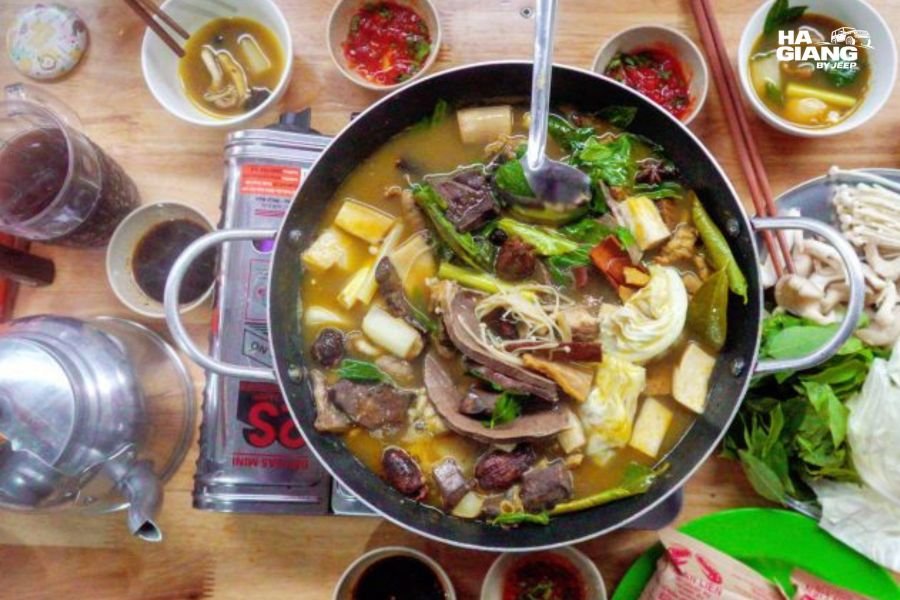
Also worth ordering: banh cuon trung, rice rolls with egg dipped in hot bone broth. Com lam, sticky rice cooked in bamboo. Men men, steamed ground corn, the Hmong staple. And whatever is in the pot that you cannot identify, which your driver can order for you.
Eat where the locals are eating and where the food is hot and freshly cooked. Our food guide covers the northern dishes in full, including one that comes with a genuine safety note.
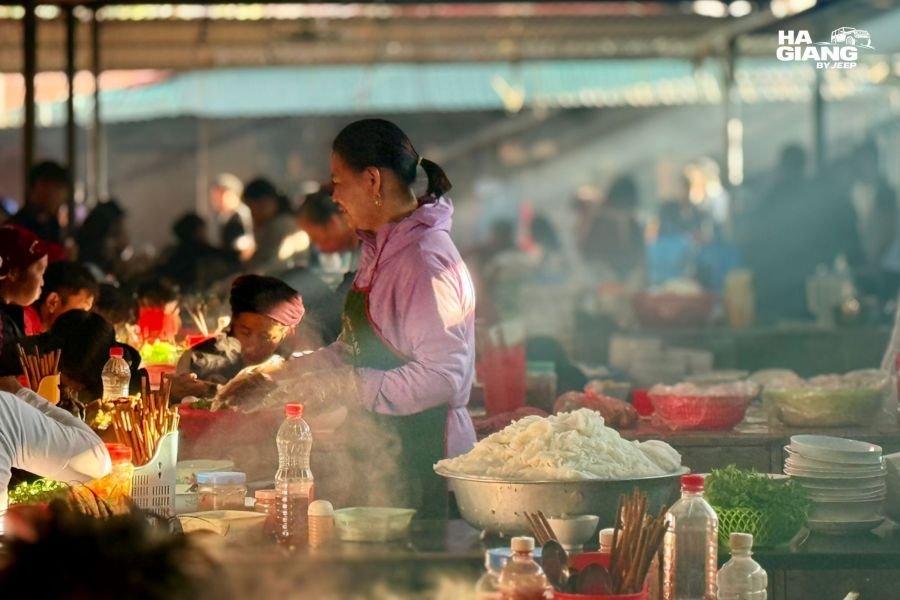
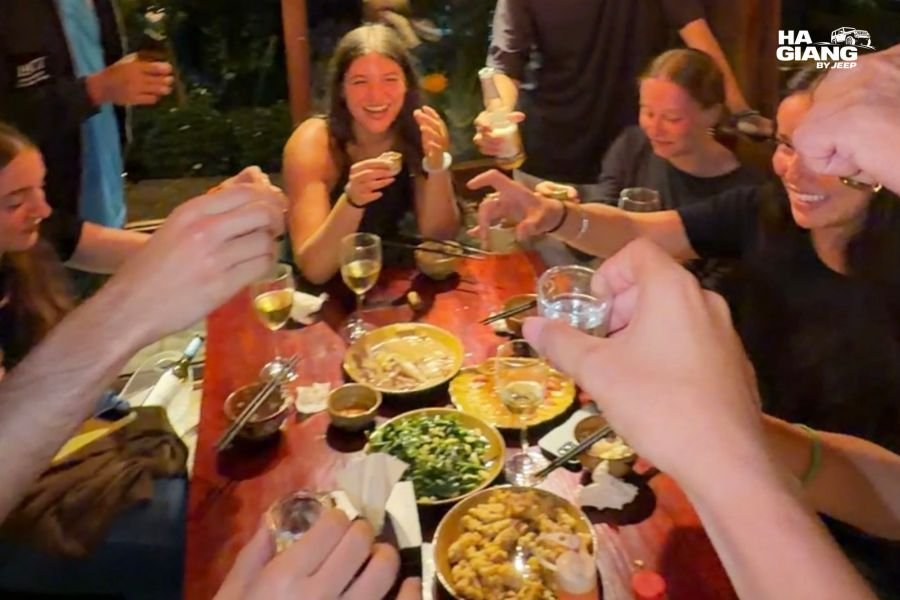
The quiet advantage of having a driver: you can accept a cup of corn wine at ten in the morning at a market table and the only consequence is the one you chose.
Mistakes people make
- Arriving at ten. The market is over. Get there at opening.
- Trusting a weekly schedule table found online for the village markets. Several of them move. Confirm before you plan a day around one.
- Trying to do Dong Van and Meo Vac markets on the same trip. Both are Sunday. Pick one.
- Not saying at booking that you want a market morning. Easy to plan, hard to improvise.
- Underdressing. A market morning in Dong Van from late autumn through winter is cold in a way people are not expecting.
- Bringing only large notes. Nothing can be changed at that hour.
- Photographing first and engaging second. It is the wrong order and it shows in the photographs.
- Booking 3 days and hoping. If a market matters to you, book 4 and let us build the route around it.
Want a market morning built into your route?
Send us your dates and we will tell you which markets fall in your window, which one to prioritise, and where to sleep the night before so you walk to it rather than drive. Email booking@hagiangbyjeep.com if you prefer.
Which jeep tour is right for you?
Ha Giang Loop, 4 days 3 nights. The one to book if the markets are why you are coming. Four days gives us room to reorder the route around whichever market falls in your window, and a real chance of catching one of the small village markets as well as a Sunday one. See the 4 days tour
Ha Giang Loop, 3 days 2 nights. Covers the classic loop and will catch a market if the timing lands well. Tell us your dates and we will say honestly whether it does. See the 3 days tour
Ha Giang and Cao Bang, 5 days 4 nights. The loop plus Ban Gioc and the second Geopark. More days means more chances of a market landing inside them. See the 5 days tour
Ha Giang and Cao Bang, 6 days 5 nights. The best odds of catching more than one market, plus Bao Lac on the Cao Bang side. See the 6 days tour
Jeep Wrangler Rubicon rental. 5,000,000 VND per day for the vehicle, about $192, for confident drivers running their own schedule. Worth noting that finding the moving village markets without local knowledge is genuinely difficult. Requirements for foreign drivers in Vietnam can change, so check the current rules first. See rental details
If this is your first trip to Vietnam, the first time visitors guide covers where the north fits in a wider itinerary. Groups should read the groups guide, since markets with ten people need a meeting point and a time.
Ha Giang market days FAQ
What day is Dong Van market?
Sunday morning, in and around the old quarter square. It starts before dawn and thins out by late morning, so arrive at opening rather than mid morning. Staying in the old quarter on Saturday night means you walk to it.
What day is Meo Vac market?
Sunday morning, at the eastern end of the loop past Ma Pi Leng. It has the strongest livestock section on the loop and sees fewer visitors than Dong Van.
Can I visit Dong Van and Meo Vac markets on the same trip?
Not on the same morning, since both are Sunday. Unless your trip spans two Sundays you need to choose. Dong Van if you are staying in the old quarter, Meo Vac if you want the quieter one.
Why do Ha Giang market days keep changing?
Several markets in the Dong Van district area run on the traditional lunar animal day cycle, which recurs every six days rather than every seven. Six does not divide into seven, so those markets shift backward by a day each week relative to the calendar. Locals call them cho lui, backward markets.
Is there a weekly schedule for every Ha Giang market?
Not a reliable one, and we will not publish a table we cannot stand behind. Dong Van and Meo Vac are Sunday. Several village markets move week to week. Send us your dates and we will confirm what actually falls inside them.
When is Khau Vai Market?
Once a year in spring, on a lunar calendar date, which means it moves every year. Ask us for the date in your travel year rather than trusting a figure from an older article.
What time should I arrive at a Ha Giang market?
As early as you can manage. These are dawn events. By late morning the trading is finished and people are walking home. A market visited at lunchtime is not really a market visit.
What can I buy at a Ha Giang market?
Indigo hemp textiles and embroidered panels, shan tuyet tea, honey, dried herbs, smoked buffalo, corn wine and locally forged knives. Check your own country's rules before buying meat products or blades.
Is it acceptable to photograph people at the markets?
With permission, yes, and most people are relaxed about it. Ask with a gesture or have your driver ask, buy something first, and show people the picture afterwards. Do not photograph children without a parent's agreement.
Should I haggle at Ha Giang markets?
Mild bargaining is normal at market stalls and not at shops with displayed prices. Keep it good humoured and in proportion. We do not publish price guidance because market prices move constantly.
Can you plan my trip around a market day?
Yes, and it is one of the most common things guests ask for. Tell us at booking rather than on the road, because the route and the homestays are fixed in advance. The 4 days itinerary gives us the most room to work with.
What should I eat at a Ha Giang market?
Thang co if offal does not put you off, banh cuon trung, com lam, and whatever is in the pot that you cannot identify. Eat where it is busy and where the food is hot and freshly cooked.