
Ha Giang Jeep Tour What to Expect: A Real Day on the Loop
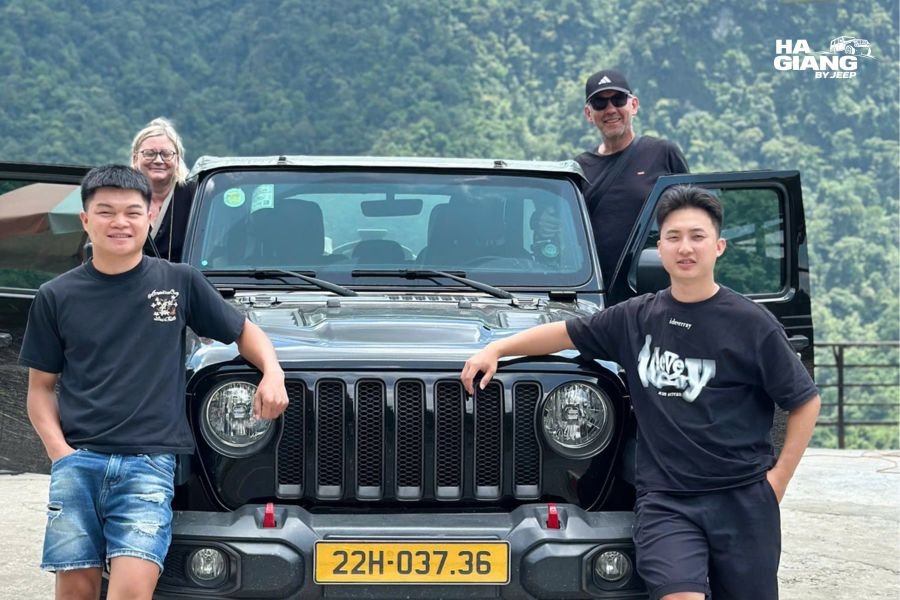
A heater, a soft top, a driver who grew up on these passes, and a road that keeps giving you reasons to stop.
Most people book a jeep in Ha Giang without a clear picture of the days themselves. They have seen the drone footage. They know Ma Pi Leng is famous. What they have not seen is the ordinary part: when you eat, how cold it gets at altitude in February, how often the jeep stops, how much of the day you spend sitting, and what happens when the weather turns at four in the afternoon.
This is a Ha Giang jeep tour what to expect guide written from the driver's seat rather than from a brochure. We run private 4x4 tours on this route all year, in dry October light and in the fog that swallows Dong Van in March, and the questions we answer by email are almost always the same practical ones. So this covers the rhythm of a normal day, the roads, the food, the cold, the paperwork, the money, and the honest trade offs.
No drama. Just what actually happens.
Ha Giang Jeep Tour What to Expect: The Short Answer
If you read nothing else, read this.
- You will spend less time driving than you think and more time standing at the side of the road than you expect.
- Days start early, around 8am, and finish in a village or town in the late afternoon, usually with time for a shower before dinner.
- Driving comes in stretches between stops. You are rarely sealed in the car for long, because the whole point of the vehicle is that it can pull over anywhere.
- The scenery does not build slowly to one big moment. It starts about forty minutes out of town and then simply does not stop.
- The mountains are cold from roughly November to March, wet and green from May to September, and busy in the shoulder months when the light is best.
- You will eat at roadside places, not restaurants with menus in four languages, and that is the best part of the food.
- Nobody rides a motorbike. Nobody has to be brave. The comfort is the product.
The rest of this guide is the long version.
Who Books a Jeep, and Who Loves It Most
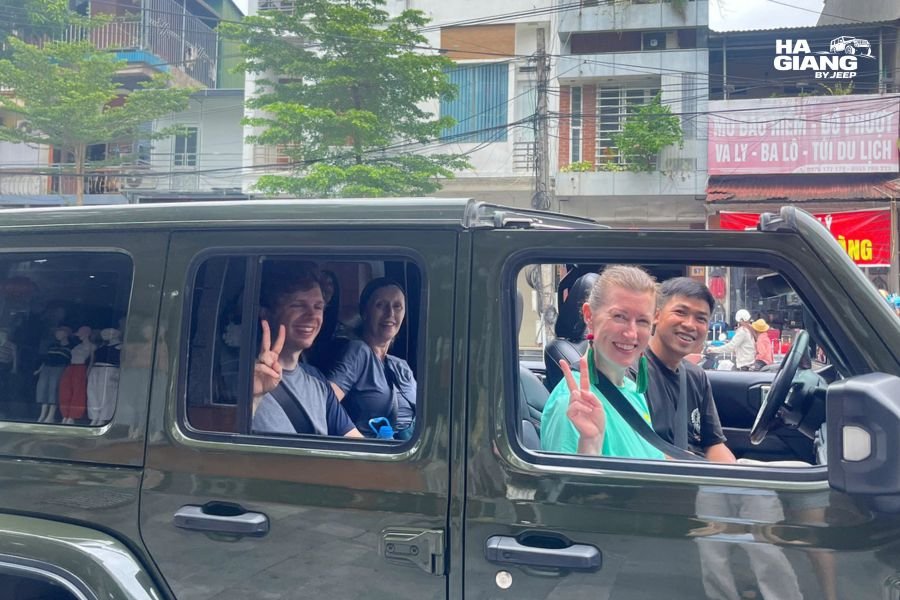
Every group in the back of our vehicles has arrived at the same conclusion from a different direction: they wanted the Loop, and they did not want to spend three days gripping handlebars in the rain.
Couples
Couples are the biggest group we carry, and the reason is not romance, it is conversation. On two bikes you ride single file with helmets on, and you talk at the stops. In a jeep you sit next to each other for three days with an open roof and a view that changes every ten minutes. Honeymooners tend to take the 3 days jeep tour when it is folded into a longer Vietnam trip, and the 4 days version when Ha Giang is the trip.
Families, and travellers in their 50s, 60s and 70s
This is the group that most often tells us they had written the Loop off entirely. Grandparents come with adult children. Parents come with a nine year old who falls asleep across the back seat after lunch. Nothing about the route requires physical fitness beyond walking up a set of stairs at a viewpoint, and every hard part, the driving, the navigation, the border paperwork, the luggage, sits with us.
Solo travellers and small groups of friends
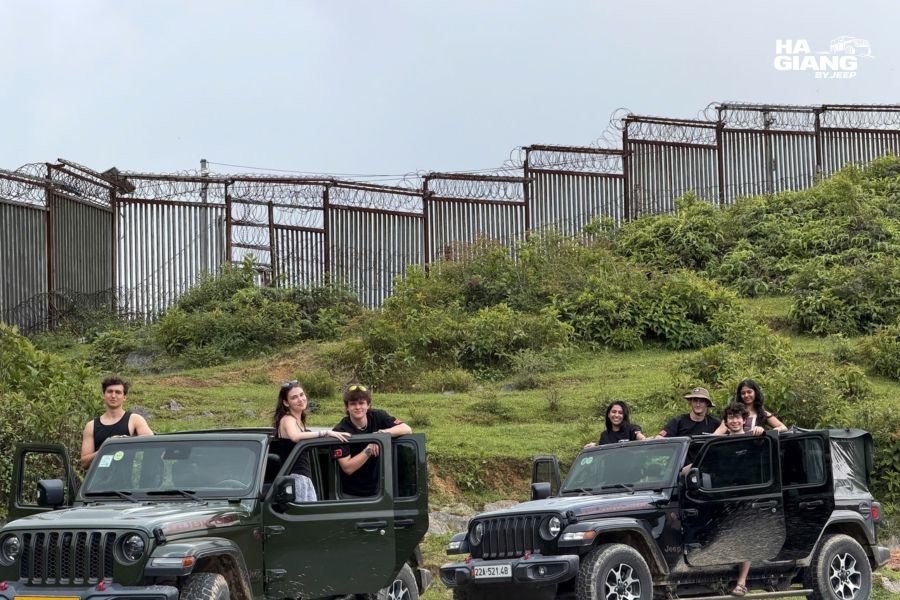
Solo guests get the same private vehicle. We do not put strangers together, so a solo booking is genuinely a private tour with a local driver rather than a seat in a shared van. Groups of four to six friends usually split across two jeeps and swap passengers each day, which turns the driving hours into part of the social side of the trip.
Not sure which duration fits? Send us your travel dates on WhatsApp and we will tell you honestly whether 3 days is enough for what you want to see, or whether you should give the route a fourth day. No deposit needed to ask.
A Day on a Ha Giang Jeep Tour, Hour by Hour
Days vary with weather, season and how long you linger. But the shape of a day on a Ha Giang jeep tour is consistent, and it looks like this.
Around 8am: the office in Ha Giang City
Most guests arrive on the overnight bus or a daytime limousine van from Hanoi, sleep in Ha Giang City, and start from there. Mornings begin with coffee, a look at the sky, and a short conversation with your driver about the day. Big luggage stays behind in the office if you want it to. You take a day bag into the jeep and leave the suitcase.
Two things worth doing before you get in: buy water, and put your rain layer somewhere you can reach without unpacking. Mountain weather does not consult the forecast.
Mid morning: the climb to Quan Ba
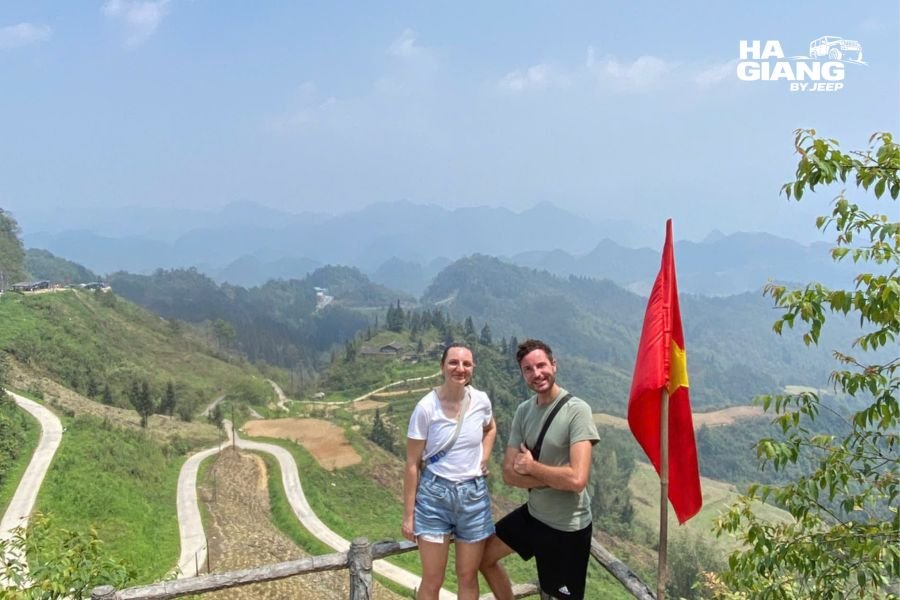
The city sits low and flat, and for the first twenty minutes you would not guess where you are going. Then the road tilts and starts climbing through the Tham Ma switchbacks. Quan Ba is the first proper stop, a viewpoint above a valley of neat green fields and two famous rounded hills. On a clear day you can see the road you are about to drive threading away north. On a foggy day you see about forty metres, and then the fog moves and you see everything at once for eight seconds. Both are worth the stop.
Late morning: Lung Tam and the road to Yen Minh
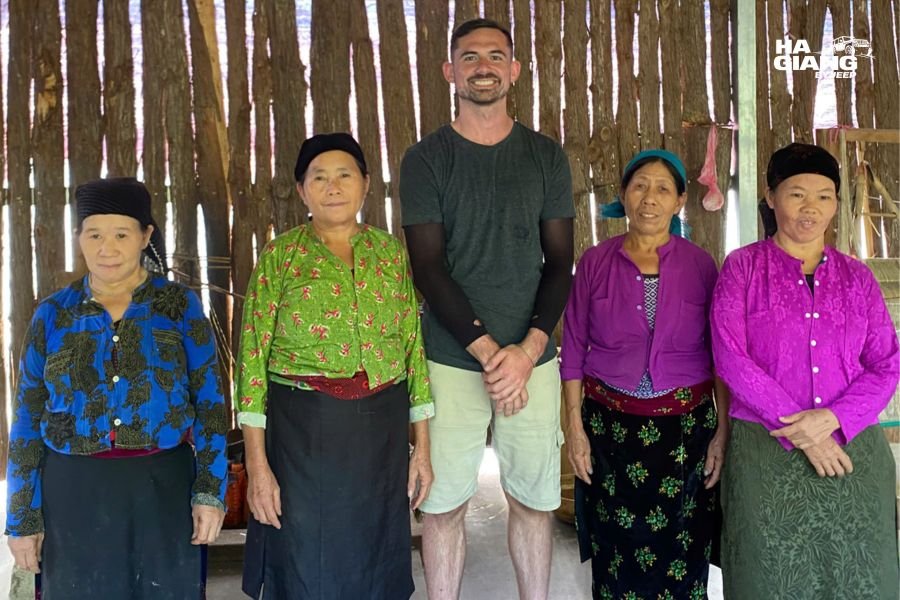
From Quan Ba the road runs toward Yen Minh through pine and limestone. This is where most itineraries include Lung Tam Linen Village, a Hmong weaving cooperative where flax is grown, spun, dyed with indigo and woven on wooden looms by hand. It is a working village rather than a show, and the smell of the indigo vats is the part people remember.
Yen Minh itself is a town, not a sight. Its job is fuel, toilets, and one more coffee.
Lunch: wherever the food smells right
Lunch happens between roughly 11:30 and 1pm, at a roadside place your driver knows. It will not have an English menu. It will have com lam, bamboo tubes of sticky rice cooked over fire, grilled pork, greens picked that morning, and rice. Vegetarians are fine here, as long as we know in advance so the kitchen can plan.
This is the first moment most guests notice the practical difference of a car. You can order a beer at lunch. You can have a glass of ruou ngo, the local corn wine, if it is offered at a homestay in the evening. Nobody is driving except the person whose job it is.
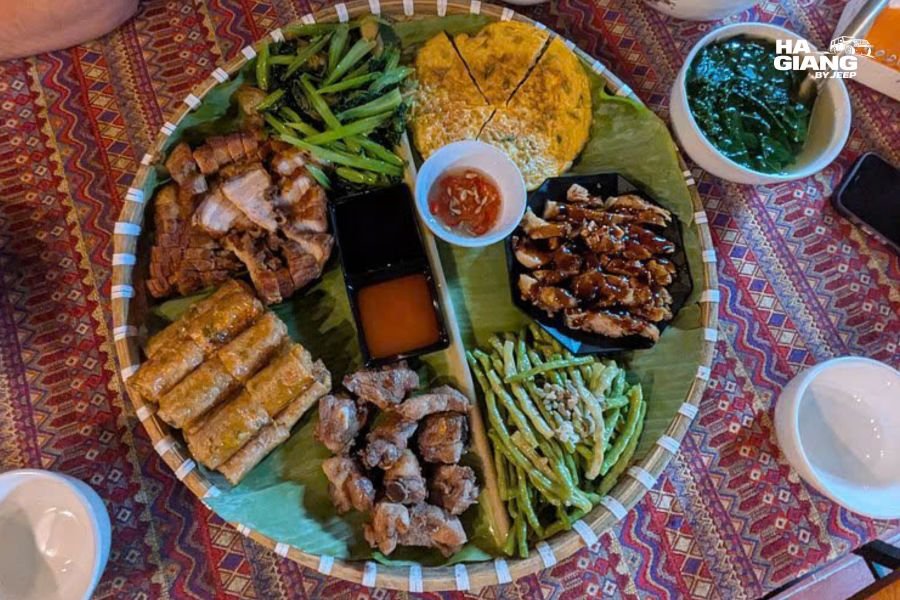
Afternoon: Sung La, Pho Bang and the road into Dong Van
The afternoon is the prettiest stretch of the first day. Sung La is a valley of stone walled houses and corn drying under the eaves, wrapped in rock. Pho Bang sits at the end of a short detour, an old town of clay walled houses and wooden shutters that sees a fraction of the traffic the main road does. Between them is the Hmong King's Palace at Sa Phin, and further north the road climbs toward Lung Cu, the flag tower at the northernmost point of the country.
You will not do all of this in one afternoon. The 4 days itinerary exists precisely so you do not have to choose.
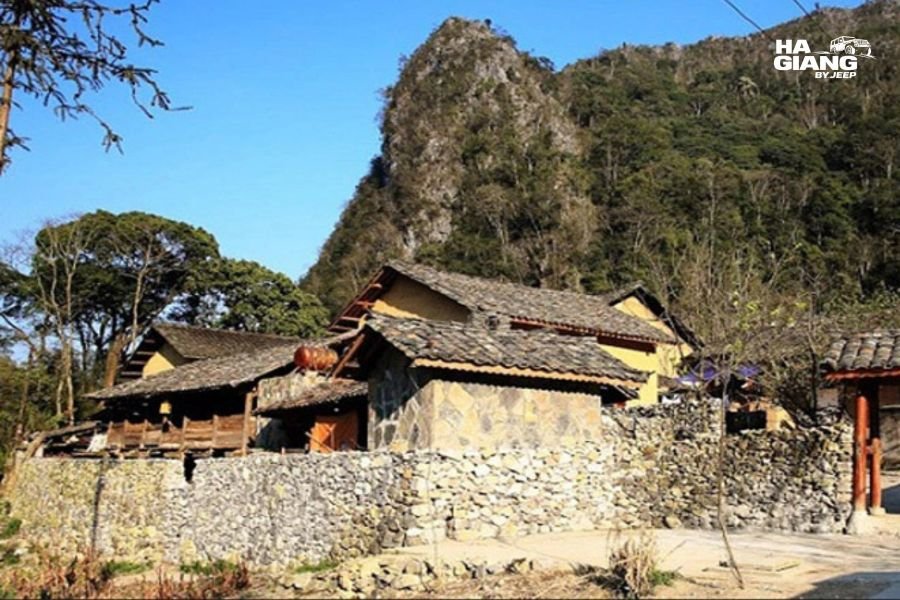
Evening: Dong Van Old Quarter
The first night is usually Dong Van. The old quarter is a short row of century old stone and clay houses with tiled roofs and red lanterns strung above the street, tables outside, and a slow crowd of travellers and locals drinking coffee and corn wine. It is small. You can walk it in ten minutes. People still sit there for three hours.
Dinner is a shared table at a homestay or a local restaurant. Then it gets cold, quickly, and you sleep better than you have in weeks.
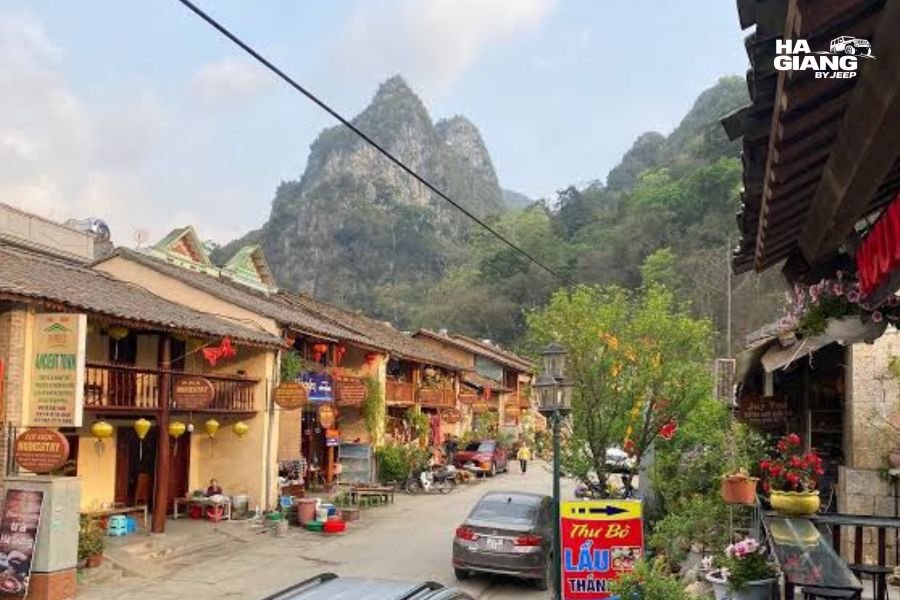
The Roads: What They Are Really Like
The question behind most emails is some version of: is this road frightening?
Honest answer: the roads are narrow, paved for the great majority of the route, and carved into the side of very large mountains. There are drops. There are also concrete barriers at most exposed sections and a driver who has been on this asphalt since he could see over the dashboard. What makes people nervous on a motorbike, gravel patches, wet corners, loose livestock, trucks appearing on a blind bend, are ordinary conditions in a 4x4.
Road conditions change with weather and with roadworks, and sections do occasionally close after heavy rain or landslides. We check the latest updates before every departure and reroute when we need to. If a section is closed the day you travel, you will still see the highlights, in a different order.
Ma Pi Leng Pass
Ma Pi Leng is the one you came for. The road cuts along a limestone wall high above the Nho Que River, which sits at the bottom of the canyon in a shade of green that does not photograph accurately. From the top viewpoints you can look straight down at boats the size of grains of rice.
In an open top vehicle you see the canyon on your side and the rock wall on the other, all at once, without turning your head or worrying about the front wheel. That single stretch is the clearest argument for the whole format.
Many guests add the Nho Que River boat trip below the pass, which involves a steep descent to the water and a short cruise into the gorge. Availability and operating hours change with the season and the water level, so treat it as an option to confirm on the day rather than a fixed inclusion.
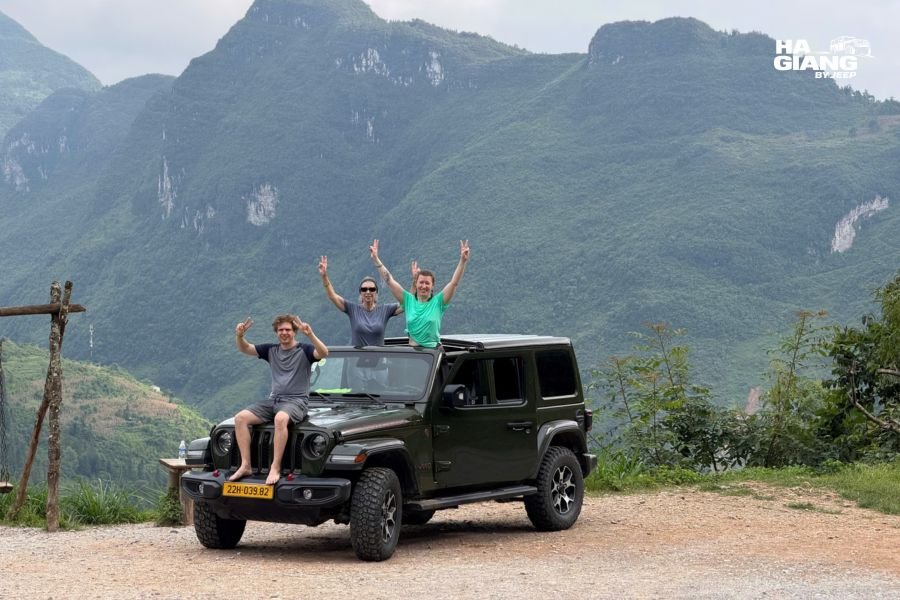
Meo Vac, the eastern side and Du Gia
Past Ma Pi Leng the road drops into Meo Vac, a market town in a bowl of mountains that feels a long way from anywhere. From there the classic loop swings south and east. On longer itineraries this is where Du Gia comes in: a green valley with a waterfall, terraced rice, and a road that carries a fraction of the traffic of the northern section. It is the part of the route people are most surprised by, because nobody put it in the trailer.
Lung Cu and the border zone
Parts of the far north sit inside a border area where foreign visitors need a permit. Arranging that is our job, not yours, and it is included as standard on our itineraries that go there. What you need to do is simple: send us clear photos of your passport pages when we ask, well before departure, because permits take time and rules can change. If you are travelling on a passport that needs extra lead time, tell us early and we will check the latest requirements.
Inside the Jeep: Comfort, Weather and the Stop Anywhere Rule
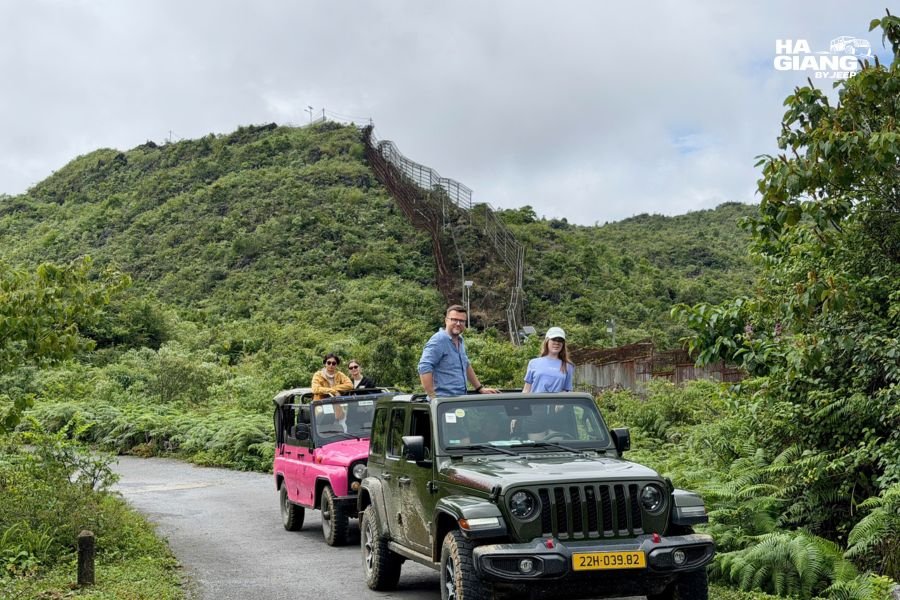
The vehicle is a Jeep Wrangler Rubicon, private to your group. Nobody else is added to it.
Open when you want it open. The roof comes off or folds back on clear days, which turns the drive into an open air viewpoint that moves. Everyone gets the same view, front seat or back.
Closed when you need it closed. A soft top goes on for rain and cold, and the heater works. On a wet January afternoon at 1,500 metres this matters more than anything else in this article. The trip does not get cancelled or shortened because of weather. It just gets a roof.
Stop anywhere. This is the quiet luxury of the format. See a buffalo blocking the road, a woman carrying a basket of indigo, a shaft of light hitting a valley, a stall selling grilled corn? Say stop. There is no parking to worry about, no convoy to hold up, no waiting for six other riders to notice you pulled over.
Luggage and space. Day bags, camera gear, jackets and shopping all travel inside with you. Large suitcases stay in Ha Giang City. Nothing is strapped to a rack in the rain.
Motion sickness. Be straight with us if you are prone to it. The route is a long sequence of curves, and the practical fixes are simple: front seat, medication taken before departure rather than after symptoms start, an open roof for airflow, and a driver who takes the corners gently once he knows. It is a common request and it is easy to accommodate.
Your Driver: What a Local English Speaking Driver Actually Does
The vehicle is half the product. The person driving it is the other half.
Our drivers are from these mountains. Not from Hanoi, not from the coast: from here. That changes the trip in ways that are hard to advertise. They know which market is on which day, which viewpoint has the light in the afternoon, which homestay cooks well, which family is weaving today, and which section of road is being resurfaced this week. They speak English at a practical, conversational level, which is enough for the story of the Hmong king, the name of the herb in your soup, and a real answer to why the houses have those particular walls.
What they are not is a licensed tour guide reading a script at each site. If your priority is deep historical narration in fluent academic English, say so when you enquire and we will arrange a dedicated guide alongside the driver rather than let you arrive expecting something different.
Support runs 24 hours a day from the office in Ha Giang City for the whole time you are on the road.
Food on the Loop: Com Lam, Banh Cuon Trung and Corn Wine
Food in Ha Giang is regional, seasonal and mostly cooked by whoever owns the front room. A rough map of what you will meet:
| Dish | What it is | When you will meet it |
|---|---|---|
| Com lam | Sticky rice cooked inside bamboo over fire, eaten with sesame salt or grilled meat | Roadside lunches, markets |
| Banh cuon trung | Steamed rice rolls with egg, served with a bowl of hot broth rather than dipping sauce | Breakfast, especially in Dong Van |
| Thang den | Warm glutinous rice balls in ginger syrup with coconut and peanut | Evenings in Ha Giang City and Dong Van |
| Chao au tau | Thick porridge made with a local tuber, bitter, deeply warming, eaten at night | Cold season evenings |
| Ruou ngo | Corn wine, distilled at home, poured generously | Homestay dinners, markets |
| Grilled everything | Pork, chicken, corn, sweet potato on charcoal at the roadside | All day |
A word on the corn wine: it is stronger than it tastes and it is offered as hospitality, not as a challenge. Drink it, enjoy it, and if you have had enough it is completely normal to leave the glass full.
Markets: Dong Van, Meo Vac and Khau Vai
Markets are the single best cultural experience on this route and they are not staged for visitors. Dong Van Sunday Market fills the square beside the old quarter with Hmong, Tay and Dao families trading livestock, textiles, tools and food. Meo Vac has its own Sunday market with a serious livestock section. Khau Vai is famous for the love market held once a year in the lunar calendar, an old tradition that draws large crowds, and the timing shifts every year, so check the current date if that is what you are travelling for.
Markets run on their own calendar, and some rotate. Tell us at booking if a market day matters to you and we will build the route around it rather than the other way around.
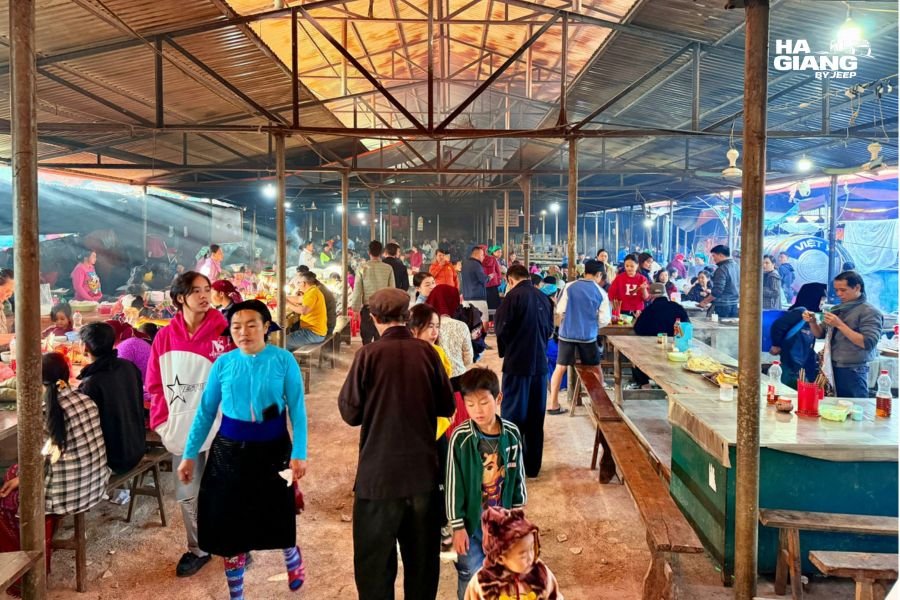
The foodie argument for a jeep, in one line. You can stop at any stall, any market, any smoking charcoal grill you pass, spend forty minutes there, order the corn wine, and then get back in a vehicle that someone else is driving. No parking, no helmet, no riding afterwards, no rushing to reach the homestay before dark. If eating is a real part of how you travel, see the 3 days and 4 days itineraries and tell us which markets fall in your dates.
Weather and Seasons: What to Expect Month by Month
Ha Giang has real seasons and they change the trip. This is a general guide rather than a forecast, and mountain weather does what it likes, so check the latest updates close to your dates.
| Period | What it feels like | Worth knowing |
|---|---|---|
| December to February | Cold, often foggy, sometimes very cold at altitude at night | Plum and cherry blossom late in this window. Soft top and heater earn their keep. Bring more warm clothing than you think |
| March to April | Mild, clearing, blossom and fresh green | One of the most comfortable windows for a first visit |
| May to June | Warm, humid, water in the rice terraces | Green and dramatic. Afternoon rain is common |
| July to August | Hottest and wettest | Landscapes at their most saturated. Higher chance of landslides and route changes after heavy rain |
| September to October | Golden rice harvest, clearer skies | The most photogenic period and the busiest. Book earlier |
| November | Cool, dry, buckwheat flowers in the north | Many drivers' favourite month |
None of these months are impossible. A jeep is genuinely an all season vehicle here, which is why our departures run through the wet months as well. What changes is what you pack.
What to Pack for a Ha Giang Jeep Tour
You do not need trekking equipment. You need layers and a way to stay dry.
Always:
- A warm layer heavier than you expect, even in summer, because passes are cold at altitude and open roofs move air
- A rain jacket, not an umbrella
- Comfortable shoes with grip for wet stone steps at viewpoints
- Sunglasses and sun cream, which people forget because they are thinking about the cold
- Cash in small notes for markets, snacks and small entry fees
- Any personal medication, including motion sickness tablets if you use them
- Power bank and a charging cable
- Passport, and a photo of your passport on your phone
Cold season additions, roughly November to March: hat, gloves, thermal layer, thick socks. It is genuinely cold at night in Dong Van and Meo Vac.
Wet season additions, roughly May to September: a dry bag or a plastic bag for electronics, a second pair of shoes, quick drying clothing.
Leave in Ha Giang City: your large suitcase, anything valuable you do not need, and formal clothing. Nowhere on this route requires a nice shirt.
Money, Inclusions and the Things People Forget to Budget For
We publish current prices on each tour page and confirm everything in writing before you pay a deposit, so this section deals with the shape of the money rather than numbers that go out of date.
Normally inside the tour price: the private vehicle and fuel, tolls and parking, your driver, accommodation for every night of the itinerary, the meals stated in that itinerary, bottled water on board, border permits where the route needs them, all entrance tickets and activity fees listed on the tour page, and 24 hour support from the office.
Normally outside it: the final dinner on your last day, alcoholic drinks, personal spending, tips for your driver, room upgrades, travel insurance, and the bus between Hanoi and Ha Giang unless you have asked us to add it.
What people forget to budget: market spending, which is where money actually goes. Textiles, indigo, knives, honey, tea, a hat you did not plan to buy. Bring more small cash than you think, because card machines are not a feature of a mountain market.
Ask for the current inclusion list for your exact dates before you pay anything. Any operator who will not put that in writing is telling you something.
Mistakes and Things to Watch For
Nothing dramatic. Just the patterns we see.
- Booking too little time. The single most common regret is a 3 days trip that should have been 4 days. The route rewards slowness, and the extra day is where Du Gia and the quieter villages live.
- Arriving on a morning bus and expecting to start immediately. Overnight buses arrive early and tired. A night in Ha Giang City before departure makes the first day better.
- Underestimating cold. Every February we lend out jackets to guests who packed for tropical Vietnam. Northern mountains are not Hoi An.
- Paying a full amount in advance to an operator you found through a message from a stranger. Book through a real website with a real office address, get your confirmation in writing, and use a payment method that leaves a record. This is general travel caution rather than a comment about anyone in particular.
- Assuming every road is open. Weather closes sections. Good operators reroute quietly. Ask how the operator handles this before you book, not while it is happening.
- Treating a homestay like a hotel. Standards are simple and warm rather than luxurious on the standard itineraries. If you want private rooms with hot water and heating throughout, say so at booking and we will price the upgraded accommodation version instead of hoping you will not mind.
Going Further: Cao Bang, Ban Gioc and the 15 Step Pass
The Loop is a circle, which means most people end up back where they started. There is another option: keep going east.
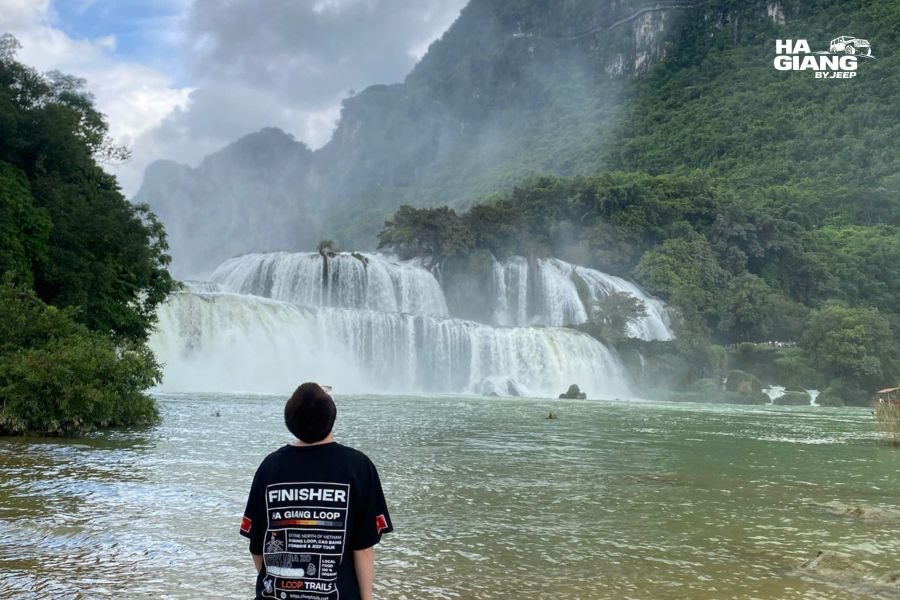
Ha Giang sits inside the Dong Van Karst Plateau UNESCO Global Geopark. A few hours east, Cao Bang holds the Non Nuoc Cao Bang UNESCO Global Geopark. Driving between the two links two of the most remarkable landscapes in the country in a single line, and the road between them is quiet in a way the northern Loop no longer is.
What that section adds:
- Ban Gioc Waterfall, a wide curtain of water on the border, best in the months after the rains when the flow is heaviest
- Pac Bo historical site, a cave and stream in a limestone valley with a specific place in modern Vietnamese history
- God's Eye Mountain, a mountain with a natural hole through the rock above a valley of grass and grazing horses
- Ngoc Con Valley, terraces, rivers and villages with almost no tourism infrastructure at all
- The 15 Step Pass, a stack of switchbacks that folds back on itself so tightly it barely looks real from above
This is what the 5 days jeep tour and the slower 6 days jeep tour are built for. Both finish in Cao Bang rather than doubling back, and you return to Hanoi from there.
Which Jeep Tour Is Right for You?
Four options, and they suit genuinely different people.
| Option | Best for | The trade off |
|---|---|---|
| 3 days 2 nights loop | Travellers on a tight schedule fitting Ha Giang into a wider Vietnam itinerary | You see the headline sights and move at a decent pace. Less time for detours |
| 4 days 3 nights loop | Most first time visitors, families, photographers, anyone who hates rushing | One more day of cost, and it is the day most people say made the trip |
| 5 days 4 nights Ha Giang and Cao Bang | Travellers who want two Geoparks and Ban Gioc without doubling back | You finish in Cao Bang, so plan your onward travel from there |
| 6 days 5 nights Ha Giang and Cao Bang | Slow travellers, couples on a longer trip, anyone who wants the quiet valleys | The longest commitment, and the least rushed way to do both regions |
| Jeep Wrangler Rubicon rental | Confident drivers who want the vehicle and their own schedule, priced by the day | You handle navigation, parking, permits and the driving yourself |
Still deciding? Tell us your dates, how many people, and whether anyone in the group gets carsick or needs an easy pace. We will tell you which one we would put our own family in.
Ha Giang Jeep Tour Review: How to Read Them Before You Book
Every operator in Ha Giang has a wall of five star reviews. That includes us. So here is a more useful filter than a star average.
Read the three star reviews first. They are the honest ones. A three star review that says the homestay was basic and the driver was excellent tells you exactly what the product is.
Look for specifics. A real Ha Giang jeep tour review mentions a driver's name, a dish, a market, a moment when the weather turned. Reviews that praise "amazing scenery" and nothing else were written about the landscape, and the landscape is the same for everyone.
Check what the reviewer wanted. A backpacker who wanted a party convoy and an older couple who wanted a quiet trip will rate the same tour very differently, and neither of them is wrong.
Check the dates and the season. A glowing October review and a soggy July review can describe an identical operator.
Ask for what reviews do not cover. Reviews rarely mention insurance, permits, what happens if a road closes, or what the cancellation terms are. Ask those directly before you pay.
Apply the same test to us. Then ask us anything the reviews did not answer.
How to Book, and What Happens Next
Booking is deliberately simple.
- Message us on WhatsApp or through the contact page with your dates, group size and which duration you are considering.
- We confirm availability and send a written itinerary with what is included, what is not, and the total.
- You confirm and pay a deposit. Passport details follow if your route needs a border permit.
- We send your driver's name and number, the pickup time, and a packing note tailored to your season.
- You arrive in Ha Giang City, sleep, and start.
Once you have a confirmed travel date, book as soon as you can. Most guests book one to three months ahead. Jeep availability is limited in a way motorbike availability is not, especially in September, October and around public holidays, and early booking is what lets us arrange the right vehicle, the right driver and the permits without pressure.
Ready to put dates on it? Choose the duration that fits your trip, then book your dates or send a message on WhatsApp at +84 938 988 593. If you would rather drive yourself, the Jeep Wrangler Rubicon rental is available by the day. Either way, tell us the season you are coming in and we will tell you what to pack.
FAQ
Do I miss anything by not being on a motorbike? No. Same route, same viewpoints, same villages, same markets, same food. The difference is that you are warm, dry, and looking at the scenery instead of the road surface.
Is a Ha Giang jeep tour suitable for older travellers? Yes, and it is one of the main reasons the format exists. There is no physical requirement beyond walking at viewpoints, the pace is yours, and the vehicle has a roof and a heater when the weather turns.
How many people fit in one jeep? Comfortably a small group, and your group travels alone. We never combine separate bookings, so a couple gets the same private vehicle a group of four gets. Tell us your group size and we will confirm the right setup.
Do I need a permit for the border areas? Some sections of the far north require one for foreign visitors, and we arrange it as part of the tour when your route includes them. You send us passport photos in advance. Rules can change, so we confirm the current requirement before every departure.
What happens if it rains for three days? The tour runs. The soft top goes on, the heater goes on, and the stops get shorter. Rain in the mountains also produces the best light and the emptiest viewpoints. If a road closes, we reroute.
Can you accommodate vegetarian or allergy requirements? Yes, with notice. Mountain kitchens are small and cook what they have, so telling us at booking rather than at the table makes a real difference to what arrives.
How do I get from Hanoi to Ha Giang City? Overnight sleeper bus or a daytime limousine van are the usual options, and the journey takes most of a night or most of a day. We can arrange it for you, or you can book it yourself and simply meet us at the office.
How do we get back from Cao Bang on the 5 days and 6 days tours? Buses run from Cao Bang City to Hanoi and the trip takes a good part of a day. We help you book the seats and drop you at the station.
When is the best time to visit Ha Giang? September and October for rice harvest and clear skies, March and April for blossom and comfortable temperatures, November for buckwheat flowers and dry roads. Every month works with the right packing.
Is Ha Giang safe for first time visitors to Vietnam? It is a rural mountain region with low crime and genuinely hospitable people. The real risks on the Loop are traffic related, which is precisely the risk that a local driver in a 4x4 removes from your holiday.
Can I book a jeep tour at short notice? Sometimes, and it is always worth asking. But vehicles are limited and peak season fills early, so treat a last minute booking as a lucky break rather than a plan.
Can I drive the Jeep Wrangler Rubicon myself? Yes, we rent it by the day to confident drivers. Requirements for driving legally in Vietnam as a foreign visitor can change, so check the current rules before you plan on self driving, and talk to us first so there are no surprises at the counter.