
Cao Bang Travel Guide: Waterfalls, Caves and Quiet Mountain Roads
The province most travellers pencil in as an afterthought, written up properly for people who want the good roads, the real food and none of the guesswork.
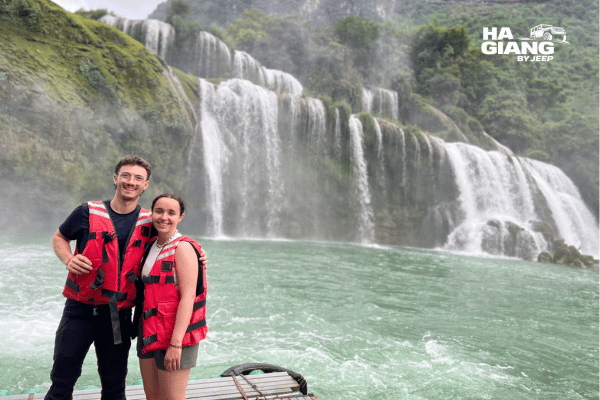
Most people arrive in northern Vietnam with Ha Giang circled in ink and Cao Bang scribbled underneath, half committed. That order tends to flip once they get there. This Cao Bang travel guide exists because the province keeps rewarding the travellers who give it proper time: a waterfall that runs the whole width of a border valley, a cave you walk through for the better part of an hour, a mountain with a hole punched clean through the summit, and roads that stack up the hillsides in visible tiers.
Cao Bang is quieter than Ha Giang. The karst is greener and more rounded, the valleys open wider, and there is more farmland between the peaks. You spend less time gripping the seat on a cliff edge and more time watching buffalo cross a river. For couples, families and travellers in their fifties and sixties, that shift in tempo is usually the whole point.
Everything in this Cao Bang travel guide comes from driving these roads with Ha Giang by Jeep guests season after season. Where something changes often, such as border area paperwork or seasonal access, this guide says so plainly instead of guessing.
Why Cao Bang Deserves More Than a Day Trip
The common mistake is treating Cao Bang as one attraction with a long drive attached. People book a rushed overnight, sprint to Ban Gioc, photograph it, and turn around. They see the postcard and miss the province. If you take one thing from this Cao Bang travel guide, make it that.
What makes a Ha Giang and Cao Bang jeep tour worth the extra days is how spread out the good stuff is, and how good the space between it feels. The waterfall sits in the far northeast. The revolutionary caves sit in the far north. The lake country sits in the middle. The most dramatic pass sits in the west, near Bao Lac, on the road in from Ha Giang. Each of those pockets has its own character, and the driving between them is genuinely part of the experience rather than dead time.
There is also the human texture. Cao Bang has fewer souvenir stalls and fewer people selling you a photo opportunity. Markets are still markets. Homestays are still houses. When you stop at a roadside noodle place in Trung Khanh, nobody hands you a laminated English menu, and the meal is better for it.
Where Cao Bang Sits and Why That Shapes the Trip
Cao Bang is a northeastern border province, sharing a long frontier with China. Its landscape belongs to the same limestone family as Ha Giang, but weathered differently: conical hills, wide alluvial valleys, rivers that turn a startling jade colour after the rain.
Two practical consequences follow from that geography.
First, the province is genuinely large and the roads curve constantly, so distances on a map understate travel effort. Ignore any source that promises exact stop to stop timings. Weather, roadworks, market days and livestock all rewrite the schedule, and anyone publishing precise numbers is guessing.
Second, several of the best places sit close to the border. Border zones come with rules, and those rules can be adjusted at short notice. Reliable operators handle the paperwork side; independent travellers should check the latest local updates rather than trusting a blog post from two years ago.
The Best Time to Visit Cao Bang
There is no bad season here, only different trade offs. Ban Gioc in particular changes personality month to month.
| Season | What it looks like | Worth knowing |
|---|---|---|
| Spring | Fruit blossom, soft haze, cool mornings | Green everywhere, fewer crowds than autumn |
| Summer | Highest water at Ban Gioc, deep green valleys | Warm and humid, heaviest rain, most dramatic waterfall |
| Autumn | Ripe rice in the valleys, clear skies | The classic window, book accommodation early |
| Winter | Cold, mist, bare branches at altitude | Quietest roads, frost possible on the high ground at Phia Oac |
Autumn
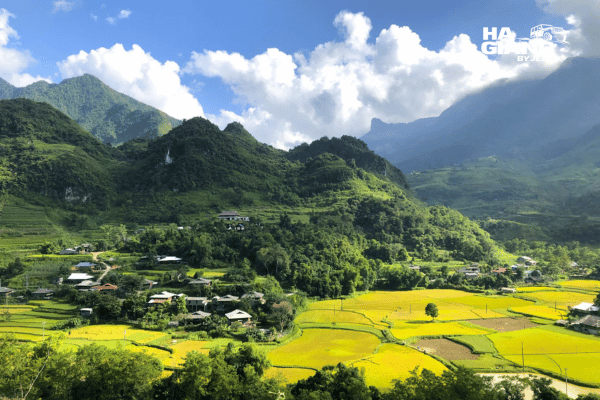
Late September into November is the sweet spot for most visitors. The Ngoc Con and Phong Nam valleys turn gold, the light is clean, and the waterfall still carries strong flow from the summer rains without the storm risk. It is also when domestic travellers arrive in numbers, so weekends at Ban Gioc feel busier.
Summer
If you want Ban Gioc at full roar, come in the wet months. The river swells, the falls widen across the whole rock shelf, and the spray reaches the viewing platforms. The cost is rain, humidity and the occasional landslide closure on smaller roads. A vehicle with a proper roof and heating handles this far more comfortably than any open option.
Winter
Cold, quiet, and underrated. The valleys hold mist until mid morning, the karst looks like ink drawing, and you get famous places almost to yourself. Up at Phia Oac the temperature can drop sharply and frost is possible. Pack seriously warm layers and it is a beautiful time to be here.
Spring
Blossom season brings plum and pear flowers to the higher villages, and the rice terraces fill with water and sky. Water levels at Ban Gioc are lower than summer, so the falls look more delicate: several separate curtains rather than one wall.
The Places This Cao Bang Travel Guide Would Not Skip
These are the anchors. Build around them and the trip mostly plans itself.
Ban Gioc Waterfall
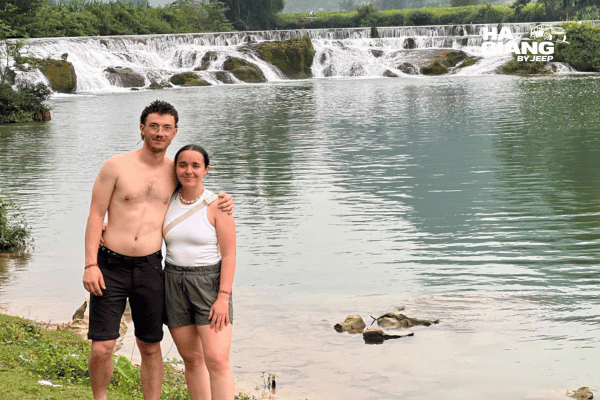
The reason most people come, and it earns the trip. Ban Gioc sits on the Quay Son River in Trung Khanh, and the border with China runs right through it. The falls drop in wide tiers across a shelf of rock, with rice fields on the Vietnamese bank and a viewing area close enough to feel the spray.
Bamboo rafts operate near the base when conditions allow, which is the best way to understand the scale. Go early in the day if you can. Late morning brings tour groups, and the light on the water is better before the sun climbs.
Nguom Ngao Cave
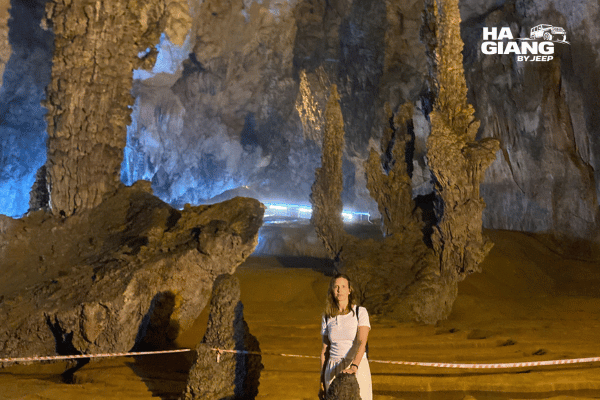
A short hop from Ban Gioc and a natural pairing with it. Nguom Ngao is a long, high ceilinged cave system with the kind of formations that keep photographers busy: curtains, columns, terraced pools. The walkway is lit and paved, which makes it manageable for older travellers and children, though it can be slippery in wet months. Sensible shoes matter more here than anywhere else on the trip.
God's Eye Mountain and the Ngoc Con Valley
God's Eye Mountain, known locally as Mat Than Nui, is a limestone peak with a natural window through it. In the dry season the plain below becomes grazing land where horses wander in front of the rock; in the wet season parts of it flood into shallow lakes. It is one of those landscapes that looks invented, and it has become the signature image of the Non Nuoc Cao Bang geopark.
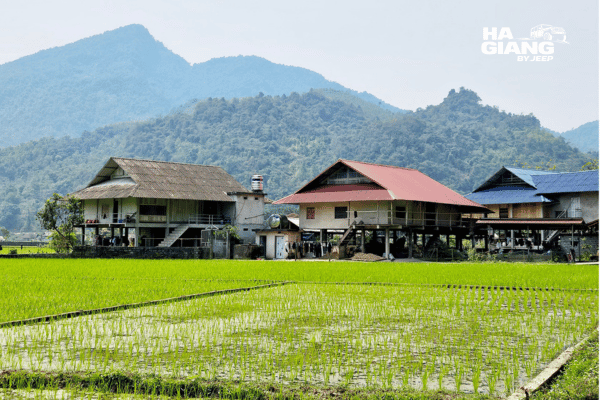
Nearby, the Ngoc Con and Phong Nam valleys follow the Quay Son River through hamlets, stilt houses and rice fields hemmed in by conical hills. There is no ticket gate and no set route. You stop where it looks good, which on a private trip means you can stop several times.
Pac Bo Historical Site
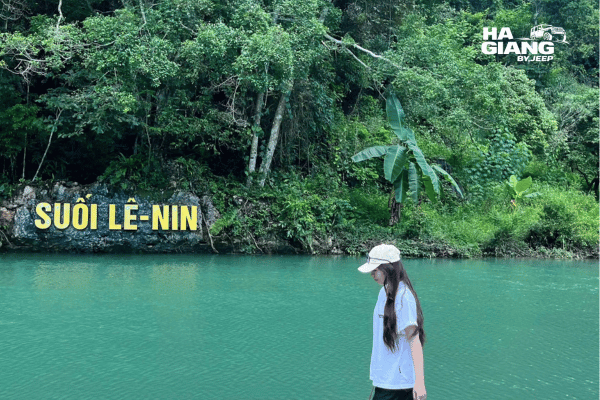
In the far north near the border, Pac Bo is where Ho Chi Minh returned to Vietnam in 1941 after decades abroad, and it carries real weight for Vietnamese visitors. Foreign travellers tend to arrive for the history and stay for the setting: a stream running an improbable turquoise through the trees, limestone cliffs above, and a quiet that feels deliberate.
Treat it as a place to walk slowly. Understanding what the site means to the people around you changes the visit considerably.
Thang Hen Lake and Ma Phuc Pass
Thang Hen is a mountain lake system sitting in a bowl of karst, with water levels that rise and fall through the year in a way that still surprises first time visitors. On the road between Cao Bang City and the lake country you cross Ma Phuc Pass, a classic switchback climb through rock walls that make a good introduction to how this province is put together.
The 15 Step Pass at Khau Coc Cha
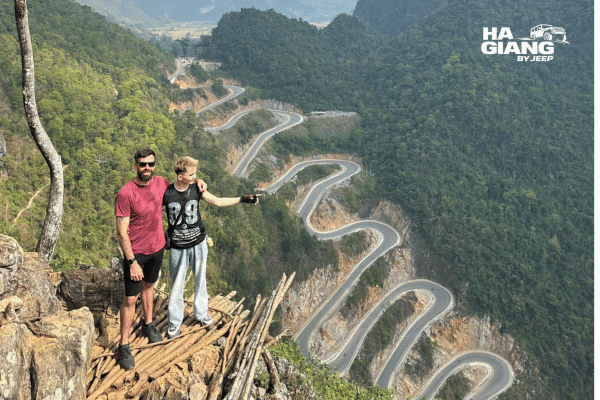
Out west near Bao Lac, this is the one that stops conversation in the vehicle. The road folds back on itself again and again up a steep flank, and from the viewpoint above you can count the tiers stacked below like a staircase. Anyone coming into Cao Bang overland from Ha Giang can build this into the route rather than making a special trip for it.
Phia Oac and the High Forest
In Nguyen Binh district, Phia Oac rises into a cool, mossy forest zone dotted with the ruins of colonial era villas. Winter brings mist, and on the coldest nights frost forms on the vegetation, which draws Vietnamese visitors up in numbers for a rare sight in the tropics. Access can be affected by weather, so check current conditions locally.
Cao Bang City
Small, walkable and pleasantly unglamorous. The city works as a base for the eastern half of the province and as the place to eat well, resupply and sleep in a proper hotel bed between homestay nights. The riverside is good for an evening stroll and the market is worth an hour in the morning.
Non Nuoc Cao Bang: What the Geopark Label Means
Non Nuoc Cao Bang became a UNESCO Global Geopark in 2018, joining Dong Van Karst Plateau in Ha Giang as the second such site in northern Vietnam. That designation is not just a badge for tourism brochures.
A geopark recognises a landscape where the geology, the ecosystems and the human culture built on top of them are managed together. In Cao Bang that means the caves, the lakes, the fossil rich limestone and the villages farming between them are treated as one connected story. Marked geopark routes thread through the province, and most of the landmarks in this Cao Bang travel guide sit on one of them.
The practical takeaway for a visitor: crossing from Ha Giang into Cao Bang links two UNESCO geoparks in one overland journey, and the transition between them is visible from the road as the rock changes shape and colour.
You do not have to be a geologist to notice it. Somewhere past Bao Lac the mountains stop looking like teeth and start looking like haystacks.
How Travellers Reach Cao Bang
Coming overland from Ha Giang
This is the route that makes the most sense if you are already doing the loop, and it turns a single province trip into a genuine crossing of the northern highlands. The road runs east through Meo Vac and Bao Lac before dropping into Cao Bang, and the scenery earns every hour of it. Our full breakdown of the eastern corridor covers what the drive is actually like and where the sensible overnight stops sit.
Coming from Hanoi
Cao Bang City is reachable directly from Hanoi by bus, including sleeper services, or by private car. Arriving this way puts you in the eastern half of the province immediately, which suits travellers who only want Cao Bang and are skipping Ha Giang entirely.
Getting around once you are there
Transport is the part of any Cao Bang itinerary that quietly decides how much you actually see. Public transport between the landmarks is thin, and the distances between them are the whole problem. Sights sit in different corners of a large province with limited connections. Most visitors solve this with a private vehicle and a driver who knows the roads, which also removes the guesswork around border area access and market day traffic.
A private jeep adds a specific advantage in Cao Bang: the good moments are unscheduled. A buffalo herd on a river crossing, a stretch of the Quay Son valley in perfect light, a village market you did not know was on. With your own vehicle you stop for all of it.
What to Eat in Cao Bang
The food here is distinct from Ha Giang and, quietly, one of the best reasons to spend extra days.
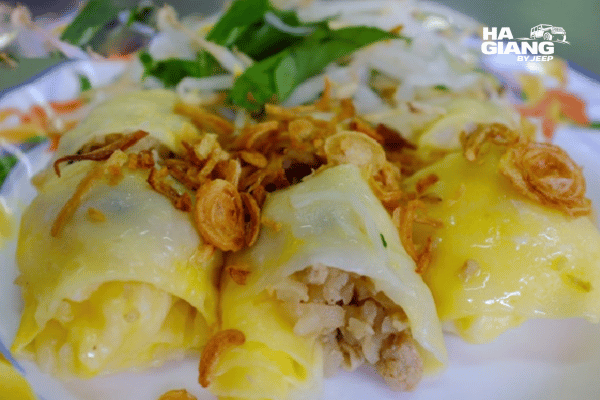
- Banh cuon Cao Bang. Steamed rice rolls served in a bowl of hot bone broth rather than dipped in fish sauce. The local version, usually with an egg cooked into the roll and a slice of pork sausage on top. Breakfast, and worth setting an alarm for.
- Pho chua. A cold, sour noodle dish layered with roast pork, peanuts, fried sweet potato and herbs, dressed rather than served in broth. Refreshing in warm weather and completely unlike the pho most visitors know.
- Vit quay bay vi. Seven flavour roast duck, marinated with a spice mixture and roasted until the skin lacquers. A Cao Bang signature and usually the best thing on a lunch table.
- Hat de Trung Khanh. Chestnuts from Trung Khanh district, roasted at the roadside in autumn. Small, sweet and seasonal.
- Banh ap chao. A deep fried winter snack of glutinous dough around a savoury filling, eaten hot with herbs and dipping sauce. Cold weather food, and it does the job.
- Ruou ngo. Corn wine, poured generously at homestay dinners. Local, strong, and offered as hospitality rather than a sales pitch.
That last one deserves a practical note. Corn wine at a homestay table is part of the evening, and the polite move is to accept a glass. Travelling with a driver means you can enjoy it without needing to think about the road afterwards, which is one of those small comforts you appreciate more than expected.
Where to Stay
For the purposes of this Cao Bang travel guide, accommodation splits into three kinds, and most good trips use more than one.
Cao Bang City hotels. Proper rooms, hot water, lifts, restaurants nearby. Best for arrival and departure nights, and for travellers who want at least one predictable bed in the trip.
Trung Khanh and the Ban Gioc area. Guesthouses, small resorts and homestays within reach of the falls. Staying out here is what lets you reach the waterfall early, before the buses arrive. For most itineraries this is the single most valuable overnight in the province.
Valley homestays. Wooden stilt houses in the Ngoc Con, Phong Nam and Quay Son valleys, usually family run. Simple, warm, and where the food is best. Facilities vary, and travellers who need a private bathroom should say so at booking time rather than hoping.
Book earlier than you think for autumn weekends and Vietnamese public holidays. Options near Ban Gioc are finite and fill quickly.
What to Pack
- Layers, and more than you expect. Mountain evenings are cold even when the days are warm, and Phia Oac in winter is a different climate entirely.
- A rain shell. Weather here changes fast in any season.
- Proper shoes with grip for the cave and the waterfall paths, both of which get slippery.
- Sun protection. Valley days are brighter and longer than they feel from inside a vehicle.
- Cash in small notes. Cards are unreliable outside Cao Bang City, and roadside food, market stalls and homestays run on cash.
- Passport, always on you near border areas.
- A power bank, plus any medication you rely on, since pharmacies in small towns will not stock foreign brands.
Paperwork, Border Areas and Rules That Change
Several of the province's best places sit close to an international border, and border zones are regulated. Requirements around access and permits do get updated, sometimes with little notice, and they can differ between locations.
Two honest pieces of advice. First, carry your passport with you throughout the province, not just at Ban Gioc. Second, do not rely on a travel blog, including this one, for the current state of any permit rule. Confirm with a local operator or the accommodation you booked, close to your travel date.
Tours that include border area stops normally handle the paperwork as part of the service. If you are travelling independently, build in a margin for the possibility that something requires an extra step on the day.
Mistakes First Time Visitors Make
- Giving the province one night. The classic error. The list of things to do in Cao Bang runs a lot longer than one waterfall: Ban Gioc alone justifies a night nearby, and the rest of the province justifies two or three more.
- Arriving at the waterfall at midday. Peak crowds, harsh light, and rafts at their busiest.
- Trusting exact driving times found online. Nobody can promise them here. Plan by half days, not by minutes.
- Assuming the geopark is one site. It is a network across the whole province, which is why transport planning matters so much.
- Skipping the west. Travellers who fly into Cao Bang City and stay east miss Bao Lac, Khau Coc Cha and the finest driving in the province.
- Underpacking for cold. Winter and high altitude nights catch people out every year.
- Booking accommodation near Ban Gioc late in autumn. It sells out, and the fallback is a long drive back to the city.
The Short Version of This Cao Bang Travel Guide
If you remember five things: give the province at least three nights, sleep near Ban Gioc and go to the falls at opening, combine Nguom Ngao with the waterfall in one loop, keep a full day for the God's Eye and Ngoc Con valley country, and check border area rules close to your travel date rather than in advance.
Which Jeep Tour Fits a Cao Bang Trip
Ha Giang Loop, short version
The classic loop for travellers on a tight schedule. Stays in Ha Giang, no Cao Bang.
View tour 4 daysHa Giang Loop, slower
Same loop at a gentler pace with more villages and time out of the vehicle.
View tour 5 daysHa Giang to Cao Bang
The efficient crossing: full loop, then east to Ban Gioc and the Cao Bang geopark.
View tour 6 daysHa Giang to Cao Bang, unhurried
Extra time in Cao Bang, daylight over the 15 step pass, and no rushed mornings.
View tour Self driveJeep Wrangler Rubicon rental
For confident drivers who want the mountains on their own terms, by the day.
View rentalCao Bang works best as the second half of a northern highlands journey rather than a standalone dash. Our 5 days and 6 days routes both cross from Ha Giang into Cao Bang and finish at Ban Gioc, which is the version most guests end up preferring once they see the map. The shorter loop tours stay in Ha Giang and suit travellers who are tight on time. Confident drivers who want the wheel themselves can look at Jeep Wrangler Rubicon rental instead.
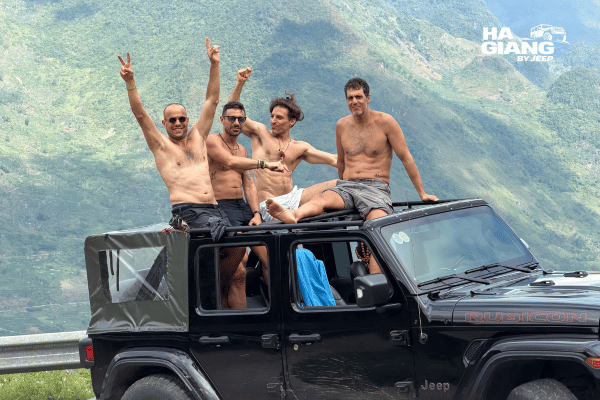
Every vehicle is private. No stranger sharing, no fixed departure schedule, and a local driver who grew up in these mountains and speaks English. The soft top goes on when the weather turns and the heating works, which matters more in a Cao Bang winter than any brochure lets on.
How to Book
Message us on WhatsApp or use the contact page with your dates, how many people are travelling and whether Cao Bang is the priority or the bonus. We will tell you honestly which route fits, including when the answer is a shorter tour than you asked about, and we will build the days around the parts of this Cao Bang travel guide you actually care about.
To confirm, we take 20% upfront to prepay homestays, driver and permits, with the remaining 80% in cash on arrival. That structure exists because the small family homestays and border area arrangements in this province need committing in advance, and it keeps the rest of your money in your pocket until you are here.
Most guests book one to three months ahead. Private jeep availability is limited in a way that motor traffic is not, so earlier is better, particularly for autumn.
Adventure without exhaustion
Ready to see Cao Bang properly?
Private jeep, English speaking local driver, homestays booked, border area paperwork handled. Tell us your dates and we will tell you honestly which route fits.
20% upfront to prepay homestays, driver and permits. The remaining 80% in cash on arrival.
Cao Bang Travel Guide FAQ
Three nights is the practical minimum to see the province properly, and four to five is better if you are coming overland from Ha Giang. A single night gets you Ban Gioc and very little else.
Yes, and it is one of the few famous sights in Vietnam that looks better in person than in photographs. The width of it is the surprise, and the setting of rice fields and karst around it does as much work as the falls themselves.
For maximum water, the summer wet months. For the best combination of strong flow, ripe rice and clear skies, late September into November. Winter gives you the quietest visit with lower water.
No. The province is well suited to travelling by private car or jeep with a local driver, which is how most families, couples and older travellers see it. Nothing on the list of highlights requires you to be behind the wheel.
Access rules for border areas can change, so confirm close to your travel date. Organised tours normally handle any paperwork required. Carry your passport with you regardless.
Yes. The walking involved at the main sights is moderate, the cave is paved and lit, and travel between the sights happens inside a vehicle with proper seats and a roof. Slippery surfaces at the cave and waterfall are the main thing to watch.
Overland through Meo Vac and Bao Lac, which is a full driving day of mountain roads and one of the better drives in Vietnam. Most people do it as part of a combined jeep tour rather than piecing together public transport.
No. Access is by road, either from Hanoi or across the mountains from Ha Giang.
Banh cuon in broth for breakfast, pho chua for a warm afternoon, and seven flavour roast duck at least once. Chestnuts if you are here in autumn.
That is the most popular way to do it. A combined route links two UNESCO Global Geoparks and finishes at Ban Gioc, which makes a stronger arc than returning to Ha Giang City the way you came.
Far less than Ha Giang, with the exception of Ban Gioc on weekends and holidays. Go early in the day and the difference is dramatic.
Cold, often misty, occasionally near freezing at altitude. Days can be bright and beautiful, evenings need real layers, and frost is possible at Phia Oac. A heated vehicle changes the experience completely.