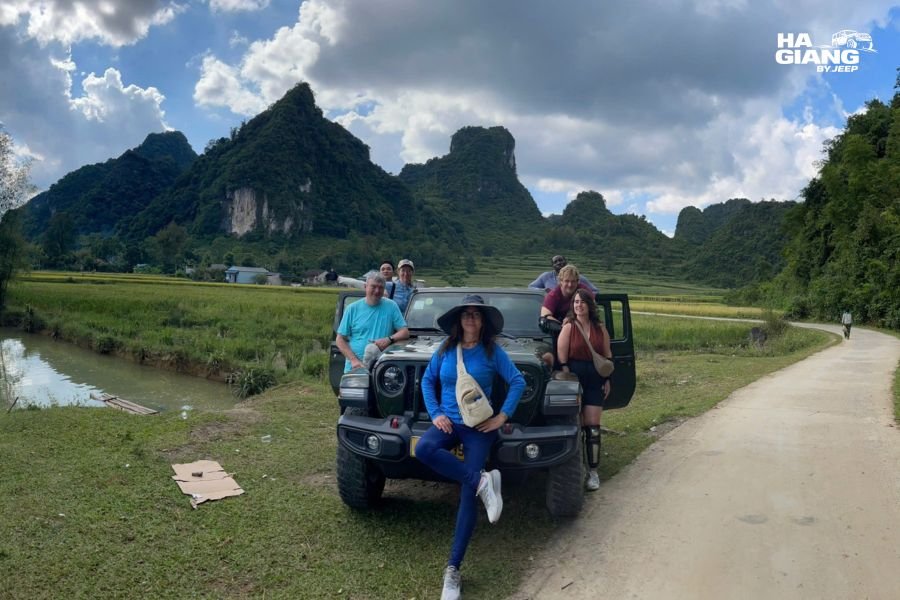
The classic Ha Giang Loop is a circuit. You start in Ha Giang City, travel north and east through the plateau, and return. Three days or four, you see Quan Ba, Yen Minh, Dong Van, Ma Pi Leng, and Meo Vac, and then you head south back to where you started.
That is a complete trip. Plenty of people do it and come home entirely satisfied.
But the road east from Meo Vac leads somewhere. So does the road west from Ha Giang City. And for travelers who have a day or two beyond the Loop, or who are planning the longer version from the start, those roads are worth understanding before the itinerary gets locked in.
Table of Contents
Three directions to extend Direction one: east to Cao Bang What Cao Bang actually offers The efficient case for going east Direction two: west to Hoang Su Phi Direction three: deeper in Ha Giang How to choose your extension The practical questions Two Geoparks in one trip Which jeep tour is right for you Frequently asked questions
Three Directions to Extend
Extensions to the Ha Giang Loop extension plan fall into three categories, each with a different character and a different cost in time.
East to Cao Bang. The road continues from Meo Vac through landscapes that change dramatically, ending at Ban Gioc Waterfall and the Non Nuoc Cao Bang UNESCO Global Geopark. This is the most commonly added extension, and the most efficiently done, because you are already heading that direction.
West to Hoang Su Phi. The other side of Ha Giang province, rarely seen on standard itineraries, with terraced hillsides on a scale that surprises people who think they have seen terraces.
Deeper in Ha Giang. Not covering more ground, but slowing down. Second nights in Dong Van, more time in Du Gia, the western plateau roads that the main Loop passes too quickly.
None of these are upgrades in the sense that one is better than another. They answer different questions depending on what you want out of extra days.
Direction One: East to Cao Bang
This is what most people mean by a Ha Giang Loop extension, and it earns its reputation.
The road east from Meo Vac leaves the bare stone plateau and enters a landscape that keeps changing. Where the Dong Van Karst Plateau is severe and grey, the country around Cao Bang is softer: limestone towers over rice valleys, rivers cutting through karst, forest coming back into the picture. You are still in the mountains. The mountains are doing something different.
Ngoc Con Valley. Nothing on the eastern plateau looks like this. The Non Nuoc Cao Bang UNESCO Global Geopark is the headline. Recognised alongside Dong Van as a Global Geopark, it covers a landscape of caves, towers, valleys and rivers that most international travelers have never heard of, which after four days on one of Vietnam's most visited routes is a particular pleasure.
What Cao Bang Actually Offers
Ban Gioc Waterfall
The landmark that appears in every guide to the northeast, and it earns it. The falls sit on the border with China, wide and tiered, with the volume and character changing completely between dry and wet season. If you arrive when the river is running full, it is genuinely one of the best waterfalls in Southeast Asia.
Ban Gioc: the waterfall changes completely between wet and dry season. The surrounding area is worth more than a stop. Bamboo groves, local boats on the river, the small village of Ban Gioc itself. The tourist infrastructure is light by comparison with Ha Giang, which adds to rather than subtracts from the experience.
Our Ban Gioc Waterfall guide explains how the season changes what you see.
Nguom Ngao Cave
Close to Ban Gioc and often visited the same day, a stalactite cave of unusual scale that takes an hour to walk through properly.
Nguom Ngao Cave, often done the same afternoon as Ban Gioc. God's Eye Mountain and Ngoc Con Valley
Nhìn Mắt Thần, God's Eye Mountain, is a limestone formation that looks at you from above whether or not you want it to. The valley below it, Ngoc Con, is one of those places that stops people mid sentence. Terraced fields, stone villages, the kind of quiet that Ha Giang used to have before the main route got busy.
God's Eye Mountain in the second Geopark of the combined trip. The 15 Step Pass
Khau Coc Cha, the 15 step pass, is a road that corkscrews down through hairpin after hairpin into a valley that opens below like a map. It does not look like anything else on the Ha Giang and Cao Bang route.
The 15 step pass. Nothing else on the northeast route looks like it. Pac Bo
Close to the Chinese border, a historical site where Ho Chi Minh returned to Vietnam in 1941 after three decades abroad. Significant to Vietnamese history and worth an hour, particularly if you travel with any interest in the twentieth century.
Pac Bo, where Ho Chi Minh returned to Vietnam in 1941. Cao Bang Town
The end of the extended trip, a provincial capital with a daily market, an evening food scene worth wandering, and the practical advantage of being a city from which getting back to Hanoi is straightforward.
Cao Bang town, the end of the extended trip and the start of the journey home. The Efficient Case for Going East
Here is the argument that settles most Ha Giang Loop extension decisions.
Reaching Cao Bang as a separate trip from Hanoi costs you two days of travel. Reaching it as a continuation of Ha Giang costs you almost none: you are already heading east, you finish in a different city, and you catch transport home from there.
For anyone who has Ban Gioc on their list at all, continuing east rather than doubling back is simply the more efficient route. You see more, you do not retrace road, and the whole journey has a shape rather than being a loop that returns to its own beginning.
This is the logic behind our 5 days Ha Giang and Cao Bang tour and 6 days Ha Giang and Cao Bang tour . Both pick up at the end of the classic Loop and keep going east, with the extra days deciding how much of Cao Bang you see and at what pace.
See the Ha Giang and Cao Bang tours
Direction Two: West to Hoang Su Phi
This one is less commonly done, which is partly what recommends it.
Hoang Su Phi sits in the western part of Ha Giang province, a few hours from Ha Giang City but in a completely different landscape from the eastern plateau. Where Dong Van is stone and severity, Hoang Su Phi is terraced rice on a scale that surprises people who thought the terraces around Sapa or Du Gia had prepared them.
Hoang Su Phi in the west. A different Ha Giang entirely. The people here are primarily La Chi, Dao and Hmong communities farming slopes that look physically impossible to farm. The roads are less travelled. The infrastructure is thinner. The experience is of a region where the visitor economy has not yet reshaped what you see.
The practical consideration is timing. Hoang Su Phi fits best at the start or end of a trip rather than as an add-on to the main Loop, because it sits on the west side of Ha Giang City while the classic Loop runs north and east. Doing both in one direction is possible with a custom route. Doing both as a complete loop extends the trip significantly.
Worth planning, worth asking about. Not a decision to make the day before you travel.
Direction Three: Deeper in Ha Giang
The third direction is not a direction at all in the geographical sense. It is more time in the same places rather than more places.
This is the extension that most itinerary articles miss, because extending an itinerary on paper usually means adding stops. Adding depth means removing them.
A Second Night in Dong Van
The single best way to extend the Loop experience without going anywhere new. Two nights in Dong Van means the first evening is arrival, and the second is yours. You walk the Old Quarter with nowhere to be. You sit in a place with good tea and stay until you want to leave. If a Sunday market falls on your second morning, you have the whole of it.
Du Gia Without the Clock Running
Du Gia appears on most four days itineraries as an afternoon on the way back to Ha Giang City. Given a full day, it becomes the most relaxed part of most people's trip.
Du Gia given a full day. The most relaxed part of most people's trips. A waterfall with a pool below it. A green valley that looks nothing like the plateau. Almost nothing to do, which turns out to be exactly what some travelers need on day four of a mountain trip.
The Tu San Canyon Boat Trip
Optional on most itineraries and almost never skipped by people who do it. The canyon is the deepest in Southeast Asia and dramatic from the road above.
Tu San Canyon from the road. From water level it is a completely different scale. From water level, looking straight up at walls of limestone, it is a different scale of thing entirely.
The Roads Less Driven
Between the main stops, there are roads that the standard loop passes through rather than stops on. Pho Bang, the small ochre-walled old town. Sung La valley and its stone houses. Bac Sum Pass on the way out of Ha Giang City. None of these require extra days, but they require stopping, which is easier when the day has slack.
How to Choose Your Extension
The right Ha Giang Loop extension depends on one question first: do you want variety or depth?
Variety: add Cao Bang. Two regions, two Geoparks, two sets of landscape, and a trip that goes somewhere rather than returning to where it started.
Depth: add time, not places. A second night somewhere, Du Gia with nothing scheduled, a morning that belongs to you.
Both: that is what a week looks like. Our guide to one week in Ha Giang sets out what seven days actually buys you and where the value starts to flatten.
A third consideration: if your time is genuinely limited and a Ha Giang Loop extension is not realistic on this trip, the standard 4 days Loop is already a better trip than a 3 days one. The extension converstation only matters once you have protected the fourth day.
Two Geoparks in One Trip
Most travelers going east do not plan it as a Ha Giang Loop extension at all. They plan a Ha Giang and Cao Bang trip, which is a different frame.
The distinction matters because it changes how the days get weighted. Thinking "I am extending the Loop" makes Cao Bang feel like an appendage. Thinking "I am crossing two UNESCO Global Geoparks in one continuous journey" makes both halves equal, which is closer to what they actually are.
Dong Van Karst Plateau Geopark and Non Nuoc Cao Bang Geopark are not the same place done twice. They are different ages, different geology, different water systems and different landscapes. Seeing both is not repetition. It is the longer version of a remarkable region.
The trip becomes: Ha Giang as the stone plateau, the cliff roads, the market towns at the northern edge of the country. Cao Bang as the river country, the caves, the valleys, the falls on the border. Two halves that make sense together precisely because they are different.
The Practical Questions
Do I need different permits for Cao Bang?
Parts of the Cao Bang route sit inside a border zone, as some of Ha Giang does. Reputable operators arrange both. Requirements are set locally and can change, so confirm current rules close to your travel dates rather than relying on any article, including this one.
Does extending cost much more?
Adding Cao Bang adds accommodation, food and vehicle costs for the extra days, plus the return journey from Cao Bang rather than Ha Giang. This is usually less than people expect because you are not paying for new logistical setup, only for more time.
Compare the full inclusions of a combined tour against the loop cost plus a separate Cao Bang trip and the combined tour almost always comes out better value.
Can I extend a tour I have already booked?
Sometimes. The key variables are whether accommodation in Cao Bang is available for your dates, whether your driver is available for the extra days, and whether border permits need additional processing. Raise it early rather than at the end of the Loop. We can check availability from the office in Ha Giang City, but the closer to your travel dates the less slack there is.
Is Cao Bang good in every season?
Ban Gioc is most dramatic with water running full, which is late summer and autumn. In dry season the falls thin. God's Eye Mountain and Ngoc Con Valley are less season dependent. Our best time to visit Cao Bang guide covers the trade offs by month.
How does the Cao Bang extension end?
The trip finishes in Cao Bang, not Ha Giang. That means the journey home to Hanoi is from Cao Bang, which is a different route and a different distance. Factor that into your onward travel.
The northeast highlands, beyond the Loop. The return road. Most extensions turn this into a continuation instead. Which Jeep Tour Is Right for You?
Ha Giang Loop, 3 days
Ha Giang Loop, 4 days
Ha Giang and Cao Bang, 5 days
Ha Giang and Cao Bang, 6 days
Jeep Wrangler Rubicon rental
Want to know whether an extension makes sense for your specific dates and group? Message us on WhatsApp and we will tell you honestly, including when the standard Loop is the better choice.
Secure Your Spot
Questions first? Contact us or message +84 938 988 593 on WhatsApp.
Frequently Asked Questions
What is the most common Ha Giang Loop extension? East to Cao Bang is the most common, and for good reason. It adds a second UNESCO Global Geopark, a different landscape and Ban Gioc Waterfall, and it is far more efficient to reach from Meo Vac than from Hanoi separately.
How many extra days does extending to Cao Bang take? The combined tour is five or six days, compared to three or four for the Loop alone. The fifth and sixth days are roughly where Cao Bang sits, depending on how much of the province you want to see.
Does the trip still start and end in the same place? No. The extended trips finish in Cao Bang rather than Ha Giang. Factor in the journey from Cao Bang back to Hanoi when planning your onward travel.
Is Cao Bang very different from Ha Giang? Yes, significantly. The eastern plateau is bare limestone and severe. Cao Bang is greener, more varied, with rice valleys, caves and rivers alongside the karst towers. Most travelers who see both say the contrast makes the combined trip stronger.
Can I add Hoang Su Phi to a standard Loop itinerary? It needs a custom route rather than a standard add-on, because Hoang Su Phi sits west of Ha Giang City while the Loop runs north and east. It works best as part of a designed trip rather than something added on arrival.
What if I want to extend but only have one extra day? One extra day adds Du Gia properly, or a second night in Dong Van, or the Tu San Canyon boat trip done without rushing. None of these reach Cao Bang, but all of them substantially improve the Loop experience.
Are the permits different for Cao Bang? Parts of the Cao Bang route also sit inside a border zone and require permits, which reputable operators arrange. Requirements can change, so confirm close to your travel dates.
Should I book the extension in advance or decide on the road? In advance, as early as you can. Accommodation in the smaller Cao Bang villages is limited, and border permits take time to arrange properly. Deciding on the road works occasionally in low season. In high season it usually does not.
What is the 15 step pass? Khau Coc Cha, a road that corkscrews through fifteen hairpin turns down into a valley. One of the most dramatic driving experiences on the extended route, and nothing like anything on the standard Ha Giang Loop.
What is God's Eye Mountain? Nhin Mat Than, a limestone formation in the Non Nuoc Cao Bang Geopark that looks like an open eye set into the hillside. Nearby Ngoc Con Valley is one of the quieter and more beautiful parts of the whole northeast.
Ha Giang by Jeep runs private 4x4 tours across the Dong Van Karst Plateau and Non Nuoc Cao Bang Geoparks, with English speaking local drivers and 24/7 support from our office in Ha Giang City. Email booking@hagiangbyjeep.com or WhatsApp +84 862 379 288.