Hmong Linen Weaving: A Living Craft in Ha Giang
The first thing you notice about Hmong linen weaving is the sound. A wooden loom being worked by hand has a rhythm to it, and in a village where several women are working, you hear the place before you see it.
The second thing you notice, if you stay long enough to watch properly, is how much work is in a single scarf. From a hemp seed in the ground to a finished piece of indigo cloth is a process with something like a dozen distinct stages, most of them done by hand, spread across months.
This guide walks through that process, explains where to see it in Ha Giang, and covers how to visit the people doing it without turning their workplace into a photo opportunity.
What is in this guide
- Linen or hemp? Clearing up the name
- Why this craft exists here
- Growing and harvesting the hemp
- From stalk to thread
- Weaving
- Beeswax batik
- Indigo dyeing
- Finishing the cloth
- Where to see it: Lung Tam and beyond
- Visiting the weavers respectfully
- Buying, briefly
- Which jeep tour suits you best
- FAQ
Linen or Hemp? Clearing Up the Name
You will see this cloth called linen everywhere, including on the sign at the village and in this article's title, because that is the established English name in Vietnam. The fibre is actually hemp.
Linen in the strict sense comes from flax. Hemp is a different plant with a similar fibre and a similar processing route. The Vietnamese word used locally is lanh, which gets translated as linen, and the name stuck.
A question travelers ask constantly. Yes, hemp is botanically related to cannabis. The fibre varieties grown for textiles are cultivated for stalk and fibre, not for anything else, and hemp has been a textile crop across Asia and Europe for a very long time. Cultivation in Vietnam is subject to regulation, which is a matter for local authorities and farmers rather than something a tour company should be explaining. If the legal detail interests you, that is a question for an official source, not a blog.
So: the sign says linen, the plant is hemp, and the cloth is the same thing either way.
Why This Craft Exists Here
Understanding the geography explains the craft.
The Dong Van Karst Plateau is limestone. Soil sits in pockets between rocks, families sometimes carry earth uphill by hand to fill those pockets, and water is scarce for much of the year. It is not country that supports cotton.
Hemp grows in it. The plant is undemanding, grows fast, and produces a strong fibre from a tall thin stalk that does not need much ground.
So Hmong households grew hemp, and clothing came from the field the same way food did. Cloth was not something you bought. It was something a family made, and the skill passed from mother to daughter as a normal part of growing up.
What that means for what you are looking at. These are not craft objects made for a market. They are a clothing tradition that has been partly redirected toward visitors in the last few decades. The patterns mean things. The garments have uses. A traveler buying a scarf is buying a piece of something that existed for its own reasons long before anyone was selling it.
And it is changing. Manufactured cloth is cheap and available. Younger people have other work. The craft survives partly through cooperatives that give it an income, which is the honest reason visiting and buying matters rather than a sentimental one.
Growing and Harvesting the Hemp
The cycle starts in the ground.
Hemp is sown, grown tall and thin so the stalks produce long fibres, then cut and dried. Drying happens in the open, and bundles of pale stalks leaning against houses and fences are a common sight in villages across the plateau.
Timing varies with altitude, weather and household, and we are not going to publish a planting calendar, because the answer differs from valley to valley and year to year. If you want to see a specific stage of the process, ask before you travel and we will tell you what is likely to be happening.
What you can see at any time of year is some part of the chain. Because the process is long and households work at their own pace, there is almost always somebody stripping fibre, spinning, weaving or dyeing, whatever the season.
See the craft, not just the viewpoint
A weaving village stop needs an hour that a tight itinerary does not have. Tell us what interests you and we will tell you honestly which trip length fits it in.
WhatsApp us See the 4 Days LoopFrom Stalk to Thread
This is the part that takes the most work and gets the least attention.
- Stripping. Dried stalks are split and the outer fibre pulled away by hand. It is repetitive work and it is hard on the hands.
- Splitting and joining. The fibres are separated down to a workable thinness, then joined end to end into a continuous length, without knots that would show in the finished cloth. This is the stage you will most often see women doing while sitting outside, talking, or walking. It fills the gaps in a day the way knitting does elsewhere.
- Softening. The joined fibre is boiled and pounded to soften it, sometimes repeatedly, until it is pliable enough to spin.
- Spinning. A hand or foot driven spinning wheel twists the fibre into thread and winds it onto a spindle.
- Preparing the warp. The long threads that run the length of the cloth are measured out and arranged in order before they go on the loom. This is fiddly, and getting it wrong is expensive in time.
The reason to know all this is simple. When you watch someone weaving, the loom is the last stage of many. Most of the work already happened.
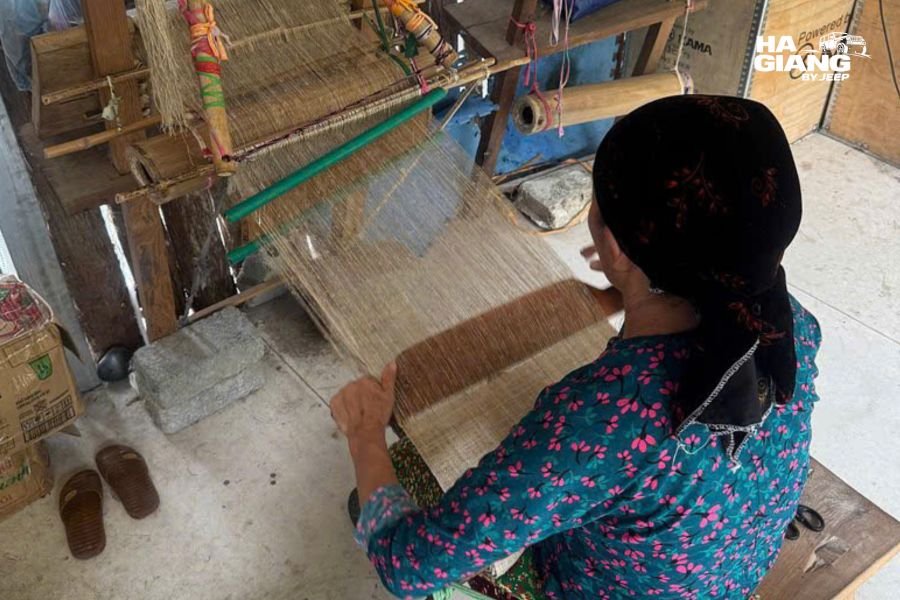
Weaving
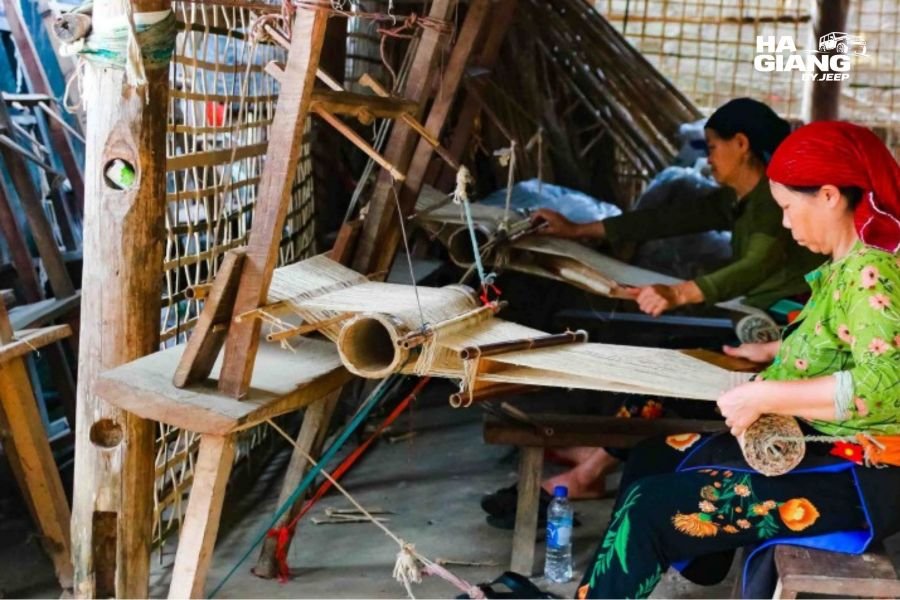
The looms are wooden, worked by hand and foot, and often old.
The weaver sits at the frame, works the treadles to lift alternating threads, and passes the shuttle carrying the crosswise thread through the gap. Then beats it into place. Then again. The width of the cloth is set by the loom, which is why traditional hemp cloth comes in relatively narrow lengths that are joined for larger pieces.
It is slower than it looks. A finished length represents days of work at the loom alone, on top of everything in the previous section.
Watch the hands and the feet. The rhythm is the thing. It is one of the few crafts where sitting and watching for ten minutes teaches you more than any explanation.
The plain cloth is the base. Everything that follows, batik, dyeing, embroidery, happens to cloth that has already been woven.
Beeswax Batik
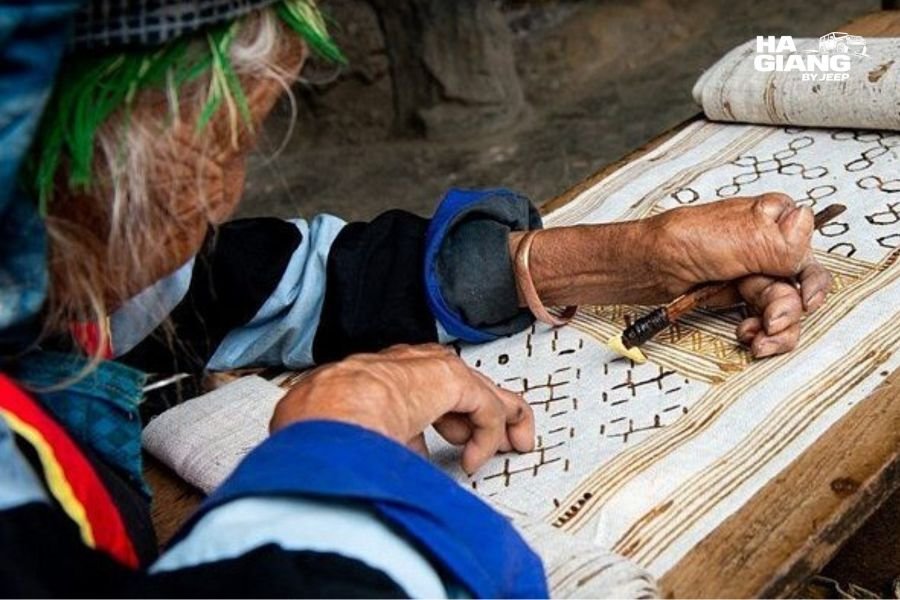
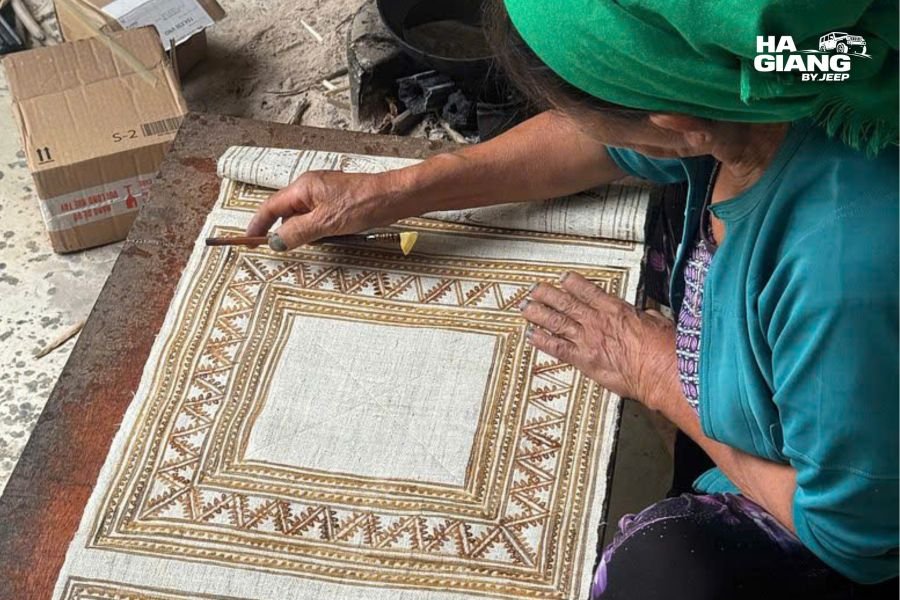
The patterns you see on Hmong cloth are often made by a resist method using wax, and watching it done is the most surprising part of the whole process for most visitors.
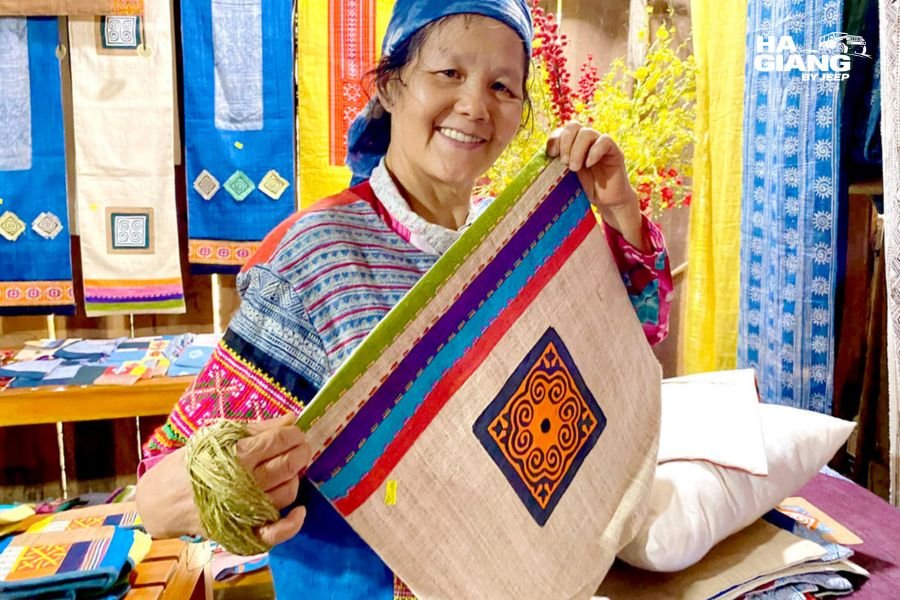
How it works. Molten beeswax is drawn onto the plain cloth with a small metal tool, freehand, in fine lines and geometric patterns. Where the wax sits, dye cannot reach. The cloth is then dyed. Afterwards the wax is removed, and the pattern appears in the undyed colour against the dyed ground.
It is done freehand. No stencil, no printing, no transfer. The geometry comes from practice and memory, and the patterns carry meaning within the community rather than being decoration invented for a market.
How to spot it in a finished piece. Look closely at the lines. Hand drawn wax lines vary very slightly in width, and you can often see where the tool was lifted and set down again. Printed cloth is perfectly uniform.
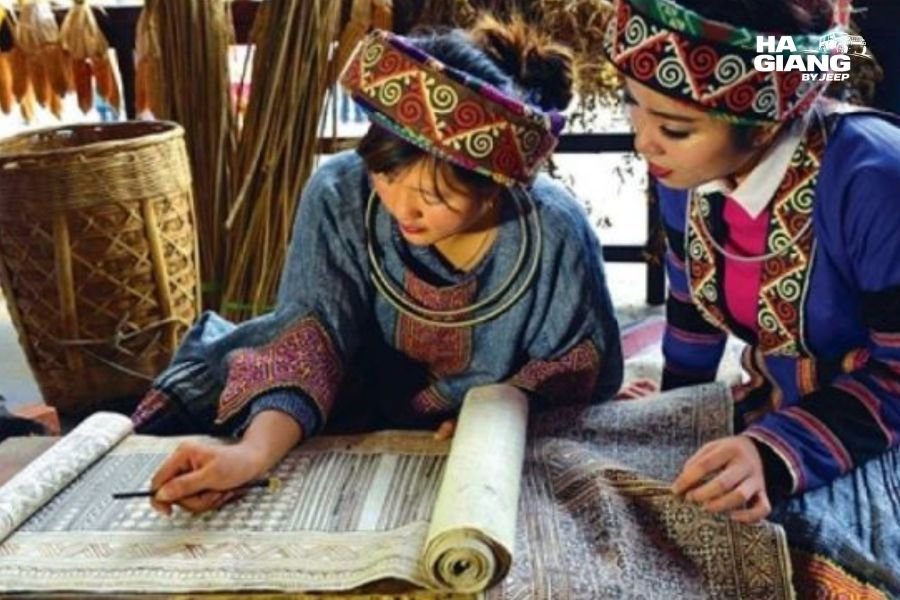
Embroidery is a separate thing. Stitched patterns are added by hand to cloth as well, and a single garment can combine woven structure, wax resist patterning, indigo dyeing and embroidery. Turning a piece over and looking at the reverse is the quickest way to understand what you are holding.
Indigo Dyeing
Indigo is the colour most people associate with Hmong textiles, and there is a reason it looks the way it does.
It is a plant dye. Indigo plants are grown, harvested and processed into a dye vat. The chemistry is old and the maintenance of a vat is a skill in itself.
Colour builds through repeated dips. Cloth is dipped, taken out, allowed to oxidise in the air, and dipped again. Each cycle deepens the colour. The very dark, almost black blues that Hmong clothing is known for come from many repetitions over a long period.
It stains everything. Dyers' hands are stained blue, and that is a normal working sight in a village doing this. It also means new indigo cloth transfers colour onto skin and other fabrics, especially when damp. Wash a new piece separately.
The sheen is deliberate. Some finished Hmong cloth has an almost metallic shine, and that is a finishing step rather than a property of the dye.
Finishing the Cloth
Two finishing steps are worth knowing about because they explain how the cloth feels in your hands.
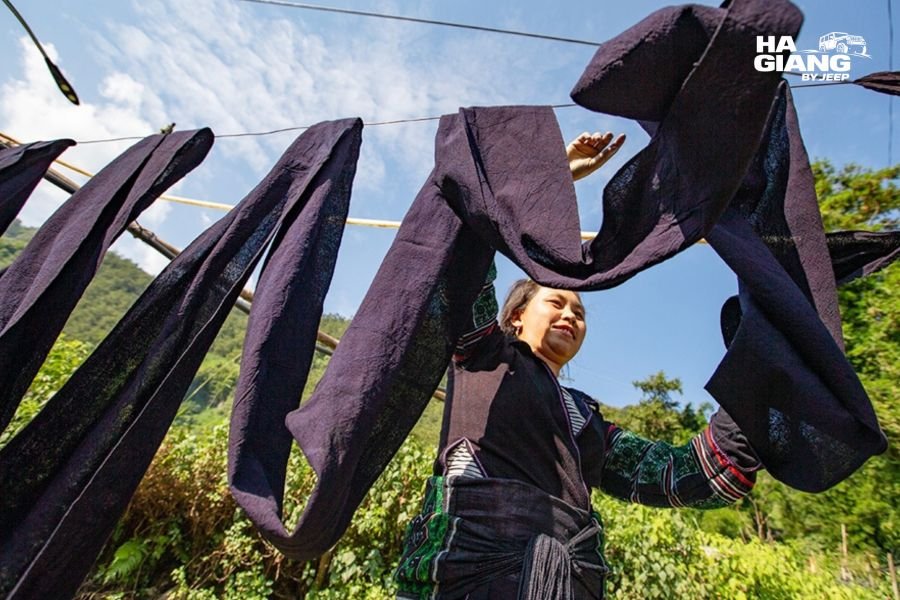
Beating and polishing. Dyed cloth is laid on a smooth stone and worked with a heavy roller, often by standing on a curved wooden block and rocking. This compresses the fibres, softens the cloth, and produces the sheen mentioned above. It is physical work and it goes on for a long time.
Washing and drying. Repeated, in the open, which is why lines of dark blue cloth outside houses are such a common sight in villages on the plateau.
After that the cloth is cut and made into whatever it is going to be: clothing, bags, scarves, panels, or lengths sold as they are.
The count, roughly. Growing, drying, stripping, joining, softening, spinning, warping, weaving, waxing, dyeing, dewaxing, beating, washing, sewing. Fourteen stages, most of them by hand, most of them done by women, spread across months. That is what a scarf is.
Where to See It: Lung Tam and Beyond
Lung Tam Linen Village, in the Quan Ba area, is the best known place in Ha Giang to see this craft. It is organised around a women's cooperative that has become the main reference point for hemp weaving in the province, and it exists in large part to give the craft an income so it survives.
What a visit involves. Seeing stages of the process, watching people work, and a shop area with finished goods. It is a working place, not a museum, and what you see depends on what is being done that day.
Give it an hour. Twenty minutes gets you a photograph. An hour gets you the process, and the process is the reason to come.
Beyond Lung Tam. Weaving is not confined to one village. Households across the plateau do this, and you will see stripping, spinning and drying cloth in villages all along the Loop route: around Quan Ba, Yen Minh, Sung La, Pho Bang and Du Gia. Those are not places you visit for the craft. They are places where you notice it if you are looking.
At markets. Dong Van on Sunday morning and Meo Vac on Sunday morning both have textile sellers, and market days are where you see the cloth in use rather than on display: worn, carried, traded between local people.
Visiting the Weavers Respectfully
This is a workplace and a home. Behave accordingly.
- Ask before photographing anyone. Chụp ảnh được không, roughly choop ang duc khom. Two seconds, and it changes the interaction from taking to sharing. Accept a no immediately and cheerfully.
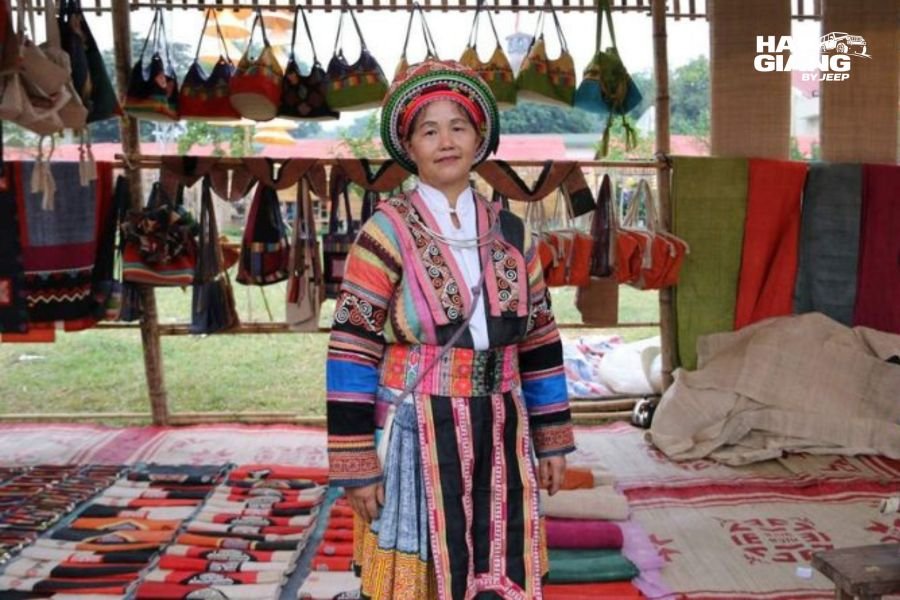
- Older women in traditional dress are photographed relentlessly at places like this. Do not add to that without asking. If someone agrees, stay a moment, show them the picture, say thank you.
- Do not touch work in progress. Thread under tension, wax at temperature, cloth in a dye vat. Ask first.
- Do not interrupt to get a better angle. If someone stops working because you are standing there, you are in the way.
- Ask questions through your driver. This is where a local driver earns his place. A translated conversation about what a pattern means, how long a piece took, or who taught the weaver is worth more than any amount of photography.
- Buy something. The single most useful thing a visitor does. Even something small.
- Do not haggle hard. You have just watched fourteen stages of hand work. Grinding somebody down over a small sum after that is not a good look.
- Do not wear traditional dress that is not yours for photographs. Dressing up in another community's clothing for your holiday album lands badly, whatever the intention.
- Children may be present. They live there. Do not photograph them without a parent present and agreeing, and do not give them money or sweets.
Buying, Briefly
Kept short here because our Ha Giang souvenirs guide covers shopping properly, including what else is worth buying in the region and what to check before flying home with it.
- Buy at the village or a cooperative where you can, so more of what you pay reaches the person who made it.
- Check the reverse of any embroidered piece. Hand work shows knots, thread ends and small irregularities. Machine or printed work is uniform on both sides. Both are sold, sometimes side by side, and neither is a scam. Buy knowingly.
- Expect indigo to transfer when the cloth is new or damp. Wash separately at first.
- Small pieces travel best. Scarves, runners, cushion covers. Light, squashable, and they get used, which large pieces often do not.
- Bring small notes. Sellers frequently cannot break a large one.
Which Jeep Tour Suits You Best
Craft stops are a time question. The villages are on the route, but stopping properly costs an hour that a compressed itinerary does not have.
| Option | Weaving village access | Best for |
|---|---|---|
| 3 Days 2 Nights Loop | Possible as a short stop, roadside weaving visible in passing | Short trips, Ma Pi Leng and Dong Van |
| 4 Days 3 Nights Loop | The sensible choice, room for Lung Tam plus a market morning | Travelers who want villages and craft, not just viewpoints |
| 5 Days 4 Nights to Cao Bang | Ha Giang craft plus Tay villages in Cao Bang, two textile traditions | The Loop plus Ban Gioc and the Quay Son valleys |
| 6 Days 5 Nights to Cao Bang | Most time for villages, markets and unplanned stops | The unhurried version across two Geoparks |
| Jeep Wrangler Rubicon rental | Total freedom on where you stop | Confident self drivers |
Three things worth naming about doing this with a driver from the region.
He can ask the questions you cannot. Almost everything interesting about this craft is in the answers, and almost none of it is written on a sign. Without translation a weaving village visit is watching. With it, it is a conversation.
He knows where it is happening. Lung Tam is the organised stop. The unplanned ones, a woman joining fibre on a doorstep in Sung La, cloth drying at a house near Pho Bang, are what people remember, and you need somebody who can pull over when he spots one.
The purchases go in the vehicle. Not carried, not strapped, not rained on. You buy a length of cloth at nine in the morning and forget about it until you unpack.
There is also the plain point that this is a stop that suits families and older travelers unusually well. It is indoors or under cover, involves no walking to speak of, and is genuinely interesting to people who have run out of enthusiasm for another viewpoint.
Build a trip with room for the villages
Tell us your dates and whether craft and markets matter to you. We will tell you which itinerary has room for Lung Tam and which does not. Book early once your dates are set, jeep availability is limited and most guests book 1 to 3 months ahead.
WhatsApp us Book now Contact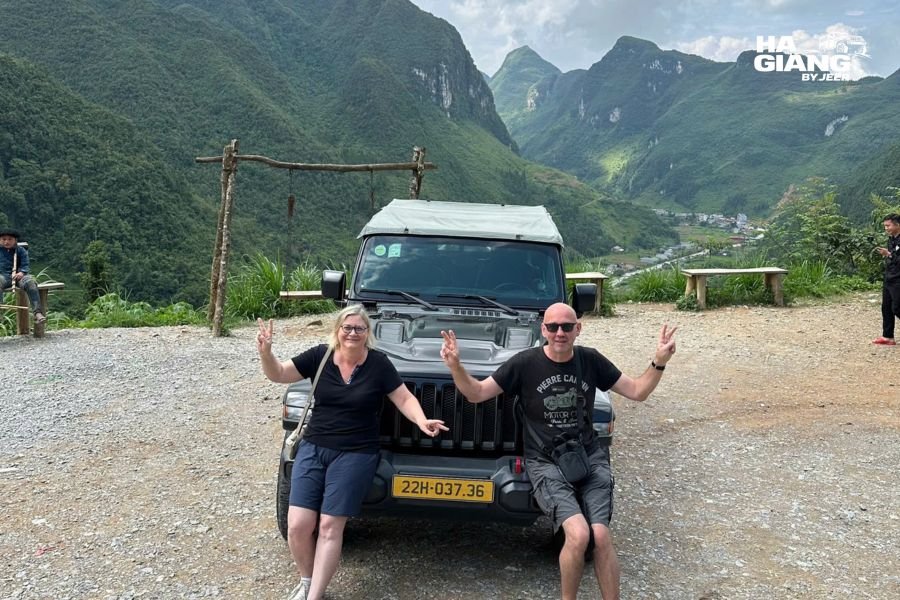
Frequently Asked Questions
What is Hmong linen weaving?
It is the traditional Hmong textile craft of northern Vietnam, in which hemp is grown, stripped, spun, woven, patterned with beeswax, dyed with indigo and finished by hand. It is called linen locally, though the fibre is hemp.
Is Hmong linen actually linen?
No. Linen in the strict sense comes from flax, while this cloth is hemp. The Vietnamese word lanh gets translated as linen and the name stuck.
Is the hemp related to cannabis?
Botanically yes, but the varieties grown for cloth are fibre crops raised for their stalks, as hemp has been across Asia and Europe for a very long time. Cultivation is subject to local regulation, which is a matter for official sources rather than a tour company.
Where can I see Hmong linen weaving in Ha Giang?
Lung Tam Linen Village in the Quan Ba area is the best known place, organised around a women's cooperative. You will also see stages of the process in villages across the plateau and textiles for sale at the Dong Van and Meo Vac Sunday markets.
How long does it take to make a piece of hemp cloth?
The full process runs to roughly fourteen stages, from growing the hemp to finishing the cloth, most of them by hand and spread across months. Weaving itself is only the middle of it.
Why is the cloth blue?
Indigo, a plant dye built up through repeated dipping and oxidising. The very dark blues come from many cycles, which is why they take so long to produce.
Does the indigo rub off?
Yes, particularly when the cloth is new or damp. Wash it separately the first few times and do not pack it against light coloured clothing.
How do I tell handmade from machine made?
Look at the reverse. Hand embroidery shows knots, thread ends and small irregularities, and hand drawn wax lines vary slightly in width. Machine and printed work is uniform. Both are sold, so buy knowingly.
Can I take photos at a weaving village?
Ask before photographing anyone, accept a no cheerfully, and do not touch work in progress. Wide shots of the workshop and the cloth need nobody's permission.
Is Lung Tam worth visiting?
Yes, if you have an hour. Twenty minutes gets you a photograph of a loom. An hour gets you the process, which is the reason to go.
Can I try weaving myself?
Sometimes visitors are shown a stage or invited to try something, but this is a working place rather than a workshop programme, and it depends entirely on the day. Ask rather than expect.
Which tour includes Lung Tam?
It sits on the Loop route near Quan Ba, so any itinerary can pass it, but stopping properly needs an hour. The 4 days Loop is the sensible minimum for a real visit rather than a photo stop.