
Truc Lam Phat Tich Pagoda: The Ban Gioc View Most Visitors Miss
Everyone photographs the waterfall from the bank. Almost nobody climbs the hill behind it and looks down.
Truc Lam Phat Tich Pagoda sits on a hillside above the valley at Ban Gioc, in Trung Khanh district, Cao Bang province. Most people arrive at the waterfall, spend an hour at water level, and drive away without knowing the pagoda is there.
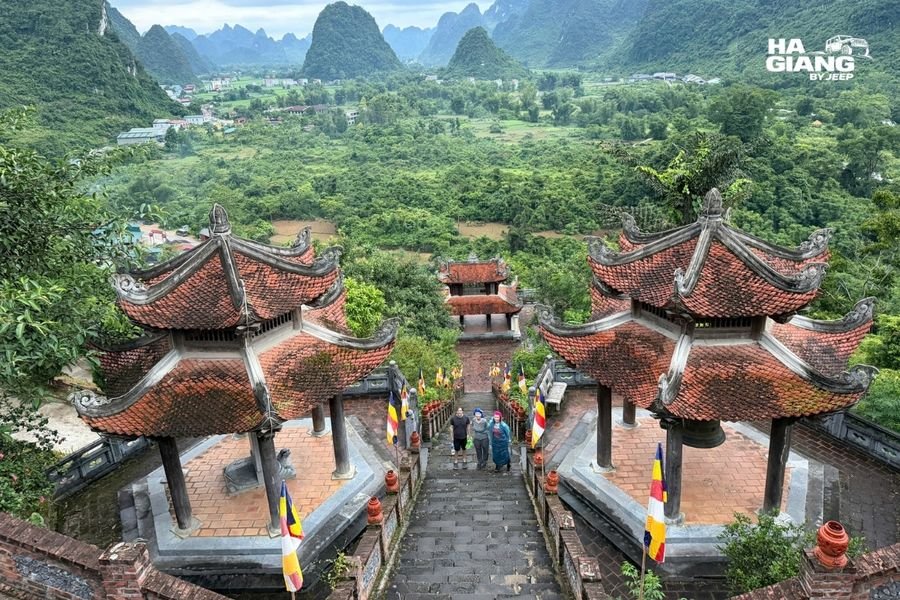
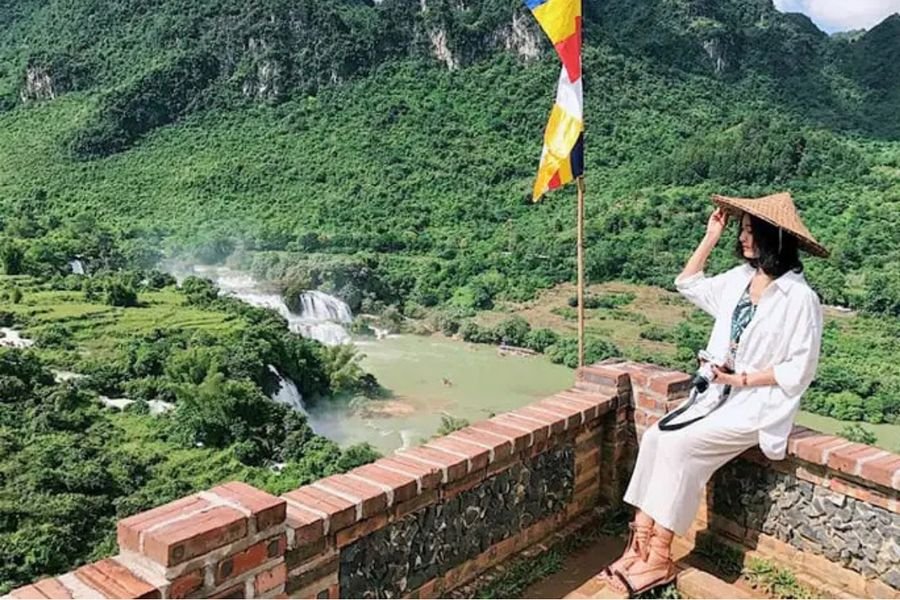
That is a missed opportunity for a simple reason. From the terraces of the pagoda you look down over the whole valley: the Quay Son River, the rice fields, the karst hills stacked behind each other, and the waterfall in its setting rather than filling the frame. It is the only elevated view of Ban Gioc that a visitor can easily reach, and it is a fifteen minute detour.
It is also a working Buddhist pagoda where people come to pray, so this guide covers how to be there properly as well as what to look at.
What is in this guide
- Why this is worth the stop
- What Truc Lam Phat Tich Pagoda is
- A short word on Truc Lam Zen
- What you actually see
- The view, which is the practical reason to come
- How much walking it involves
- How to visit a working pagoda
- Timing it with Ban Gioc
- Practical notes
- What this page will not tell you
- Which jeep tour is right for you?
- FAQ
Why this is worth the stop
Three reasons, in the order that will matter to you.
The view. Covered properly below, and it is the main practical argument. Ban Gioc from the ground is impressive and slightly hard to read, because you cannot see how it sits in the valley. From the pagoda you can.
It is quiet. The waterfall car park is the busiest place in Cao Bang province. The pagoda, a short drive up the hillside, usually is not. If the crowd at the falls has worn you down, this is the antidote and it is ten minutes away.
It is a genuinely interesting building. Traditional Vietnamese pagoda architecture, built recently and built well, in a spectacular position. If you have been through Ha Giang and Cao Bang looking at limestone and villages, this is a different kind of thing to look at.
What Truc Lam Phat Tich Pagoda is
A Buddhist pagoda in the Truc Lam Zen tradition, built on the hillside above the Ban Gioc valley near the Chinese border.
It is a modern construction in traditional style, completed in the 2010s, and it is often described as the first pagoda built in this border area of Cao Bang. The architecture follows classical Vietnamese pagoda form: a three entrance gate, terraces climbing the hillside, a main hall, a bell tower, an ancestral house and statue areas, all under tiled roofs with curved eaves.
It is not a ruin and it is not a museum. Monks and lay visitors use it, incense burns, and on significant days it is busy with worshippers rather than tourists.
The setting is the point. Sited where it is, the pagoda functions as a lookout as much as a place of practice, and it was clearly built with that in mind.
A short word on Truc Lam Zen
Brief, because this is a jeep company blog and not a religious studies page, but worth knowing because most foreign visitors do not.
Truc Lam is a distinctly Vietnamese school of Zen. It was founded in the thirteenth century by Tran Nhan Tong, a Vietnamese king who abdicated the throne, became a monk and established the tradition. That origin is unusual enough to be worth pausing on, and it is why Truc Lam occupies a particular place in Vietnamese Buddhism rather than being an import.
The tradition has seen a substantial modern revival, and Truc Lam monasteries and pagodas have been built across the country in recent decades. This one is part of that network.
That is as far as we go on doctrine. We are not going to explain Buddhist practice on a tour operator's website. If it interests you, read properly, and ask your driver, who will know a great deal more than this page does.
What you actually see
The site climbs the hillside in terraces, so you walk up through it.
The three entrance gate. The tam quan, at the bottom of the approach. Traditional form, three openings, and the first thing you photograph.
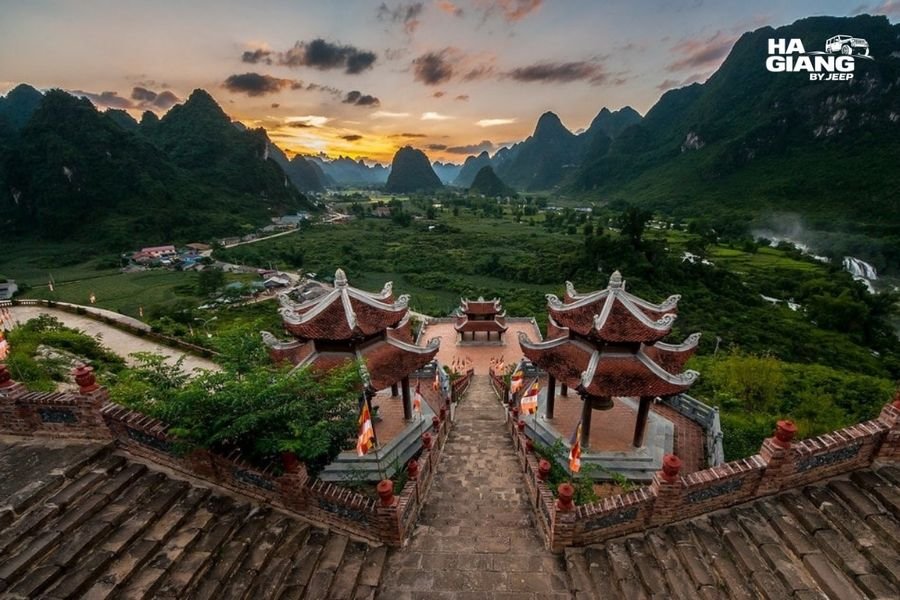
The terraces and steps. Stone steps climbing between levels, with trees either side and the valley opening out further with every flight. This is where the walking is.
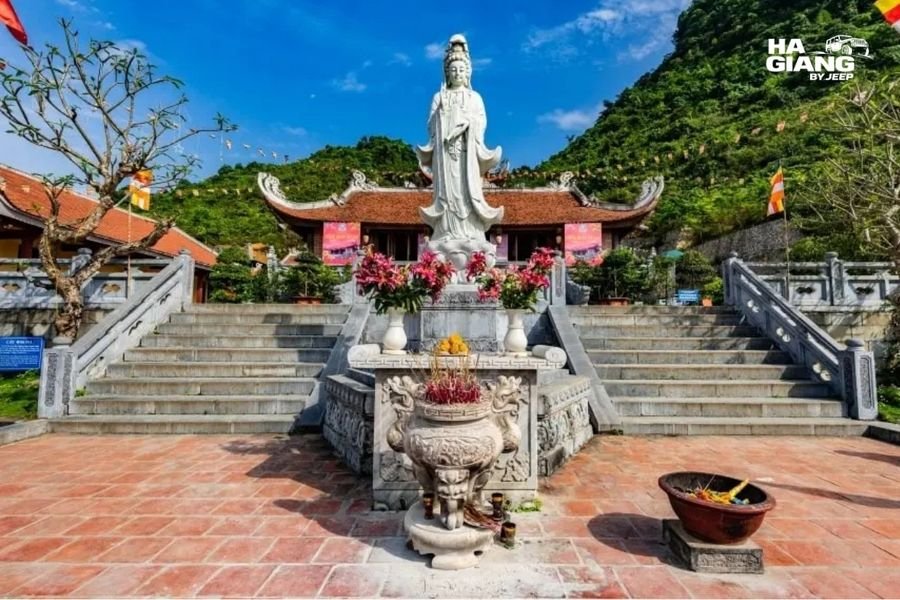
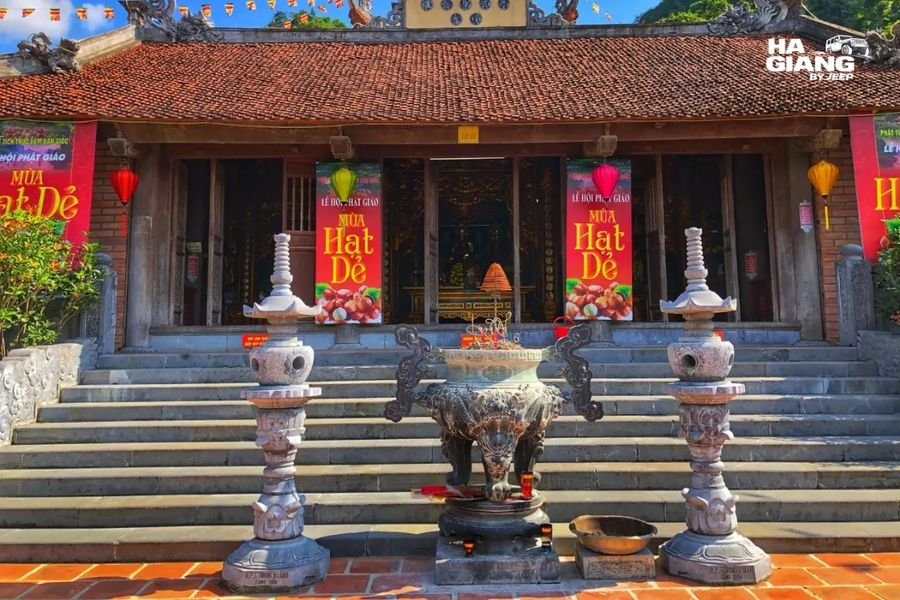
The main hall. The central building, with a tiled roof and curved eaves, statuary inside, and the standard arrangement of a Vietnamese pagoda. Take your shoes off where indicated and follow what other people do.
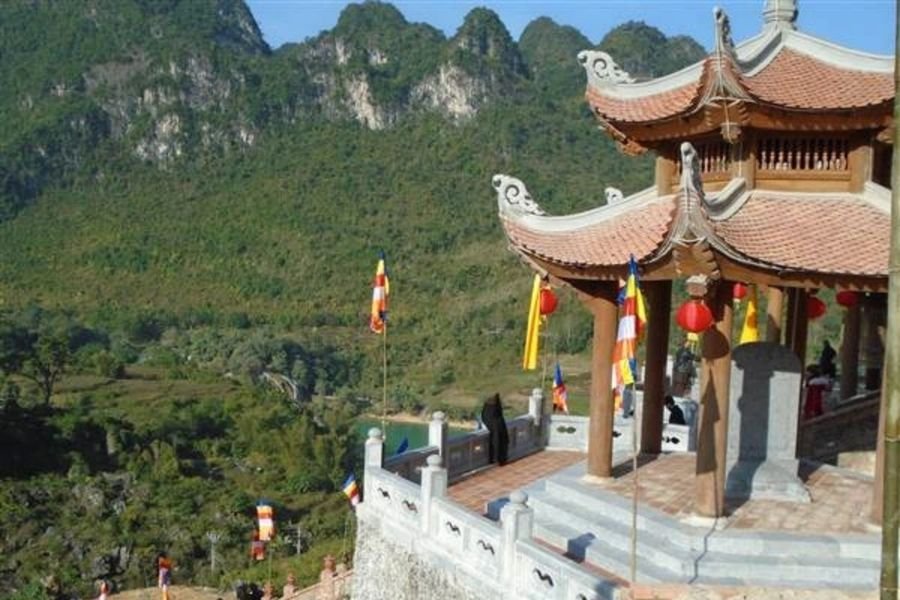
The bell tower. Housing a large bronze bell. Look, do not ring.
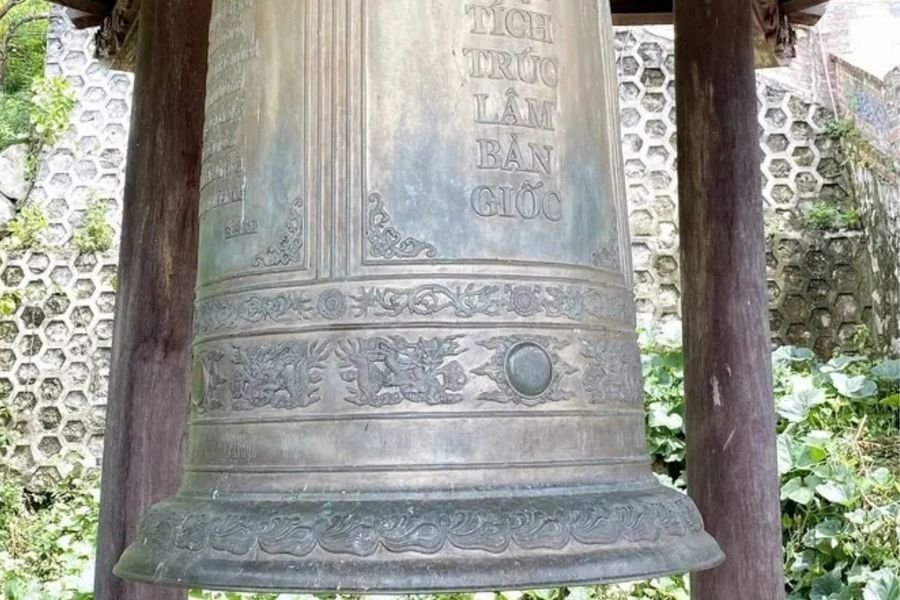
Statue and courtyard areas across the terraces, with places to sit.
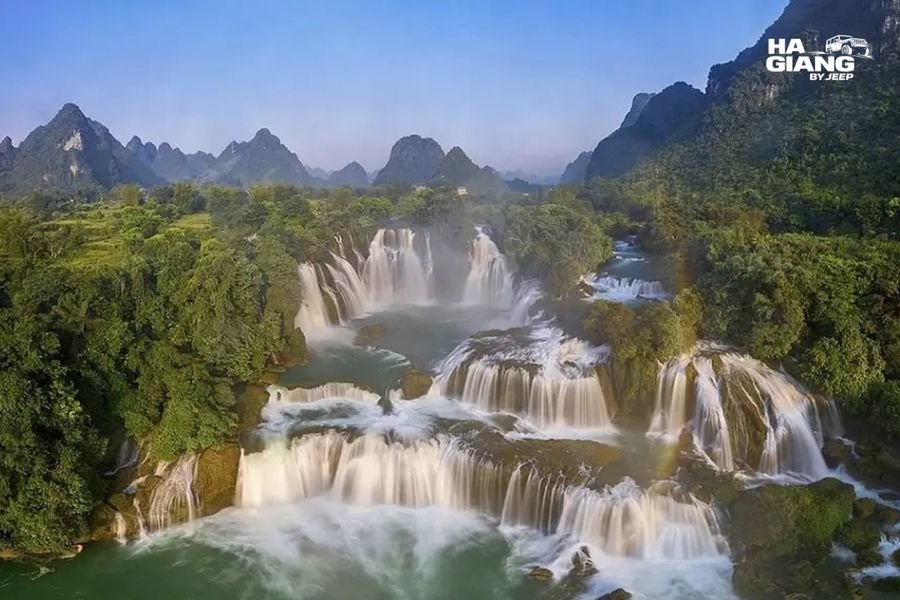
Incense and offerings. Burning most days. This is the part that tells you it is a working site rather than a monument, and it is worth noticing before you start photographing.
Going to Ban Gioc and want the pagoda in the plan?
Tell us at booking. It is a short detour but it needs half an hour built into the day rather than being squeezed in at the end.
The view, which is the practical reason to come
The section to read if you skip everything else.
What you see from the upper terraces: the Quay Son River curving through the valley floor, rice fields laid out on both banks, karst hills receding behind one another, and the waterfall area below. On a clear day it is the best wide view in this corner of the province.
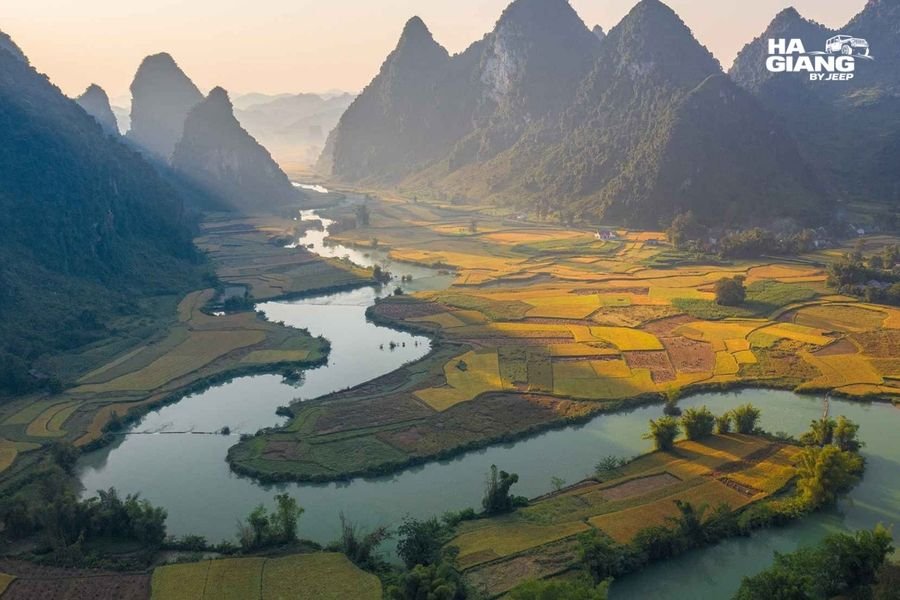
Why it is different from the ground view. At the falls you stand at water level looking across. Everything is close, loud and impressive, and you cannot see the shape of the landscape it sits in. From the pagoda you get the shape: the river coming in, the valley opening, the border hills behind. It reads as a place rather than as a photograph.
For photographers. Two genuinely useful notes. This is a wide and layered composition rather than a detail one, so it suits a longer lens for compressing the karst layers and a wide for the whole valley. And it is a completely different palette from the falls themselves, which means a Ban Gioc morning gives you two distinct sets of images rather than twenty versions of one. Our photography guide covers light and timing across the region.
Weather note. The valley holds haze and low cloud, and in the wet months the view can close in entirely. That is worth knowing rather than worth worrying about, because the pagoda in mist is its own thing.
How much walking it involves
Same treatment we give every stop, because guests ask and a vague answer is useless.
| Part of the site | Effort | What is involved |
|---|---|---|
| Entrance gate and lower terraces | Low | Level or gently graded, paved |
| Climbing between terraces | Moderate | Stone steps in flights, with landings and places to sit between them |
| Reaching the upper terraces and the best view | Moderate | The most steps, and where the view is. Take it slowly, it is not a race |
| Main hall and courtyards | Low once you are up there | Level, paved, benches |
The honest summary: this is a stop with steps in it, and there is no way round that, because the whole point is that it is above the valley. Most people manage it comfortably at their own pace. If steps are genuinely difficult, the lower terraces still give you a partial view and the buildings, and there is no shame in stopping where you stop.
Our senior travelers guide applies the same effort scale to every major stop on the wider route, and the guide for adult children travelling with parents covers how to decide these in advance rather than at the bottom of a staircase.
Wear shoes with grip. Stone steps, and they are slick after rain.
How to visit a working pagoda
People come here to pray. None of the following is complicated and all of it is noticed.
- Dress. Shoulders and knees covered. This is the single most common thing foreign visitors get wrong at religious sites in Vietnam, and a scarf in your day bag solves it.
- Shoes off where indicated, which is usually at the threshold of the main hall. If you see shoes outside a door, that is the instruction.
- Follow what other people do. At the three entrance gate, people often use the side openings rather than the central one. Inside, watch where people stand and how they move, and copy it. This works better than any list.
- Feet. Do not point the soles of your feet at an altar or a statue when sitting.
- Do not touch statues, altars, offerings or the bell.
- Do not turn your back on an altar for a photograph. The selfie with the Buddha image behind you is the specific thing to avoid.
- Photography. Generally fine in the grounds. Check signage before photographing inside a hall, and never photograph people at prayer.
- Keep your voice down and silence your phone.
- Do not eat or smoke in the grounds.
- Donations. There are boxes. Nothing is expected of you, and if you do give, do it quietly rather than as a performance.
- If you are unsure about anything, ask your driver. Two seconds, and it saves the awkward version.
Timing it with Ban Gioc
Routing, because this determines whether the stop happens at all.
The pagoda is minutes from the waterfall, up the hillside on the same side of the valley. It is not a separate excursion. Which is exactly why it is missed: it is close enough that people assume they will get to it and then run out of the day.
The sensible pairing is one half day for both. Waterfall first at water level, then up to the pagoda for the wider view, then on. Doing it in that order works better than the reverse, because seeing the falls close up first makes the elevated view mean something.
Nguom Ngao Cave is also in the same corner and also pairs into the same half day if you move reasonably. Three stops is a full morning rather than a rushed one.
Tell us at booking if you want the pagoda. It costs half an hour, which is nothing in isolation and is exactly the half hour that gets cut when a day runs long.
Our Cao Bang Loop guide explains how the whole province works as a hub with spokes, and why the Ban Gioc corner is the one you should give a proper half day to.
Practical notes
Tickets and opening hours. We do not publish either, because both can change and a stale figure is worse than none. Ask us and we will confirm the current position, and your driver will handle it on the day.
Border proximity. This is close to the Chinese border, like everything in this corner. Foreign visitors need a border area permit for the relevant zones, which we arrange from our Ha Giang City office using passport details supplied in advance. Carry your passport. Procedures can change, so we confirm current practice close to your travel date.
Drones. Border area plus religious site. Two reasons to check rather than one. Rules are strict, permissions are required, and we are not summarising regulations that change. Tell us at booking if you are hoping to fly.
Time needed. Thirty to forty five minutes covers it comfortably, including the climb and time at the top.
Best time of day. Morning light is better for the valley view and the site is quieter. Significant days in the Buddhist calendar bring worshippers rather than tourists, which is worth knowing so you can be appropriately unobtrusive.
Facilities. Basic. Bring water for the climb.
Cash in small notes, as everywhere outside the cities here.
What this page will not tell you
Stated plainly, same as our Pac Bo guide.
We are a jeep tour company, not a religious authority. This page tells you what is there, what the view is like, how many steps are involved and how to behave. It does not explain Buddhist practice or doctrine, and it would be presumptuous of us to try.
We are not publishing entry fees or opening hours that will be wrong later.
We are not going to romanticise it. It is a modern building in a beautiful position, used by people who live here. That is enough without embellishment.
If you want depth, read properly, and ask your driver on the way up the hill. That conversation is more interesting than anything a blog can do.
Planning the Cao Bang half of a trip?
Send us your dates and tell us whether Ban Gioc, the pagoda and Nguom Ngao are all on your list. We will build the morning around them rather than fitting them in. Email booking@hagiangbyjeep.com if you prefer.
Which jeep tour is right for you?
Ha Giang and Cao Bang, 6 days 5 nights. The most time in the Ban Gioc corner, and the itinerary where the pagoda, the waterfall and Nguom Ngao all fit without rushing. Also takes in Pac Bo, God's Eye Mountain and Ngoc Con Valley. See the 6 days tour
Ha Giang and Cao Bang, 5 days 4 nights. Both provinces, with Cao Bang concentrated on the Ban Gioc corner. The pagoda fits if you ask for it at booking. See the 5 days tour
Ha Giang Loop, 4 days 3 nights. Ha Giang only, no Cao Bang and no Ban Gioc. The classic plateau circuit with room in it. See the 4 days tour
Ha Giang Loop, 3 days 2 nights. The short version of the loop, for fixed dates. See the 3 days tour
Jeep Wrangler Rubicon rental. 5,000,000 VND per day for the vehicle, about $192, for confident drivers running their own route. Requirements for foreign drivers in Vietnam can change, so check the current rules first. See rental details
If you are weighing the two provinces, the Ha Giang versus Cao Bang guide compares them honestly. If you are also visiting Pac Bo, note that it sits on a different spoke and needs its own planning.
Truc Lam Phat Tich Pagoda FAQ
What is Truc Lam Phat Tich Pagoda?
A Buddhist pagoda in the Truc Lam Zen tradition, built on the hillside above the Ban Gioc valley in Trung Khanh district, Cao Bang. It is a modern construction in traditional Vietnamese style, completed in the 2010s, and it is a working pagoda rather than a monument.
Where is the pagoda at Ban Gioc?
On the hillside above the valley, minutes from the waterfall on the same side. It is a short drive up rather than a separate excursion, which is why so many visitors miss it.
Why visit the pagoda if I am already seeing Ban Gioc?
The view. From the upper terraces you look down over the Quay Son River, the rice fields and the karst hills, with the waterfall in its setting. It is the only elevated view of the valley a visitor can easily reach, and it is much quieter than the falls.
How long do you need there?
Thirty to forty five minutes, including the climb up through the terraces and time at the top. It pairs with the waterfall and Nguom Ngao Cave into one comfortable half day.
How many steps are there?
The site climbs in terraces with flights of stone steps between them, with landings and places to sit. Most people manage it comfortably at their own pace. If steps are difficult, the lower terraces still give you the buildings and a partial view.
What is Truc Lam Zen?
A distinctly Vietnamese school of Zen founded in the thirteenth century by Tran Nhan Tong, a king who abdicated to become a monk. The tradition has seen a modern revival and pagodas in the Truc Lam network have been built across Vietnam in recent decades.
What should I wear?
Shoulders and knees covered. It is a working religious site and this is the thing foreign visitors most often get wrong at Vietnamese pagodas. A scarf in your day bag solves it.
Can I take photographs?
Generally yes in the grounds. Check the signage before photographing inside a hall, and never photograph people at prayer. Do not turn your back on an altar for a selfie.
Is there an entrance fee?
We do not publish fees or opening hours because they can change and a stale figure is worse than none. Ask us and we will confirm the current position for your travel dates.
Can I fly a drone at the pagoda?
Do not assume so. It is both a border area and a religious site. Check current regulations well before you travel and tell us at booking if you are hoping to fly.
Which of your tours includes the pagoda?
It fits comfortably on the 6 days Ha Giang and Cao Bang combo and can be added to the 5 days version if you ask at booking. It costs about half an hour, which is exactly the half hour that gets cut when a day runs long, so say so in advance.
What is the best time of day to go?
Morning, for better light over the valley and fewer people. Significant days in the Buddhist calendar bring worshippers rather than tourists, which is worth knowing so you can be unobtrusive.