
Ha Giang Food Guide: What to Eat, Where to Find It, and What to Order Twice
The best meal you eat up here will cost about the same as a coffee at home, and it will be served at a plastic table by somebody's grandmother.
Ha Giang food does not work like food in Hanoi or Hoi An. There is no restaurant scene to research, no list of places you need to book, and very little written down. What there is instead: a handful of regional dishes you will not find further south, weekly markets that function as the region's real kitchens, and homestay tables where dinner arrives as ten shared plates and nobody asks what you would like.
Which means the useful thing a food guide can do here is not rank restaurants. It is tell you what the dishes are, when and where they appear, which ones are worth rearranging a morning for, and which one has a genuine safety note attached that most guides skip.
This is that guide. Written from the road, across the Dong Van Karst Plateau and east into Cao Bang.
What is in this guide
- What eating in Ha Giang is actually like
- The dishes worth planning around
- Chao au tau: the one dish that comes with a warning
- Market food, and how to eat at one
- Ruou ngo and the toasting
- Where you actually eat on a jeep tour
- Vegetarian, vegan, allergies, and fussy eaters
- Not getting ill
- Cao Bang food, if you go east
- What to bring home
- Which jeep tour is right for you?
- FAQ
What eating in Ha Giang is actually like
Four things to adjust your expectations around.
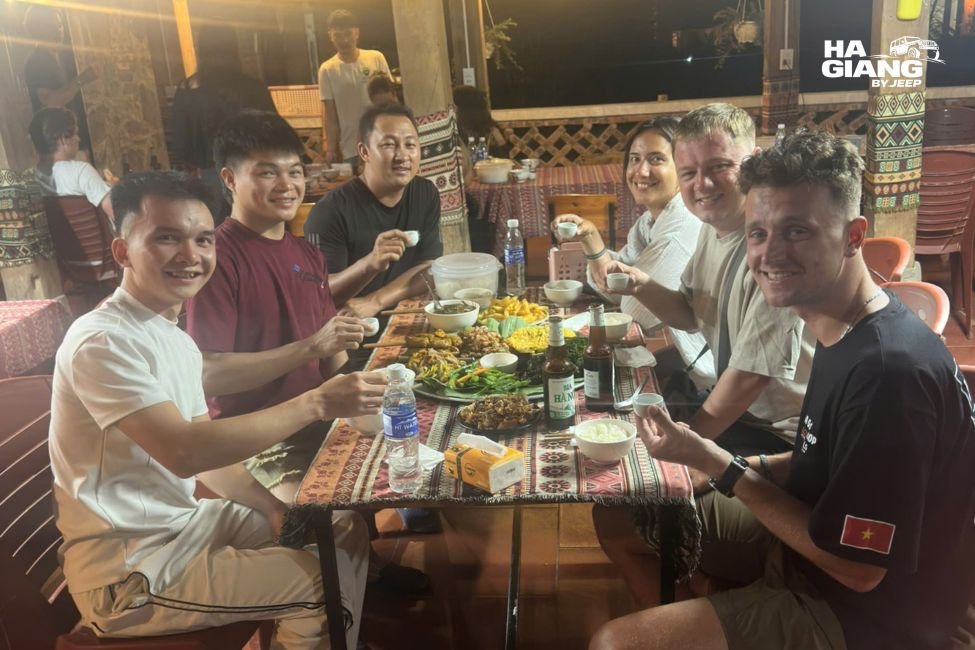
Meals are shared, not individual. At a homestay, dinner comes out as plates in the middle of the table: rice, a grilled meat, tofu, wild greens, a soup, whatever the kitchen has that day. Everyone reaches in. There is no ordering and no menu, and it is almost always better than anything you would have chosen.
The good stuff is at markets and roadside stalls. Not in towns with signage. A roadside place with six plastic stools and a pot on a gas ring is the format, and your driver knows which ones are worth stopping at, which is the single most useful piece of local knowledge on the whole trip.
Breakfast is savoury and it is early. Rice rolls, noodle soup, sticky rice. Nothing sweet, nothing baked. Villages start their day early and food follows.
Cash only, small notes. Draw money in Ha Giang City. Nothing outside it takes cards, and a stallholder cannot break a large note at seven in the morning.
The dishes worth planning around
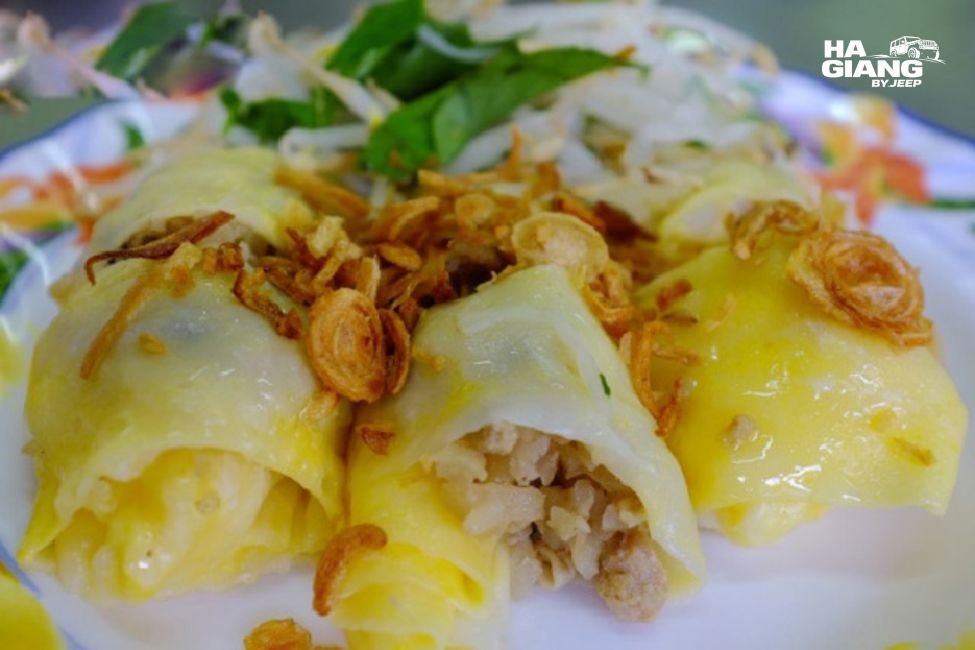
Banh cuon trung
The Ha Giang breakfast, and the dish most visitors end up eating three days running.
Thin rice sheets are steamed over cloth, an egg is cracked in while the sheet is still on the steamer, then the whole thing is rolled around minced pork and wood ear mushroom. What makes the Ha Giang version different from the one you get in Hanoi is the dipping: instead of fish sauce, it arrives with a bowl of hot bone broth, often with a slice of grilled pork sausage floating in it. You dip the roll in and eat it soaked.
Where: everywhere, from about 6am. Ha Giang City, Dong Van, Yen Minh, Meo Vac. Order it on your first morning and you will understand the region better by 7am than most itineraries manage all day.
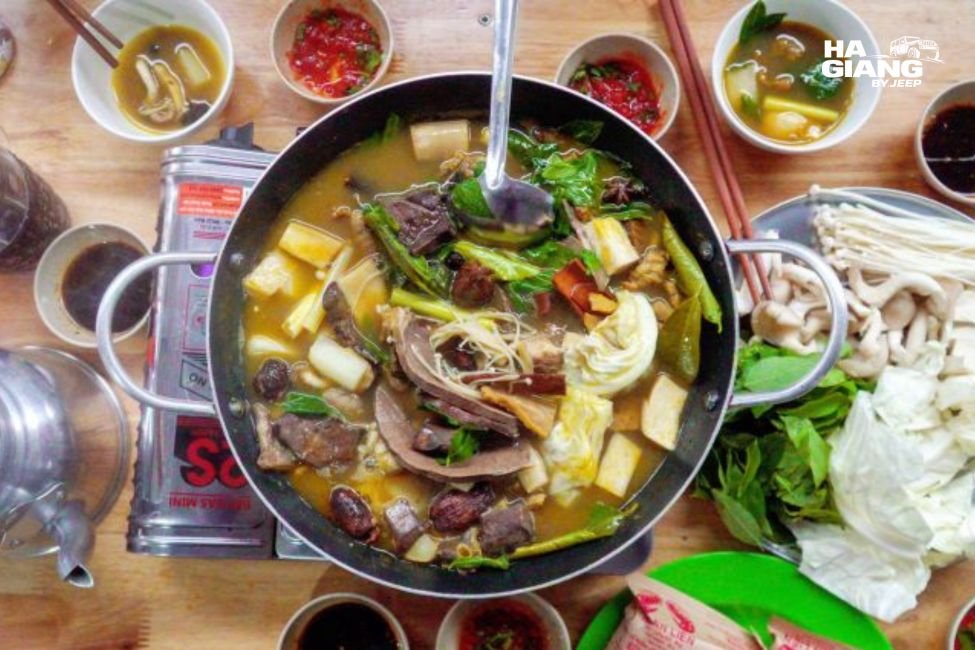
Thang co
The famous one, and the one nobody warns you about properly.
Thang co is a Hmong market stew, cooked in a wide pan over a fire and simmered all morning. Traditionally it is made with horse, and it uses the whole animal, offal included, seasoned with local spices including cardamom and a bark called thao qua. It is deeply savoury, strong smelling, and it is not a dish designed for tourists. Buffalo and beef versions are common now.
Honest advice: try it at a market, where it belongs, with a cup of corn wine beside it. Some visitors love it. Plenty do not finish the bowl. Both reactions are normal, and the stallholder has seen both many times, so there is no need to perform enthusiasm you do not feel. If offal is a hard no for you, this is not the dish to prove yourself on.
Where: Meo Vac market and Dong Van Sunday Market, in the morning.
Men men
Steamed ground corn, the Hmong staple. Maize grows where rice will not, which is most of this plateau, so men men is what generations here have actually eaten. Dry, slightly sweet, usually served alongside a soup to soften it.
It is not a highlight dish and it does not need to be. Eating a bowl of it while looking at the maize planted in cracks in the limestone outside tells you more about the region than any viewpoint.
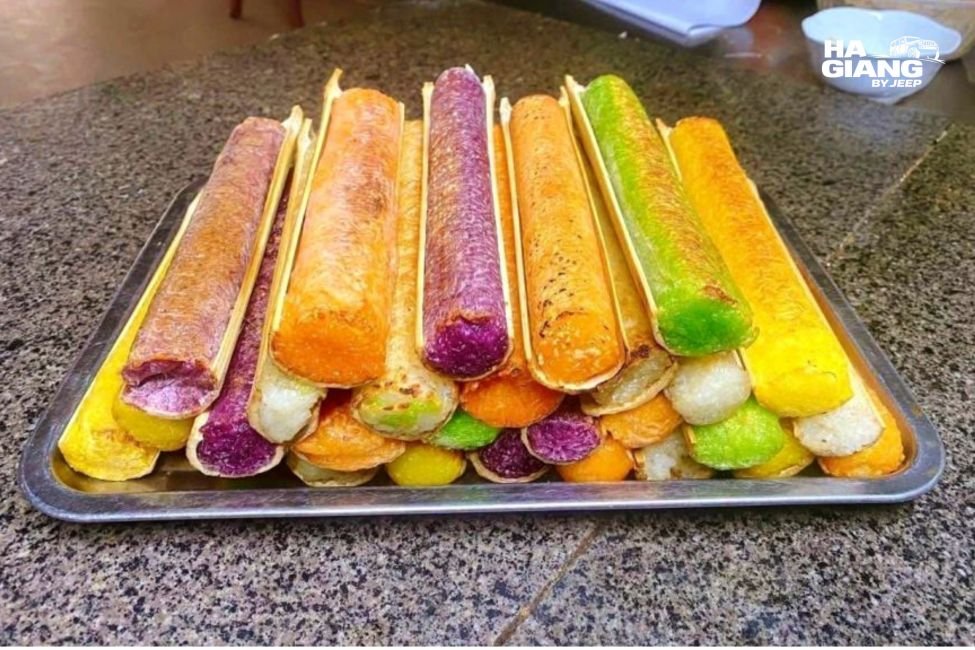
Com lam
Sticky rice cooked inside a bamboo tube over coals, then split open. Faintly smoky from the bamboo, eaten with grilled meat or with sesame salt. Sold at roadside stops and markets, cheap, and the easiest thing in the region to eat while standing at a viewpoint.
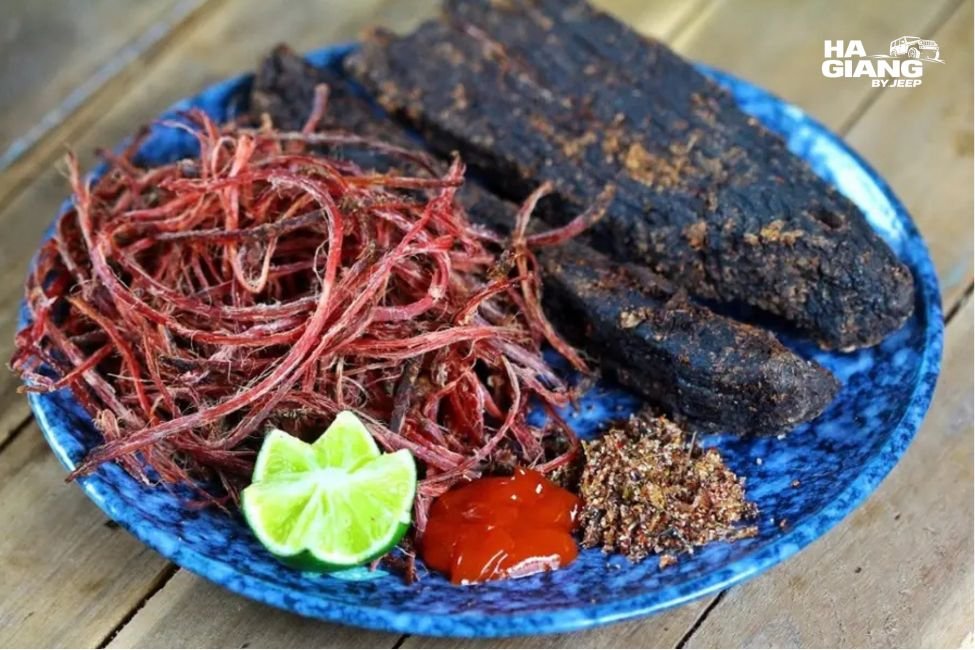
Thit trau gac bep
Buffalo meat rubbed with spice and hung above the kitchen fire to smoke and dry for weeks. Dense, chewy, intensely savoury, torn into strips and eaten with beer or corn wine. Most homestays have some hanging in the kitchen.
This is also the single best thing to bring home, because it travels well and it does not exist anywhere else you are likely to go.
Thang den
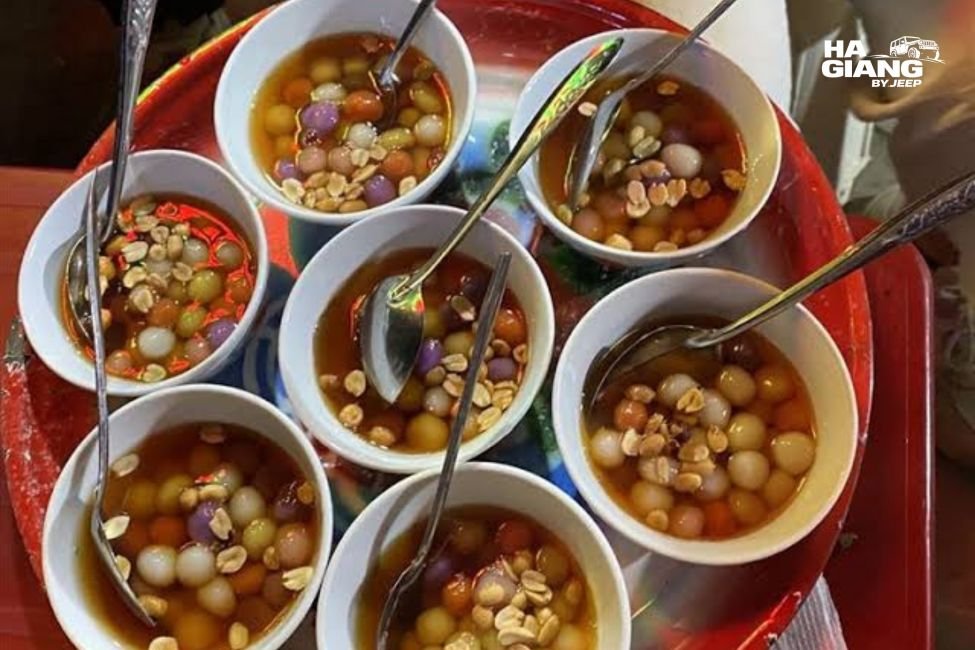
The evening one. Glutinous rice balls, usually filled with mung bean or black sesame, served in hot ginger syrup with coconut and roasted peanut on top.
It appears on the streets of Dong Van after dark, mostly in the colder months, and it is exactly what you want after a day on the passes when the temperature has dropped and you have run out of layers. A bowl costs very little and it will be the thing you describe to people at home.
Xoi ngu sac
Five colour sticky rice, coloured with plant dyes rather than anything artificial, made for festivals and market days by Tay and Nung families. More often seen at markets and celebrations than on a daily table, so if you see it, buy some.
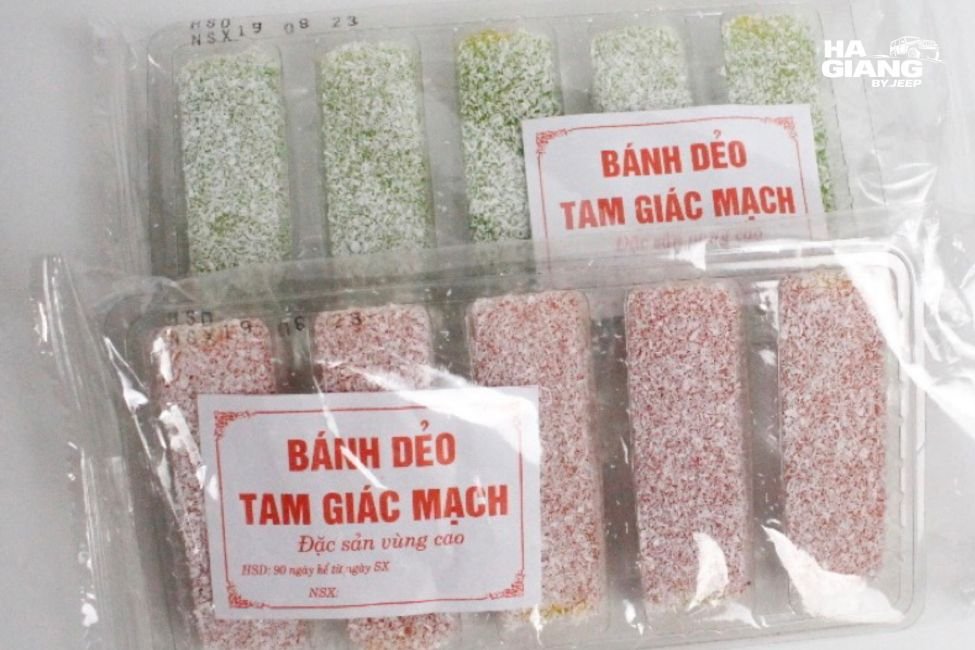
Banh tam giac mach
Buckwheat cake. After the buckwheat flowers finish across the plateau in late autumn, the seed gets ground into flour and pressed into flat round cakes, grilled or steamed. Dense, slightly bitter, faintly nutty. Sold at markets and at roadside stalls near the flower fields in season.
It is a genuinely local product with a short window, and it connects directly to the landscape people come here to photograph.
Pho and bun
Available everywhere, reliably good, and the safety net for anyone in your group who is not ready for a market stew at 8am. No shame in it. A bowl of pho in a small town in the mountains is still a bowl of pho in the mountains.
A private jeep changes how you eat here
You can pull over at any roadside stall or market that looks right, stay as long as the food takes, and accept a cup of corn wine at lunch without anyone in your group having to think about driving afterwards. Tell us you are here for the food and we will route your days through market mornings.
Chao au tau: the one dish that comes with a warning
This deserves its own section, because most food guides list it as a curiosity and stop there.
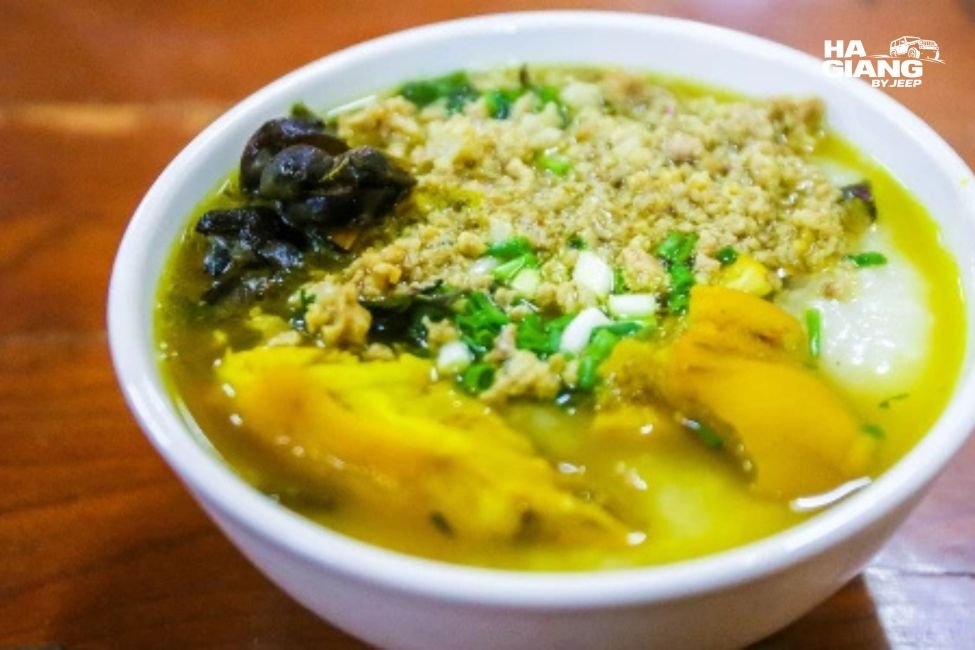
Chao au tau is a dark, thick, savoury porridge made with rice, pork trotter and the au tau root, served hot, usually in the evening and more commonly in the colder months. It has a distinctive bitter edge, it is regarded locally as warming, and it is genuinely a Ha Giang speciality that you will not find elsewhere.
The au tau root is toxic if it is not prepared correctly. It comes from a plant in the aconite family, and traditional preparation involves long soaking and many hours of simmering to make it safe to eat. This is not folklore. Improperly prepared au tau has caused poisoning, and it is the reason the dish is cooked the way it is.
What that means for you, practically:
- Eat it at established places in Ha Giang City or Dong Van where it is cooked routinely by people who have made it for years. Do not buy it from a source that seems improvised.
- Never attempt to prepare it yourself, and do not buy the raw root as a souvenir to cook at home.
- If you feel unsure, skip it. There is no shortage of other things to eat here and nobody will think less of you.
- If you have any doubt about whether this dish suits you, ask us before you order and speak to a doctor about anything health related. We are a tour operator, not a medical source, and we would rather tell you plainly what we know than pretend the question does not exist.
Eaten where it is properly made, it is a fine dish and a real piece of the region. It just belongs in a paragraph with the facts attached rather than on a list of quirky things to try.
Market food, and how to eat at one
The markets are where the food actually lives, and they run on a weekly rhythm rather than a daily one. Dong Van Sunday Market is the big one. Meo Vac has its own. Khau Vai Market happens once a year in spring on a lunar calendar date. Village markets rotate through the week.
Plan your dates around at least one market morning. It is the single highest value scheduling decision on a Ha Giang trip, food or otherwise.
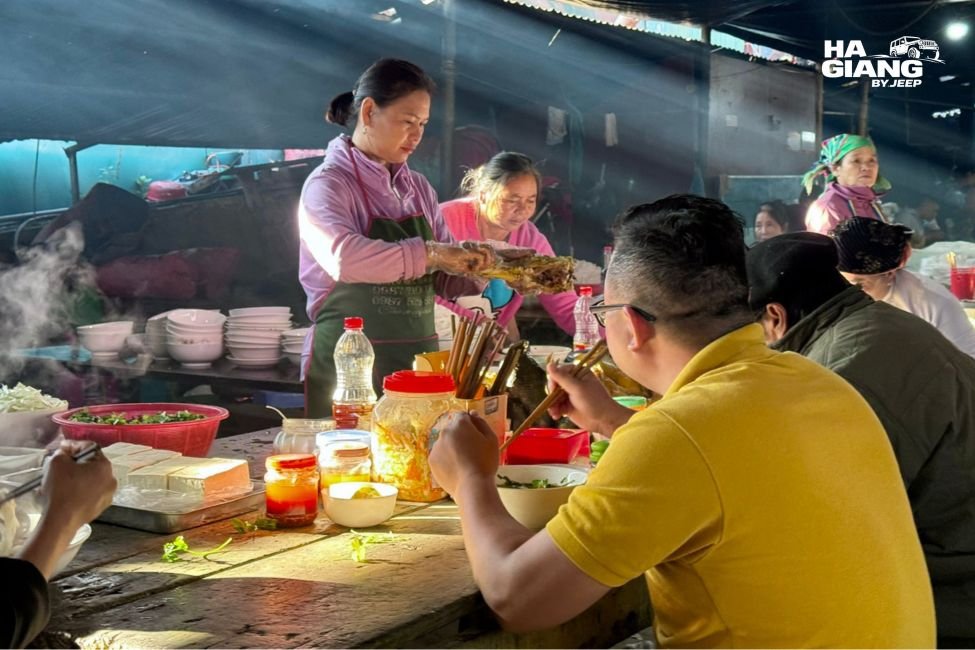
How to do it well:
- Go early. Markets here start before dawn and thin out by late morning. By eleven you are looking at the aftermath.
- Eat where the locals are eating. The busy stall has turnover, which means fresher food and a pot that has not been sitting.
- Point and nod. No menus, no English. Point at what somebody else is eating and hold up a finger. It works every time.
- Sit down and stay a while. The market is not a shop, it is the week's social event. People have walked down from the hills for it.
- Bring small notes and expect to pay very little.
- Ask your driver to order for you if something looks interesting and unidentifiable. They know what it is and whether you will like it.
Ruou ngo and the toasting
Ruou ngo is corn wine, distilled in villages across the plateau, served from a plastic bottle into small cups, and it appears at most homestay dinners without anyone asking whether you would like some.
Toasting is the social form. Someone raises a cup, everyone drinks, and then someone else does. It is how the evening gets going and it is genuinely one of the nicest parts of staying with a family here.
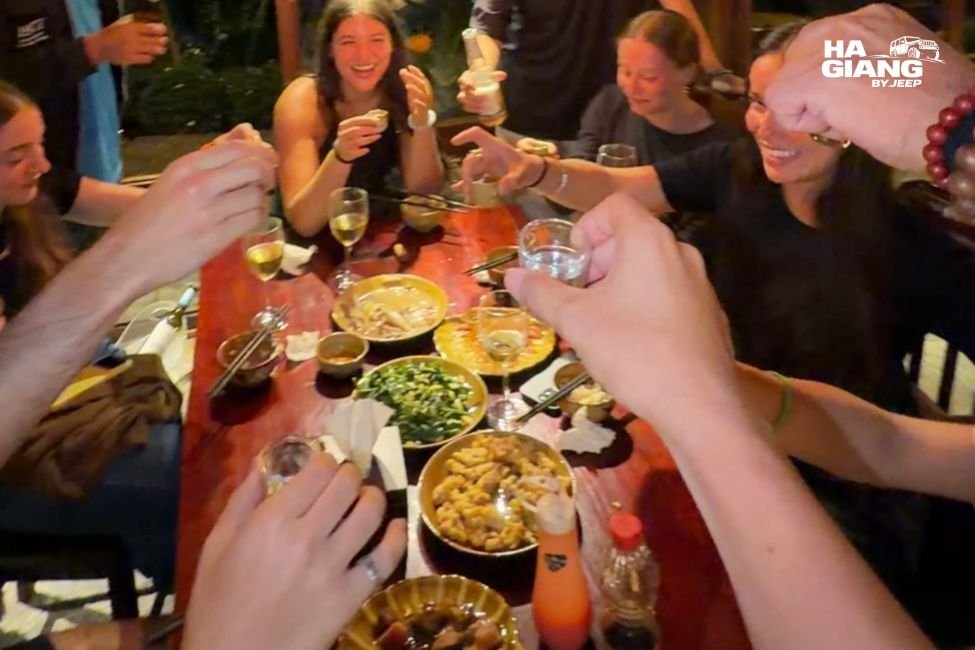
Two honest notes. It is stronger than it tastes, and strength varies from village to village because it is made at home rather than in a factory. Pace yourself, particularly on the first night, and particularly if you want to be at a viewpoint at sunrise the next morning.
The practical advantage of having a driver is exactly this. You can accept the third toast at a homestay table or a cup at a market stall at ten in the morning, and the only consequence is the one you signed up for.
Where you actually eat on a jeep tour
Three settings, and they cover almost everything.
Homestay dinners. Cooked by the family, shared at one long table with the other guests. This is where the good eating happens. Rice, grilled pork, tofu, wild greens, a soup, sometimes a chicken, sometimes smoked buffalo torn off the string above the fire.
Roadside stops. Lunch is usually somewhere with a pot, a griddle and a view, chosen by your driver rather than by an internet review. Com lam, grilled meat, pho, whatever is being cooked.
Markets. Breakfast on a market morning is the best meal of most trips.
The thing that ties these together is that you can stop for any of them, whenever you want, for as long as it takes. Food is the part of travel that most rewards not being on a schedule, and it is the part that a fixed itinerary damages first.
Vegetarian, vegan, allergies, and fussy eaters
All manageable with notice. None of it manageable at 7pm in a village kitchen.
Vegetarian is straightforward if we know in advance. Tofu, eggs, wild greens, bamboo shoots, sticky rice, mushrooms. Village kitchens cook plenty of it. What they cannot do is improvise a second menu after the pork is already on the table.
Vegan needs more notice and more specificity. Fish sauce and pork fat are used almost by default in seasoning, so tell us clearly rather than saying "no meat" and hoping.
Allergies must come to us at the booking stage, in writing, ideally with the Vietnamese term if you know it. Peanut is used widely. Shellfish is rare up here but appears in seasoning. Write it in your booking form rather than mentioning it to a driver on day two.
Fussy eaters and children. Rice, eggs, grilled pork, pho and com lam cover almost anyone. Nobody has to eat thang co.
If you are travelling as a group, collect all of this from your people at the same time you collect passport details for the border permit. Our guide for groups has the full checklist of what to gather before you book.
Not getting ill
Sensible habits rather than fear. Most visitors eat everything and are fine.
- Eat where it is busy. Turnover matters more than appearance.
- Hot food, freshly cooked, is the safest thing in any market. A pot that has been simmering since 5am is doing exactly what it should.
- Drink bottled or boiled water. Homestays provide hot water and tea constantly.
- Be a little more careful with ice and with cut raw salad in remote villages than you would be in a city. Not a rule, just a sensible weighting.
- Wash your hands or carry gel. Market stalls do not have sinks.
- Bring your own basic medication for an upset stomach. Village pharmacies stock little and you do not want to be looking for one at midnight.
- Ease into the corn wine on night one. A significant share of rough mornings up here are not food related.
Cao Bang food, if you go east
The 5 and 6 days tours continue into Cao Bang, and the food changes noticeably. Lower, wetter, more rice, more river.
- Banh cuon Cao Bang. Similar rolls to the Ha Giang version but served sitting in a bowl of bone broth rather than dipped into it, usually with a meatball. Different dish, same family, worth eating both to compare.
- Vit quay bay vi. Seven flavour roast duck, marinated with a spice mix and roasted until the skin goes dark and crisp. The signature Cao Bang dish and the one to order if you eat one thing there.
- Pho chua. Sour pho, served cool rather than hot, with roast pork, peanuts, herbs and a tangy sauce. Completely different from the pho you know.
- Hat de Trung Khanh. Trung Khanh chestnuts, roasted and sold by the bag in autumn. Seasonal and short, so if the timing lines up, buy them.
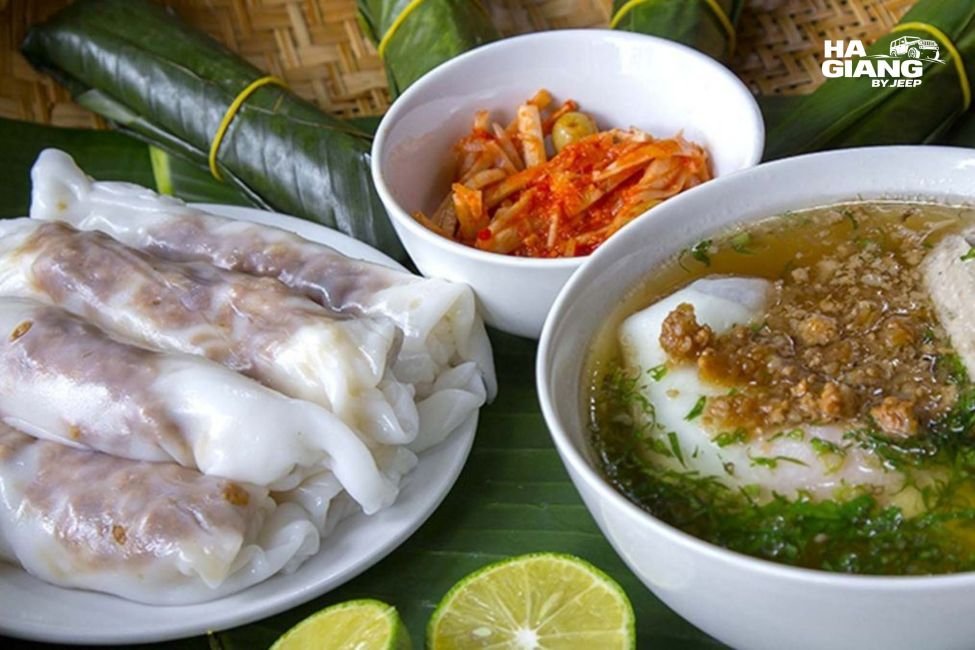
Combine this with Ban Gioc Waterfall, Pac Bo, God's Eye Mountain and Ngoc Con Valley and the eastern half of the trip stands up on its own rather than being an add on.
What to bring home
Small, packable, and actually from here:
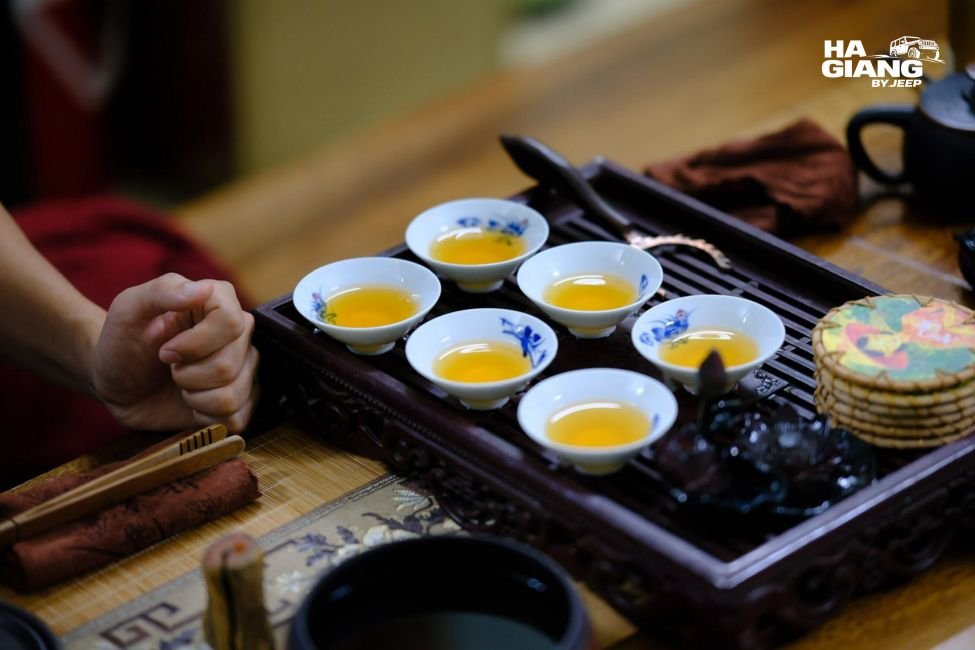
- Shan tuyet tea. Grown on old tea trees in the highlands of Ha Giang, with a distinct pale, slightly smoky character. The best souvenir from the region and it weighs nothing.
- Thit trau gac bep. Smoked buffalo, vacuum packed at markets. Check your own country's rules on bringing meat products in before you buy.
- Buckwheat products in season, from cakes to flour.
- Local honey and dried herbs from market stalls.
- Ruou ngo, if you can carry it. Sold in reused plastic bottles, which airlines have opinions about, so plan the packaging.
Want your trip routed through the food?
Tell us your dates and we will build the days around market mornings, put you in homestays that cook well, and note dietary needs before the kitchens start. Every tour is private, so a long lunch never costs you the afternoon. Email booking@hagiangbyjeep.com if you prefer.
Which jeep tour is right for you?
Ha Giang Loop, 3 days 2 nights. Covers the classic loop and gets you to at least one market if your dates line up. Tight but workable. See the 3 days tour
Ha Giang Loop, 4 days 3 nights. The one to book if food is part of why you are coming. The extra day is what lets us build the trip around a market morning rather than hoping one lands conveniently, and it gives you unhurried homestay evenings instead of early starts. See the 4 days tour
Ha Giang and Cao Bang, 5 days 4 nights. Two regions and two quite different kitchens. Plateau food, then the roast duck and sour pho of Cao Bang. Finishes in Cao Bang. See the 5 days tour
Ha Giang and Cao Bang, 6 days 5 nights. The most eating time, the shortest driving days, and the best chance of catching more than one market. See the 6 days tour
Jeep Wrangler Rubicon rental. 5,000,000 VND per day for the vehicle, about $192, for confident drivers running their own schedule. Worth noting that self driving and corn wine at lunch do not combine. Requirements for foreign drivers in Vietnam can change, so check the current rules first. See rental details
For a general picture of how a day runs, see what a jeep tour is actually like. If you are coming alone, the solo travel guide has the costs for one person, and eating alone here is easier than you would expect because homestay dinners are communal by default.
Ha Giang food FAQ
What food is Ha Giang famous for?
Banh cuon trung, rice rolls with egg dipped in hot bone broth, is the signature breakfast. Thang co, a Hmong market stew, is the most famous market dish. Thang den, sweet rice balls in ginger syrup, is the evening one, and chao au tau is the local porridge.
What should I eat for breakfast in Ha Giang?
Banh cuon trung, from around 6am, available in Ha Giang City, Yen Minh, Dong Van and Meo Vac. Pho and bun are everywhere as an alternative. Nothing sweet and nothing baked, breakfast here is savoury.
Is Ha Giang food spicy?
Not by default. Chilli and pickled condiments are served on the side so you control it. The bigger adjustment for most visitors is not heat but strong savoury flavours and unfamiliar cuts of meat.
What is thang co and should I try it?
A Hmong market stew simmered all morning, traditionally made with horse and using the whole animal including offal, with buffalo and beef versions now common. Try it at a market if offal does not put you off. Plenty of visitors do not finish the bowl and that is a perfectly normal reaction.
Is chao au tau safe to eat?
The au tau root is toxic unless prepared correctly, which is why the dish involves long soaking and hours of simmering. Eat it at established places where it is made routinely, never prepare it yourself, and skip it if you feel unsure. Ask us before ordering if you have any doubts.
Can I eat vegetarian or vegan in Ha Giang?
Yes, with advance notice. Tofu, eggs, wild greens, bamboo shoots and sticky rice are all standard. Tell us at the booking stage rather than on the road, because fish sauce and pork fat are used by default in seasoning and a village kitchen cannot rewrite dinner at 7pm.
Where do you eat on a Ha Giang jeep tour?
Homestay dinners cooked by the family and shared at one table, roadside stops chosen by your driver, and markets on market mornings. Every tour is private, so you can stop wherever looks good and stay as long as the food takes.
Is street food in Ha Giang safe?
For most visitors, yes. Eat where it is busy, choose hot freshly cooked food over anything sitting, drink bottled or boiled water, and be a little more cautious with ice and raw salad in remote villages. Carry basic stomach medication because village pharmacies stock very little.
What is ruou ngo?
Corn wine, distilled in villages and served in small cups at homestay dinners. Toasting is part of the culture here. It is stronger than it tastes and strength varies by village, so pace yourself, especially if you want an early start the next day.
How much does food cost in Ha Giang?
Meals here are inexpensive by international standards and paid locally in cash. We do not publish specific figures because roadside and market prices move around, and we would rather not quote a number you then find is out of date. Draw cash in Ha Giang City in small notes.
Which market should I plan my trip around?
Dong Van Sunday Market is the biggest and the best for food. Meo Vac has its own market, and Khau Vai Market happens once a year in spring on a lunar date. Tell us your dates and we will tell you which markets fall within them.
What Ha Giang food can I take home?
Shan tuyet tea is the best option, light and genuinely from this region. Smoked buffalo travels well but check your own country's rules on importing meat. Buckwheat products and local honey are also easy to pack.