
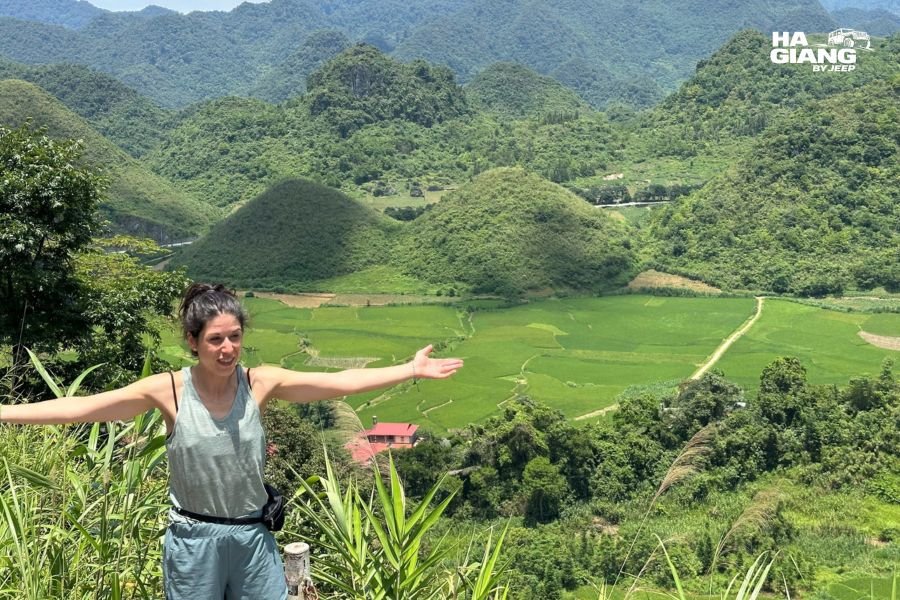
Ha Giang Solo Travel Guide: Cost, Safety, and What a Day Really Looks Like
You do not need a travel partner, a motorbike licence, or a high tolerance for discomfort to see the far north of Vietnam properly. You do need a realistic plan.
Ha Giang solo travel has a reputation problem. Half the internet tells you it is the best few days you will spend in Vietnam. The other half quietly assumes you are twenty five, confident on two wheels, and happy to sleep in a room with eleven strangers. Both pictures are incomplete, and the second one puts off a lot of people who would love this region.
This guide is written for the traveler arriving alone. It covers what the trip costs for one person rather than for a couple, how safe the roads really are, what the border permit paperwork involves, and what a normal day looks like when nobody else is holding the map. We run private jeeps up here, so we see solo travelers arrive every week: people in their thirties between jobs, women travelling alone for the first time, retired couples where one partner stayed in Hanoi, photographers who wanted room for a tripod. The practical notes below come from those trips.
What is in this guide
- Is Ha Giang a good place to travel solo?
- Three realistic ways to do Ha Giang solo travel
- Is Ha Giang safe for solo travelers?
- What Ha Giang solo travel actually costs
- A day on the loop when you are travelling alone
- The places worth your solo time
- Going further: Cao Bang for solo travelers
- Eating alone in Ha Giang without feeling alone
- What to pack
- When to go
- Which jeep tour is right for you?
- How booking works
- FAQ
Is Ha Giang a good place to travel solo?
Yes, with one honest asterisk about cost that we will get to in section four.
Ha Giang province sits in the far north, against the Chinese border, about 300 kilometres from Hanoi. The road loop that runs through Quan Ba, Yen Minh, Dong Van and Meo Vac climbs across the Dong Van Karst Plateau, a UNESCO Global Geopark of limestone towers, terraced maize plots and villages that still hold weekly markets the way they did fifty years ago. It is the kind of landscape that rewards stopping constantly, which is exactly what solo travelers tend to want and exactly what a group schedule tends to prevent.
Who actually shows up here alone
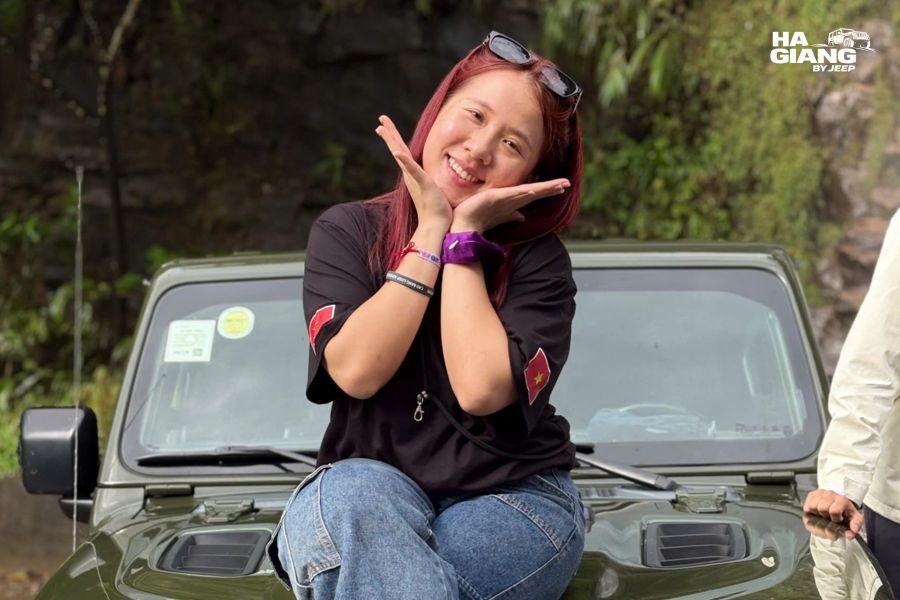
More people than you would guess. In practice the solo travelers we drive fall into a few groups.
- People who cannot or do not want to ride a motorbike, and assumed that ruled the region out entirely.
- Travelers over forty who want the scenery without three days of vibration and wind.
- Solo women who would rather not be the only person responsible for a vehicle on a wet mountain pass.
- Photographers and writers who need to stop at odd hours and stay longer than a group would allow.
- People with a tight schedule who need the trip to actually work, with no lost half day waiting for a group to assemble.
The honest downsides of going solo
There are three, and pretending otherwise helps nobody.
Cost per person is higher. A private vehicle costs what it costs. One person in a jeep pays for the whole jeep. Numbers are in section four, with no softening.
You carry all the decisions. Nobody else is checking the weather, remembering the permit, or noticing that the light is about to go. A local driver removes most of this, which is a large part of why solo travelers book one.
Evenings can be quiet if you let them. Homestay dinners are communal, so this is easy to fix, but if you book only private rooms in quiet towns you can end up eating alone four nights running. Mix it up.
Three realistic ways to do Ha Giang solo travel
There is no train and no airport up here. However you arrive, the loop itself is done by road.
1. Private jeep with a local driver
The simplest version. You sit in the front, a driver who grew up in these mountains handles the passes, and you stop wherever you want. The jeep is open air with a soft top and heating for cold or wet days, so weather changes the view rather than the plan. There is no vehicle to park at markets, no route to memorise, and no ride home at the end of a long day.
For a solo traveler the practical gain is not luxury. It is that the person next to you knows which market is on tomorrow, which viewpoint is empty at 7am, and who to call if anything goes wrong. That is our Ha Giang Loop jeep tour over 3 days or the slower 4 days version.
2. Self drive Wrangler Rubicon
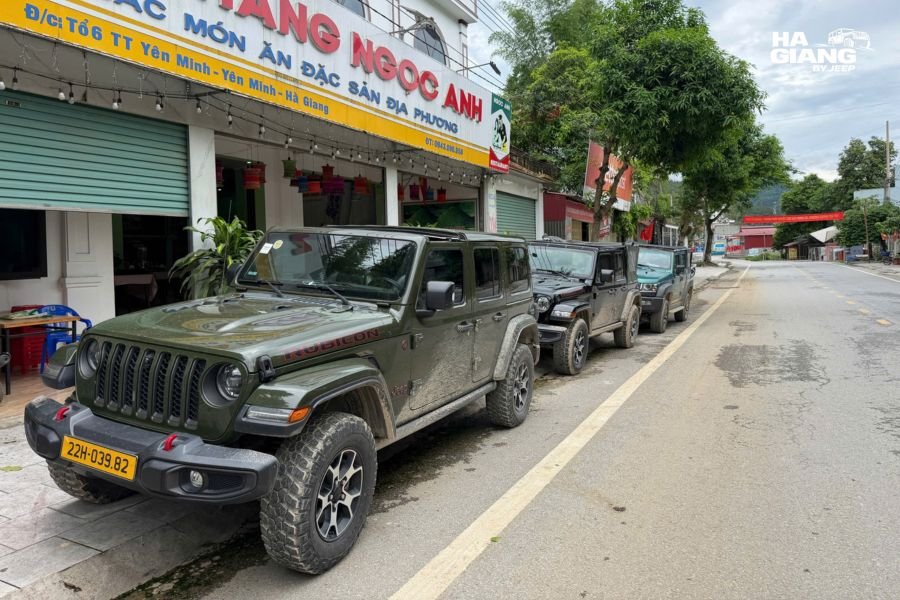
If you hold the right licence and you are genuinely confident on unfamiliar mountain roads, you can rent the vehicle and drive it yourself. Solo travelers who choose this are usually experienced drivers who want total control of their timetable. Rental is priced per day for the whole vehicle, so the economics are similar to a private tour without the driver's local knowledge.
Two honest cautions. Driving requirements for foreign visitors in Vietnam can change, so confirm your licence situation before you commit, and check the latest rules rather than trusting a forum post from two years ago. And mountain fog after dark is a different sport from mountain roads in daylight. Details on the jeep Wrangler Rubicon rental page.
3. Public buses and local transport
This is the low budget route and it does work, but be clear about the trade. Buses connect Ha Giang City with the larger loop towns. They do not stop at viewpoints, they do not wait while you photograph a market, and connections in the smaller towns are limited. You will see the region through a window on somebody else's schedule, and you will spend a lot of the trip waiting.
Plenty of travelers do it and enjoy it. It suits people with more days than money. It does not suit anyone with four days and a list of places they actually want to see.
Not sure which itinerary fits your dates?
Send us your arrival date and how many nights you have. We will tell you honestly whether 3 days is enough or whether you should stretch to 4, and quote the real cost for one person.
Is Ha Giang safe for solo travelers?
Broadly, yes. The region is not dangerous in the way the word usually implies. The genuine risks here are road related and weather related, not personal.
Roads, weather, and the thing people underestimate
The loop roads are paved for most of their length and in decent condition, but they are mountain roads: narrow in sections, with drops, blind corners, livestock, trucks, and long stretches with no barrier. Rain changes them quickly. Fog on Ma Pi Leng can reduce visibility to a few metres with very little warning, and it can arrive on a clear morning.
Road conditions and any repair closures change through the year, so treat any specific claim you read online, including ours, as a starting point and check current local updates before you travel. Landslide repairs happen most often in the wet months.
The thing people underestimate is fatigue. Six hours of concentration on a mountain road is tiring even for good drivers. Tired people make the decisions that cause accidents. That is the practical argument for having somebody else drive, and it applies more to solo travelers than to anyone else, because there is no second person to take over.
Solo female travelers
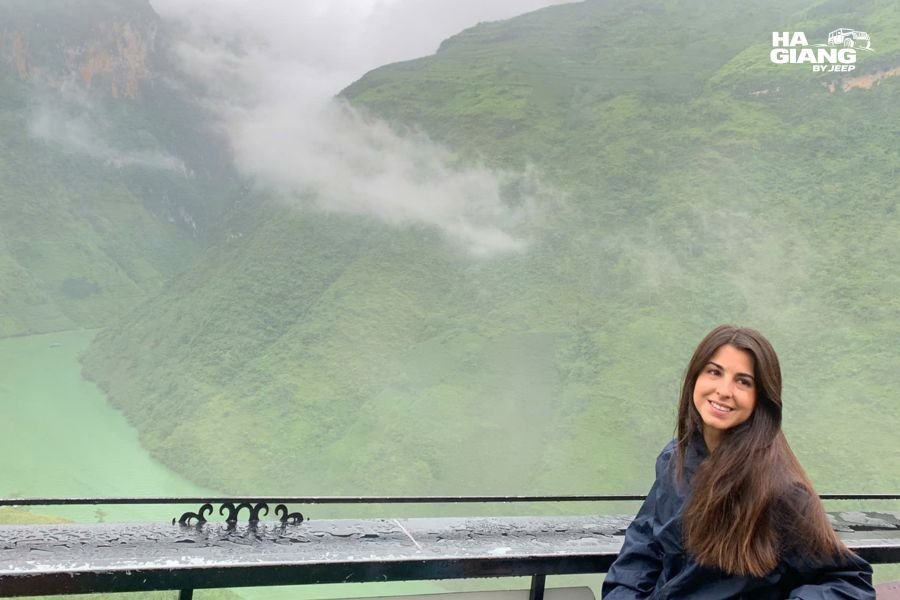
Ha Giang is generally comfortable for women travelling alone, and we drive solo female guests regularly. The usual sensible habits apply anywhere: share your itinerary with someone at home, keep a charged phone, be selective about drinking with strangers, and prefer accommodation with other guests around rather than an isolated place at the end of a track.
A few Ha Giang specific notes. Mobile coverage is good in the towns and patchy on the passes, so do not rely on being reachable between stops. Homestays are family run and social, which most solo women find reassuring rather than intrusive. If you would rather have a female driver or a specific arrangement, ask when you book rather than on arrival, because we cannot always rearrange staffing at short notice.
Border permits and paperwork
Parts of the loop run close to the Chinese border, and foreign visitors need a border area permit for those sections. It is a routine document, not an obstacle, but somebody has to arrange it and it is issued locally.
If you travel with us, the office in Ha Giang City handles this. If you are travelling independently, plan time for it and bring your passport. Requirements and issuing procedures can change, so check the current situation close to your travel date. Carry your passport with you on the loop rather than leaving it at a hotel in Ha Giang City.
Mistakes that cost solo travelers the most
Rather than warning you about specific operators, here are the errors we see repeated.
- Booking too little time. Two nights on the plateau is the minimum for the classic loop. One night means a lot of driving and almost no stopping.
- Arriving on the overnight bus and starting the tour the same morning with no sleep. It is doable, and it ruins day one. Consider a room in Ha Giang City for a few hours.
- Paying a deposit through an unofficial channel to someone contacted only through a social media message. Book through a real website with a real office address, whoever you book with.
- Packing for the tropics. Dong Van in January is cold.
- Leaving the market day to chance. Several of the best experiences here are weekly. Plan around them.
- Assuming ATMs are everywhere. Draw cash in Ha Giang City. Small villages and roadside stops are cash only.
What Ha Giang solo travel actually costs
Here is the part most guides skip. These are our published prices, in Vietnamese dong with an approximate US dollar figure. All tours are private, so nobody else is added to your vehicle.
The private jeep math, stated plainly
| Tour | Solo (1 person) | With one friend (2 people, total) |
|---|---|---|
| Ha Giang Loop, 3 days 2 nights | 15,990,000 VND (about $615) | 19,990,000 VND (about $769) |
| Ha Giang Loop, 4 days 3 nights | 19,990,000 VND (about $769) | 25,990,000 VND (about $1,000) |
| Ha Giang and Cao Bang, 5 days 4 nights | 27,990,000 VND (about $1,077) | 36,990,000 VND (about $1,423) |
| Ha Giang and Cao Bang, 6 days 5 nights | 36,990,000 VND (about $1,423) | 44,990,000 VND (about $1,730) |
The pattern is obvious once you see it laid out. A solo traveler pays for the whole jeep and the whole driver, so the per person figure is at its highest. Two people split it and the cost per head drops sharply. This is simply what private travel costs, and we would rather show you the number than bury it.
Jeep Wrangler Rubicon rental, if you are driving yourself, is 5,000,000 VND per day for the vehicle, about $192, which works out similarly for one person over a short trip.
If that number is beyond your budget, say so when you enquire. We would rather point you at a shorter itinerary that works than sell you something that strains your trip.
Where you sleep: dorm bed or private room
Base tour prices include a dorm bed in a homestay. For a lot of solo travelers this is the good option rather than the cheap one, because the shared dinner table is where the evening happens.
If you want your own space, upgrades are per room per night:
- Private room for 1 to 2 people: 500,000 VND per room per night
- Private family room for 3 to 4 people: 700,000 VND per room per night
On a 3 days 2 nights trip, two nights in a private room adds 1,000,000 VND, about $38. A reasonable middle path is one night in a dorm and one in a private room.
Getting to Ha Giang and back
Bus transfers are not included in the tour price. They are booked one way, per person. From Hanoi Old Quarter or Noi Bai Airport to Ha Giang, current options are:
| Departure | Type | Price per person |
|---|---|---|
| 07:00 | Limousine | 400,000 VND |
| 10:30 | VIP Sleeper | 450,000 VND |
| 16:00 | Limousine | 400,000 VND |
| 20:30 | Regular Sleeper | 350,000 VND |
| 21:00 | VIP Sleeper | 450,000 VND |
| 21:00 | Cabin Sleeper | 400,000 VND |
Coming back from Ha Giang to Hanoi Old Quarter or Noi Bai Airport:
| Departure | Type | Price per person |
|---|---|---|
| 16:00 | Limousine | 400,000 VND |
| 18:00 | Regular Sleeper | 350,000 VND |
| 21:00 | VIP Sleeper | 450,000 VND |
| 21:00 | Cabin Sleeper | 400,000 VND |
Arriving from Sapa instead: 11:00 VIP Sleeper at 450,000 VND, 11:00 Cabin Sleeper at 400,000 VND, or 17:00 Limousine at 400,000 VND. Returning from Ha Giang to Sapa: 18:00 VIP Sleeper at 450,000 VND or 18:00 Cabin Sleeper at 400,000 VND.
For a solo traveler the cabin sleeper is usually worth the small extra over a regular sleeper. You get an enclosed bunk rather than a shared open berth, which makes a real difference when you are travelling alone overnight. Ha Long Bay, Ninh Binh and Cat Ba connections exist too, and we will quote them on request.
The small stuff
Food, drinks, entrance tickets at some sites, and the optional Nho Que River boat trip are paid locally, in cash. Prices for these move around and we will not invent figures here. Draw enough cash in Ha Giang City to cover several days comfortably, because card acceptance thins out fast once you leave the city.
A day on the loop when you are travelling alone
Days differ, but the rhythm is consistent. Here is a realistic middle day.
Around 6:30. You wake in a homestay in Yen Minh or Dong Van. It is colder than you expected. Somebody is already cooking. You walk outside with a coffee and watch mist sit in the valley below the house.
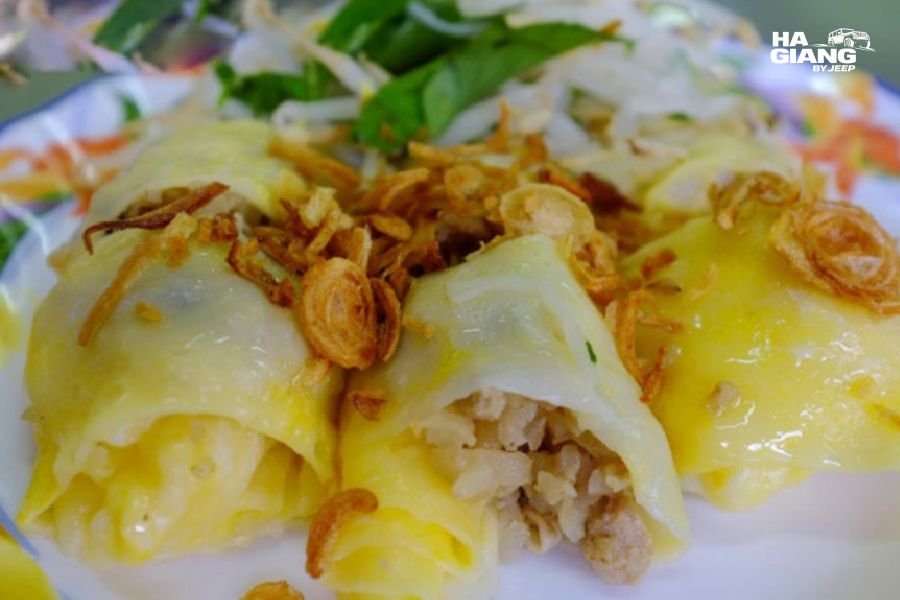
7:30. Breakfast. Often banh cuon trung, steamed rice rolls filled with egg, served with a bowl of hot bone broth to dip them in. It is the local breakfast and it is better than it sounds on paper.
8:15. The jeep leaves. The soft top is off if the weather allows. Within twenty minutes you have asked to stop twice, once for a viewpoint and once because a group of school children waved.
10:00. A village stop. Sung La, maybe, with its clay walled houses, or Pho Bang, a quiet old town where very few tour vehicles bother to turn off. You spend forty minutes here because you can. Nobody is waiting for you in a convoy.
12:30. Lunch at a roadside place your driver knows. Com lam, sticky rice cooked in bamboo, grilled meat, greens. You will not find this place on a map.
14:00. Ma Pi Leng. The road is cut into the cliff face high above the Nho Que River, and there is a pull off where everyone stops. Ask to continue two hundred metres past it and you will usually have a better view to yourself.
16:30. Meo Vac, or back toward Dong Van. Time for a walk before dark.
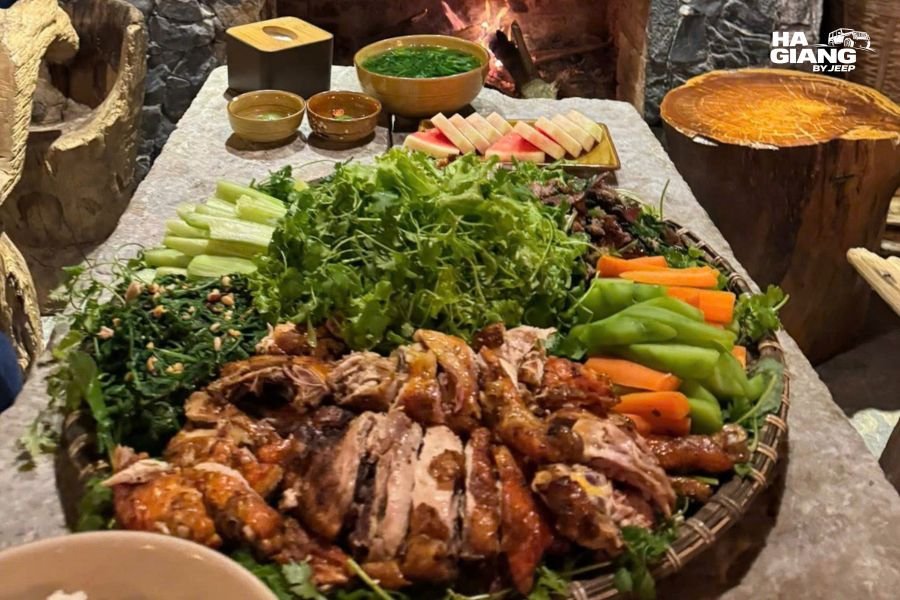
19:00. Dinner at the homestay, on a long table with whoever else is staying. Rice, tofu, pork, wild greens, a bowl of soup. Somebody produces a bottle of ruou ngo, the local corn wine, and the toasting begins. You are travelling alone and you have been alone for approximately none of the evening.
This is the part solo travelers tend to mention afterwards. Not the passes. The dinners.
The places worth your solo time
Quan Ba and Lung Tam
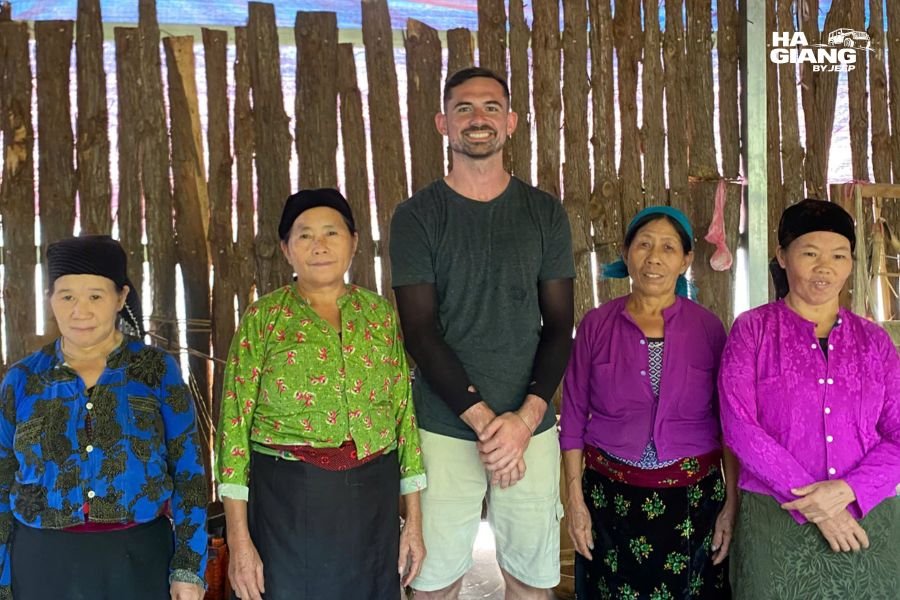
The first proper viewpoint out of Ha Giang City looks down over the twin conical hills at Quan Ba and the valley beyond. Nearby, Lung Tam is a linen village where Hmong women grow, spin, dye and weave hemp into indigo cloth on wooden looms. It is a genuinely interesting stop for anyone who likes craft, and a good place to buy something made where you are standing.
Yen Minh, Sung La, Pho Bang
The middle stretch. Yen Minh is a pine forested plateau town, useful as a base. Sung La sits in a small bowl of maize fields with old clay houses. Pho Bang is a former trading town of faded shophouses that most itineraries skip entirely, which is precisely the argument for going.
Dong Van Old Quarter and the Sunday market
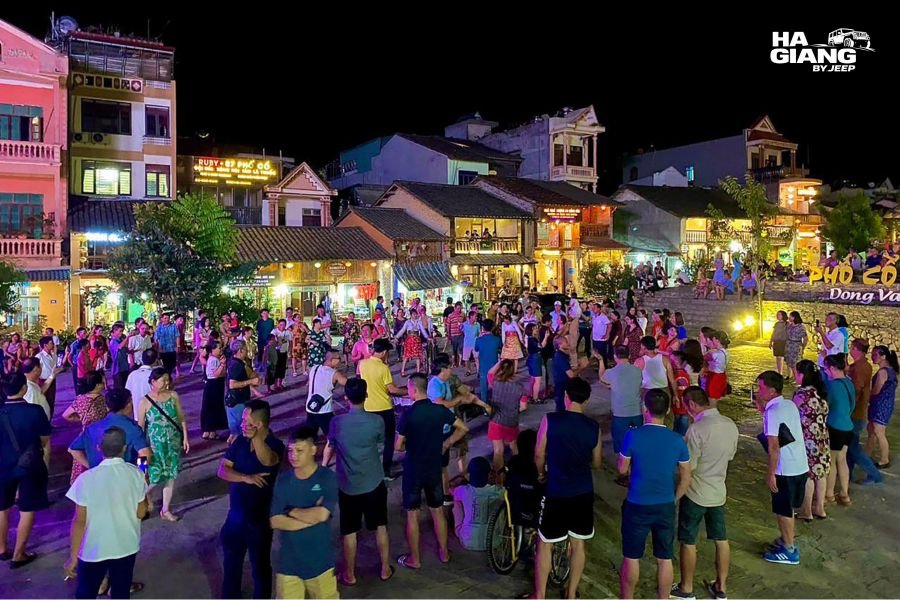
Dong Van Old Quarter is a small grid of century old houses under a limestone wall, with a market square at the centre. It is the best evening base on the loop and a comfortable place to wander alone after dark.
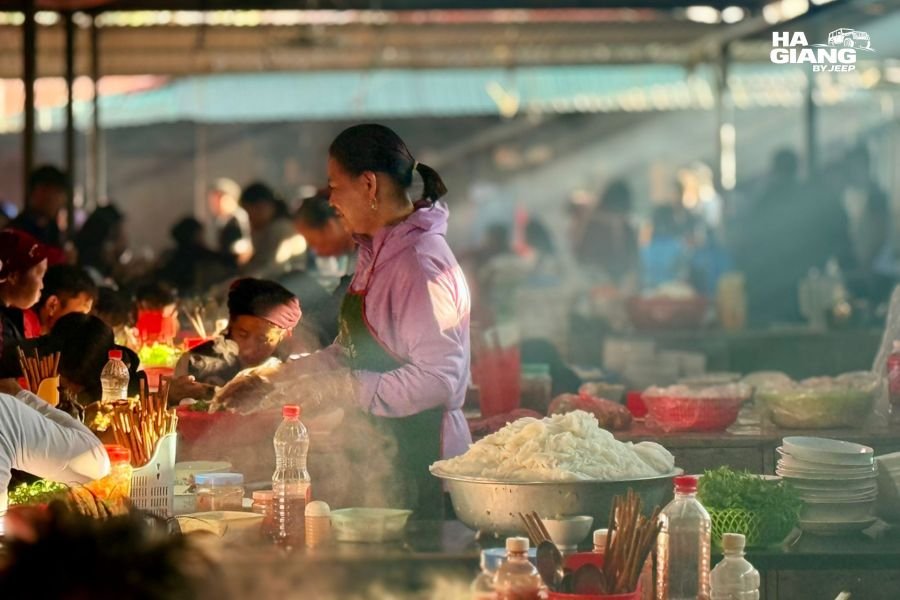
The Dong Van Sunday Market runs on Sunday mornings and it is one of the strongest reasons to plan your dates rather than let them happen. Villagers come down from surrounding hills in full dress to trade livestock, textiles, tools and food. Arrive early. It thins out by late morning.
Ma Pi Leng and Meo Vac
Ma Pi Leng Pass connects Dong Van and Meo Vac along a road carved into the canyon wall above the Nho Que River. It is the single most photographed stretch of the loop and it earns it. The optional boat trip on the Nho Que puts you at the bottom of the canyon looking up, which is a completely different experience from the road above. Boat operating hours vary with water levels and season, so check on the day.
Meo Vac is the market town at the eastern end. It also hosts Khau Vai Market, held once a year in spring on a lunar calendar date. If your trip lands anywhere near it, rearrange things to be there.
Lung Cu
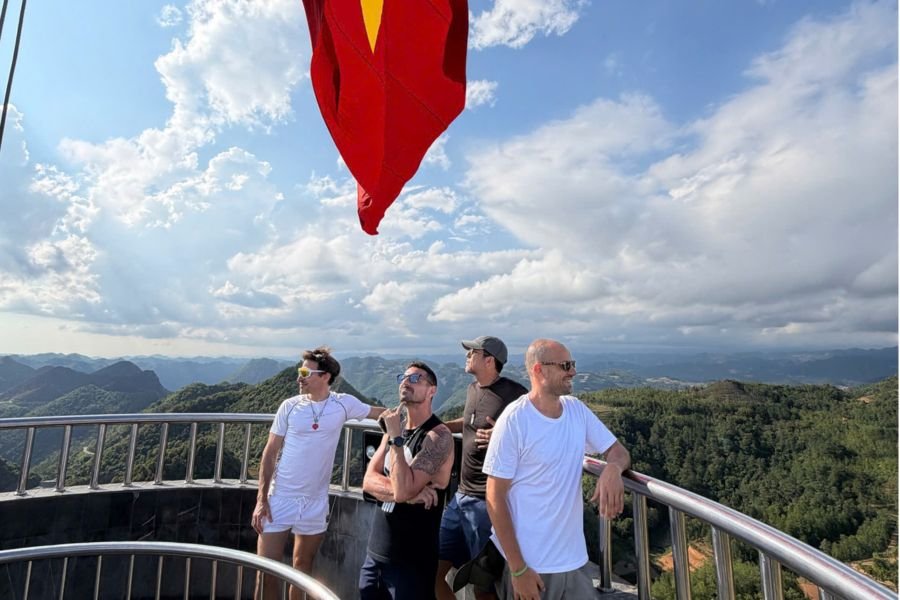
The Lung Cu Flag Tower stands on a hill at the northernmost tip of the country, with a stairway up to a viewing platform. On a clear day you look out over farmland running away in both directions across the border. It is a detour rather than a through route, so it usually features on the 4 days itinerary.
Du Gia
The quiet finish. Du Gia is a valley village with a waterfall and swimming spot, reached on the longer loop back toward Ha Giang City. It is the sort of place where an afternoon disappears. This is one of the main reasons to take 4 days rather than 3.
Going further: Cao Bang for solo travelers
If you have a week rather than a long weekend, the combo tours continue east from Ha Giang into Cao Bang province, which holds a second UNESCO Global Geopark, Non Nuoc Cao Bang. Two Geoparks in one trip, and the second one sees a fraction of the visitors.
What is out there:
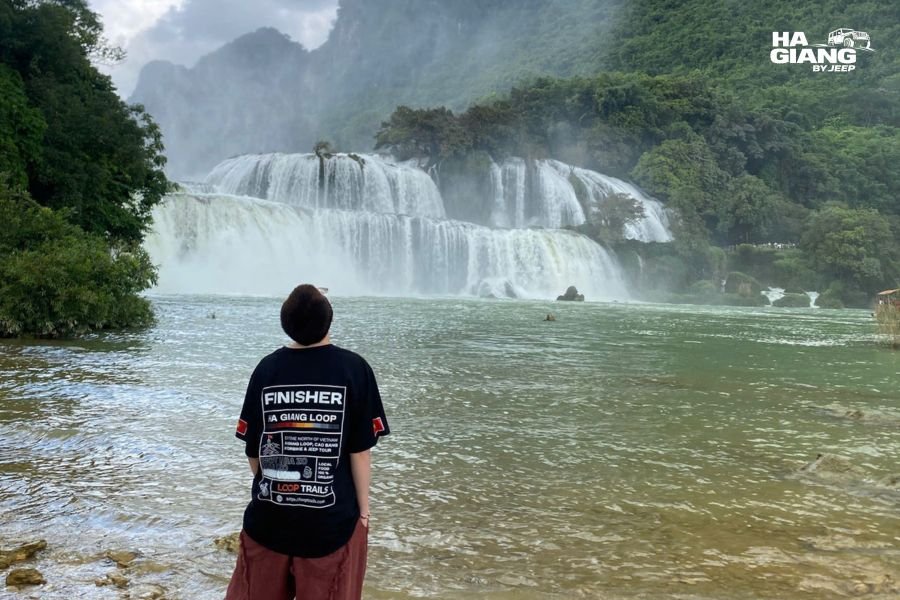
- Ban Gioc Waterfall, a wide tiered waterfall on the border river, with bamboo rafts that take you close to the base.
- Pac Bo Historical Site, a cave and stream complex in a quiet limestone valley, significant in modern Vietnamese history and set in genuinely lovely countryside.
- God's Eye Mountain, a limestone peak with a natural hole punched clean through it, above a small lake and grazing horses.
- Ngoc Con Valley, rice fields, water buffalo and old villages along a slow river, the kind of landscape you drive through without stopping and then regret.
- The 15 level pass near Bao Lac, a switchback climb that stacks hairpin after hairpin up the mountainside, on the 6 days routing.
One piece of logistics that matters for solo planning: the combo tours finish in Cao Bang, not back in Ha Giang. Your return transfer leaves from there. Options to Hanoi Old Quarter or Noi Bai Airport are 16:00 Limousine at 450,000 VND, 06:00 the following day Limousine at 450,000 VND, 11:30 the following day Limousine at 450,000 VND, 20:30 Cabin Sleeper at 450,000 VND, or 20:30 VIP Cabin Sleeper at 500,000 VND. If you need to get back to Ha Giang instead, there is a 16:00 Limousine and an 08:00 next day Limousine, both 450,000 VND.
Build your onward flight around this. Solo travelers get caught out by it more than groups do, because there is nobody else double checking the schedule.
Eating alone in Ha Giang without feeling alone
Eating solo in a country where meals are shared can feel awkward. In Ha Giang it mostly does not, because homestay dinners are communal by default and roadside places are informal.
Things worth ordering:
- Banh cuon trung. Steamed rice rolls with egg, dipped in hot bone broth. The regional breakfast.
- Com lam. Sticky rice cooked inside a bamboo tube over coals, eaten with grilled meat or sesame salt.
- Thang den. Glutinous rice balls in hot ginger syrup, sold in the evening around Dong Van. Ideal when it is cold.
- Chao au tau. A dark, slightly bitter porridge made with a local tuber, typically an evening dish and more common in the cooler months.
- Ruou ngo. Corn wine, distilled locally and poured generously at homestay tables. Strong. Pace yourself.
There is one quiet advantage to being driven. You can accept the third toast of corn wine at a homestay dinner, or stop at a market stall for a beer at midday, without a vehicle to think about afterwards. Solo travelers who drive themselves spend a good part of every evening doing that arithmetic.
Tell us about dietary needs when you book rather than at the first dinner. Vegetarian food is easy to arrange with notice and awkward to improvise in a village kitchen at 7pm.
What to pack
The plateau sits high and the weather changes fast. Pack for two seasons in the same day.
Always:
- A warm layer and a windproof outer layer, even in summer. Mornings on the passes are cold.
- Rain jacket. Not a poncho, which is useless in wind.
- Sun protection. High altitude sun is stronger than it feels.
- Cash in small notes, drawn in Ha Giang City.
- Passport, on you, for the border area permit.
- Power bank. Charging points at homestays are limited and shared.
- Basic medication, plus anything you take regularly. Pharmacies in villages are minimal.
November to March, add: thermal base layer, hat, gloves. Dong Van gets genuinely cold and homestays are not always heated.
April to September, add: quick drying clothes, a dry bag for electronics, insect repellent.
Leave behind: a large hard suitcase. Soft bags travel better in a jeep and in a homestay.
When to go
Short version, with the honest caveat that weather does not read guidebooks.
- September to November. The most popular window. Cooler, generally clearer, and buckwheat flowers appear across the plateau, usually from around late October into November. Book early for these weeks.
- December to February. Cold, sometimes very cold at altitude, with fog and low cloud. Fewer visitors, dramatic light when it clears, and a strong argument for a heated vehicle.
- March to May. Warming up, green, with plum and pear blossom early in the season. A good balance of weather and quiet.
- June to August. Green and dramatic, terraced fields full, and the wettest months. Rain is heavier and landslide repairs are more likely. Enjoyable if you are flexible.
Check a current forecast close to your date and expect it to be wrong at least once.
Ready to lock in dates?
Tell us your arrival day and how many nights you have. We will send back the itinerary that fits, with a straight answer on cost for one person, transfer times, and what the permit needs. No pressure, no drip campaign.
Which jeep tour is right for you?
Four options. Here is how solo travelers usually choose.
Ha Giang Loop, 3 days 2 nights. The right call if you have a fixed window and need the trip to fit around a flight. Covers the classic loop: Quan Ba, Yen Minh, Dong Van, Ma Pi Leng, Meo Vac. Busy but not rushed. See the 3 days tour
Ha Giang Loop, 4 days 3 nights. The one we recommend most often to people travelling alone. Same route, more room in it, plus Lung Cu and Du Gia. The extra day is where the unplanned stops live, and unplanned stops are most of what solo travelers came for. See the 4 days tour
Ha Giang and Cao Bang, 5 days 4 nights. The loop plus the drive east to Ban Gioc and the Non Nuoc Cao Bang Geopark. Good if you have a week and want two regions rather than one done twice. Finishes in Cao Bang. See the 5 days tour
Ha Giang and Cao Bang, 6 days 5 nights. The full version, routed through Bao Lac and the 15 level pass, with time at Pac Bo, God's Eye Mountain and Ngoc Con Valley. For travelers who would rather see one part of the country properly than three parts briefly. See the 6 days tour
Jeep Wrangler Rubicon rental. For confident drivers with the right paperwork who want the vehicle and none of the schedule. See rental details
If you are still deciding between the jeep and other ways of doing the loop, our post on what a jeep tour is actually like day to day covers the practical detail.
How booking works
Once you have a confirmed travel date, book as soon as you can. Most guests book 1 to 3 months in advance. Jeep availability is limited, so early booking gives us room to arrange the permit, the driver and the homestays properly.
What we need from you: arrival date, number of nights, passport details for the border area permit, dietary requirements, and whether you want dorm or private rooms. What we send back: the itinerary, the total in Vietnamese dong, transfer options with times, and a payment link.
The office is in Ha Giang City and support runs 24 hours a day while you are on the road. If something changes, weather or otherwise, you talk to a person rather than a form.
Ha Giang solo travel FAQ
Is Ha Giang safe for solo travelers?
Generally yes. The main risks here are road and weather related rather than personal. Mountain roads are narrow with fog and rain arriving quickly, so the safest single decision a solo traveler can make is not being the one driving. Standard precautions apply as anywhere: share your itinerary, keep a charged phone, and stay somewhere with other guests around.
Can I do the Ha Giang Loop alone without riding a motorbike?
Yes. A private jeep with a local driver covers exactly the same route and the same stops, in any weather, with no riding experience required. This is the most common reason solo travelers contact us.
How much does Ha Giang solo travel cost?
Our private jeep tours start at 15,990,000 VND, about $615, for one person over 3 days and 2 nights, including dorm accommodation and a driver. Bus transfers from Hanoi are extra, from 350,000 VND per person each way. Private room upgrades are 500,000 VND per room per night.
Why is the solo price so much higher per person?
Every tour is private, so a solo traveler pays for the whole vehicle and driver rather than splitting it. Two people on the same 3 days tour pay 19,990,000 VND total, which is roughly 10,000,000 VND each. If you are travelling with a friend, the maths improves a lot.
Will I be put in a jeep with strangers?
No. Every tour is private. Your jeep carries you and your driver, and nobody is added later.
Is 3 days enough, or should I take 4?
Three days covers the classic loop and works well if your dates are fixed. Four days adds Lung Cu and Du Gia and, more importantly, adds slack. Solo travelers who like to stop and linger usually prefer 4 days.
Do I need a permit for Ha Giang?
Foreign visitors need a border area permit for the sections of the loop near the Chinese border. We arrange it from our Ha Giang City office. Bring your passport and carry it with you. Procedures can change, so confirm current requirements close to your travel date.
Is Ha Giang good for solo female travelers?
Yes, and we drive solo female guests regularly. Homestays are family run and social, towns are small and walkable, and having a local driver means you are never navigating a mountain pass alone at dusk. Ask about specific arrangements when you book rather than on arrival.
How do I get from Hanoi to Ha Giang alone?
Sleeper bus or limousine van, roughly a 300 kilometre trip. Departures from Hanoi Old Quarter or Noi Bai Airport run from 350,000 to 450,000 VND per person one way. A cabin sleeper gives you an enclosed bunk, which is usually worth the extra when travelling alone.
What happens at the end of a Ha Giang and Cao Bang tour?
Those tours finish in Cao Bang, not back in Ha Giang. Return transfers to Hanoi Old Quarter or Noi Bai Airport run from 450,000 VND per person, including an overnight sleeper and several daytime limousines. Plan your onward flight around this.
Will I be lonely?
Less than you expect. Homestay dinners are shared at one long table with other guests and the host family, markets are busy and social, and you will have a driver to talk to for several hours a day. The solo travelers who tell us they wished for more company are usually the ones who booked private rooms every night.
When is the best time for Ha Giang solo travel?
September to November is the most popular window, cooler and clearer, with buckwheat flowers usually from late October. March to May is quieter and green. Winter is cold and dramatic. June to August is the wettest. Check a current forecast before you pack.