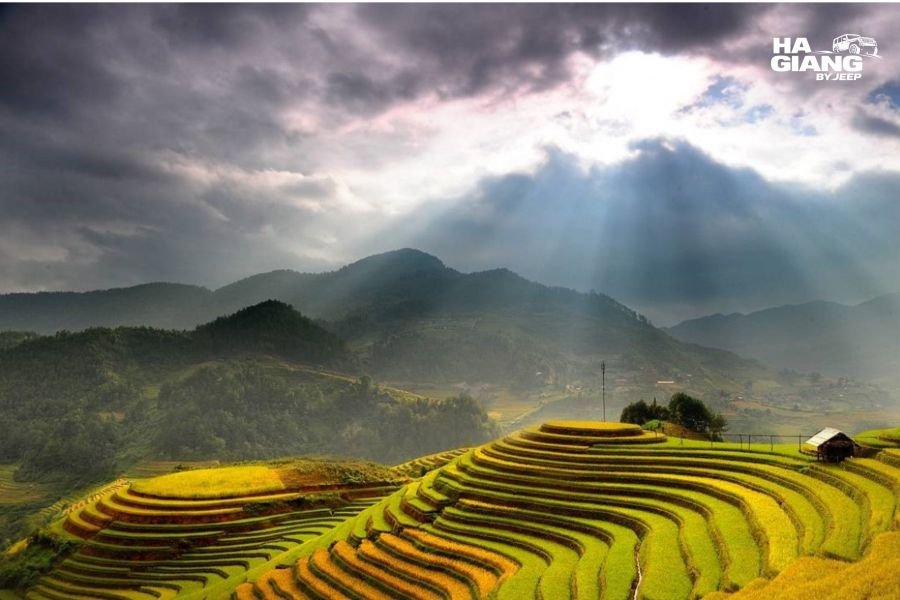
Hoang Su Phi Rice Terraces: When to Go and What to See
The Hoang Su Phi rice terraces are the part of Ha Giang most travelers hear about last and remember longest.
Most visitors come north for the karst towers, the pass roads and the flag tower on the border. Then somebody shows them a photograph taken in the far west of the province: a whole mountainside carved into curved steps, flooded, holding the sky like a stack of broken mirrors. Trips get longer after that. This guide covers what the Hoang Su Phi rice terraces are, when they look their best, how travelers actually reach them, and how to see them without spending your holiday clinging to a handrail on a rough road.
We run private jeeps out of an office in Ha Giang City, and this western corner is the trip we get asked about the least and recommend the most. It is slower, quieter and greener than the famous loop, and it rewards people who are willing to give it a full day instead of a rushed photo stop.
Where Are the Hoang Su Phi Rice Terraces?
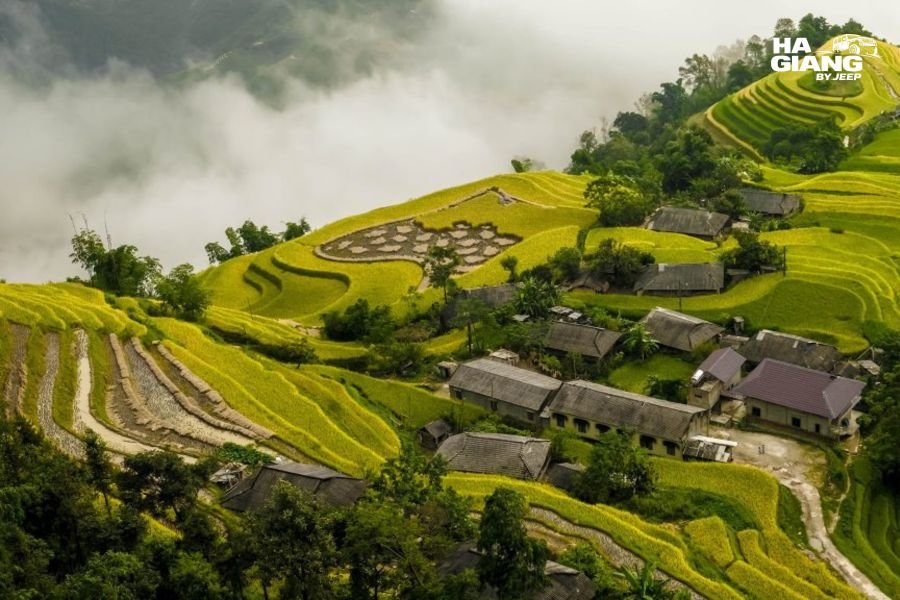
Hoang Su Phi sits in the far west of Ha Giang, out toward the Lao Cai border, on the opposite side of the province from Dong Van and Meo Vac. The landscape is completely different from the loop. Instead of grey limestone spikes and bare rock, you get tall soft mountains covered from riverbed to ridge in cultivated steps, some of them stacked more than a hundred levels high.
The terraces were built over generations by La Chi, Dao, Nung, Tay and Hmong families, each community shaping the slope in its own way. They are not decorative. Every step is a working field that feeds a household, which is why the view changes so completely across the year.
The area was recognised as a national heritage site more than a decade ago, and that listing covers a cluster of communes rather than a single viewpoint. There is no gate, no ticket booth on the main road, and no single spot where you are supposed to stand.
The Villages Worth Knowing By Name
You do not need to memorise the map, but these names come up constantly and it helps to recognise them when a driver suggests a detour.
- Ban Phung and Ban Luoc: the classic amphitheatre views, deep valleys wrapped in terraces on every side.
- Ho Thau: higher, cooler, close to the Chieu Lau Thi massif and some of the best cloud seas.
- Thong Nguyen and Nam Hong: tea country, ancient Shan Tuyet trees growing between the fields.
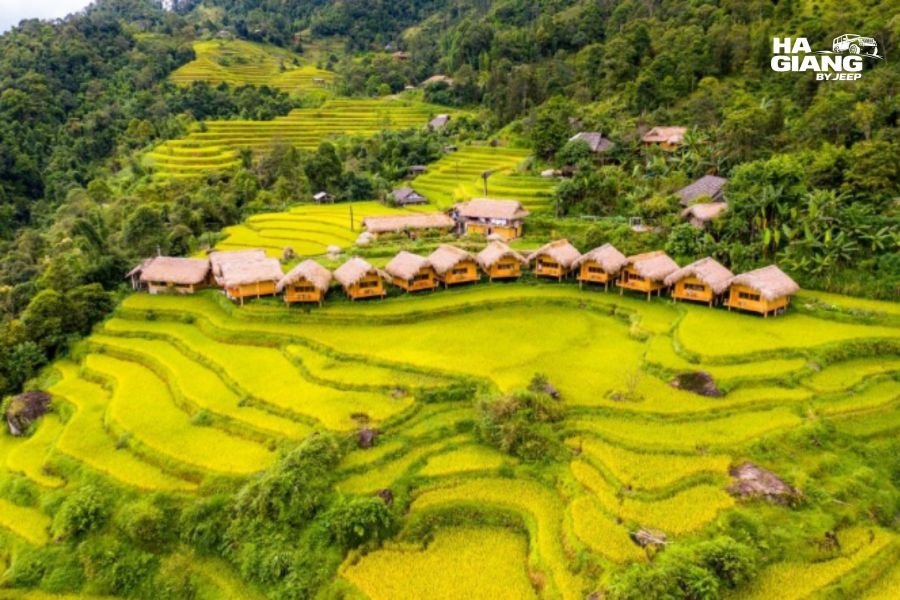
- Nam Ty and San Sa Ho: quieter valleys where the terraces run right up to the houses.
- Vinh Quang: the small town at the centre of the district, where most travelers eat lunch or fill the tank.
Vietnam reorganised its provincial and commune level administration recently, so newer maps, older signposts and booking systems may label these places differently. The valleys have not moved. Check latest updates if the name on your map does not match the name on the road sign.
How Hoang Su Phi Differs From the Karst Plateau
Travelers often assume the Hoang Su Phi rice terraces are simply another stop on the standard route. They are not. The loop runs north and east from Ha Giang City through the Dong Van Karst Plateau Geopark, while Hoang Su Phi lies southwest. Getting there and back is a separate journey on separate roads.
The practical difference is mood. The plateau is dramatic and vertical, all cliffs and switchbacks and big weather. Hoang Su Phi is softer and more agricultural. You spend the day in villages, at farm level, watching people work. Photographers, slow travelers and repeat visitors to Vietnam tend to fall hardest for it.
When to Visit the Hoang Su Phi Rice Terraces
There are two famous seasons and two underrated ones. Timing matters more here than almost anywhere else in the north, because you are looking at a crop, and a crop looks different every month.
Water Pouring Season
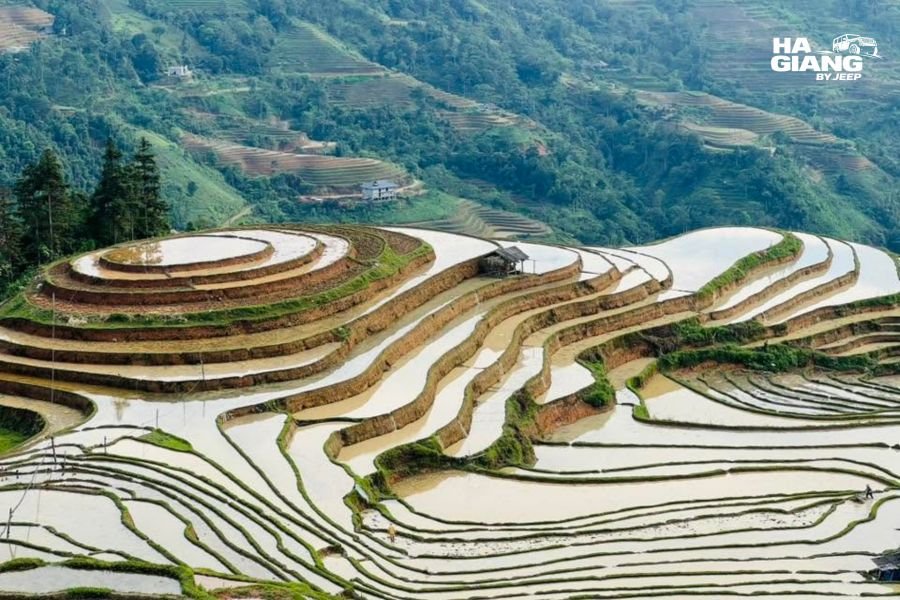
Roughly May into June, farmers channel water down the slope and the Hoang Su Phi rice terraces fill one level at a time. Late afternoon light turns the whole hillside into liquid silver. This is the season photographers plan trips around, and it is short. Exact dates shift with rainfall and altitude, so check latest updates before locking in flights.
Golden Harvest Season
Roughly September into early October, the rice ripens and the mountains turn yellow and copper. Harvest is happening while you watch: families cutting by hand, buffalo on the paths, threshing machines humming in the valley. It is the busiest and most photographed window of the year, and the one worth booking earliest.
Green Season and the Quiet Months
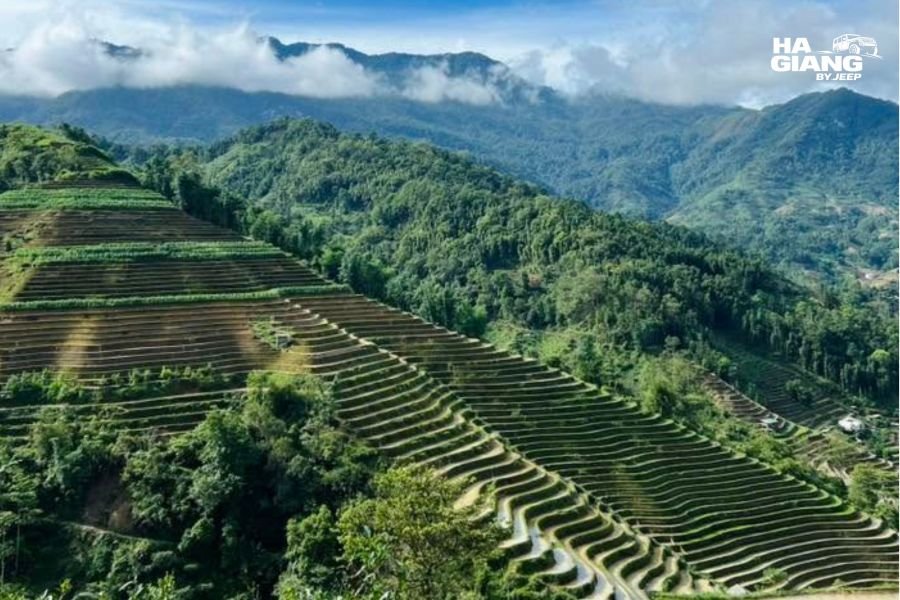
July and August give you deep saturated green, waterfalls at full strength and very few visitors. From November to April the Hoang Su Phi rice terraces are bare, but the mornings deliver enormous cloud seas, the tea hills stay green and the villages feel entirely your own. Cold season travel is comfortable in a jeep with a soft top and heating, which is exactly why we keep running this route in winter.
| Season | Rough timing | What you see | How busy |
|---|---|---|---|
| Water pouring | May to June | Flooded, mirrored terraces | Moderate, photographers |
| Green season | July to August | Deep green fields, strong waterfalls | Quiet |
| Golden harvest | September to early October | Yellow terraces, harvest work | Busiest |
| Quiet months | November to April | Bare fields, cloud seas, tea hills | Very quiet |
Two honest warnings. First, the exact turn of each season moves by a week or two every year, and villages at different altitudes turn at different times, so a single date range is never the full picture. Second, be careful with any source that gives you precise arrival times for each stop. Mountain roads do not work that way, and weather rewrites the plan.
Getting to Hoang Su Phi
Almost everyone reaches the Hoang Su Phi rice terraces from Ha Giang City. The usual approach heads south on the main highway toward Tuyen Quang, turns west at the Tan Quang junction, then climbs a provincial road up into the district. From the junction onward the road stops being a highway and starts being a mountain road: narrow, twisting, sometimes patched, occasionally under repair.
Coming from Hanoi, most travelers take an overnight sleeper bus or a daytime limousine van to Ha Giang City, sleep, then head west the following morning. Trying to reach the terraces directly from Hanoi in one push makes for a punishing day and usually costs you the good light at both ends.
Why Road Conditions Matter More Here
Two things make this route different from the loop. The surface is less consistently maintained, and the best viewpoints are up side roads that were built for tractors and farm vehicles rather than tour traffic. Rain changes things fast: landslips get cleared quickly in this region, but they do happen, and a road that was fine last week may be single lane this week.
A high clearance 4x4 with a driver who knows which side track is passable today is not a luxury here. It is the difference between seeing the Hoang Su Phi rice terraces from the valley floor and standing above them at the angle you came for. If you plan to drive yourself, our Jeep Wrangler Rubicon rental is built for exactly this kind of surface, and we brief every renter on current conditions before they leave the office.
What a Day Among the Terraces Actually Looks Like
A day in the Hoang Su Phi rice terraces has a rhythm, and fog sets it. Mornings start early and cold. Fog fills the valleys overnight and sits there until the sun burns a hole in it, so the first hour is often spent climbing above the cloud rather than looking at fields. Then the layer breaks, and suddenly there are three villages below you that were invisible five minutes earlier.
By mid morning the light gets hard and the terraces flatten out, which is the right time to be down at village level instead. You walk a short section of path, buy tea from somebody who grew it, watch a woman carry a load of cut rice up a stairway of mud that she has walked ten thousand times. Lunch is usually simple and local: com lam roasted in bamboo, greens picked that morning, maybe banh cuon trung if you passed the right stall.
Afternoon is for the long ridge drives. Windows down, roof open if the weather allows, stopping wherever the view opens up. This is the part where being in a private jeep changes the day completely. There is no schedule to protect and no convoy to keep up with, so when the light hits a slope at the right angle you simply stop.
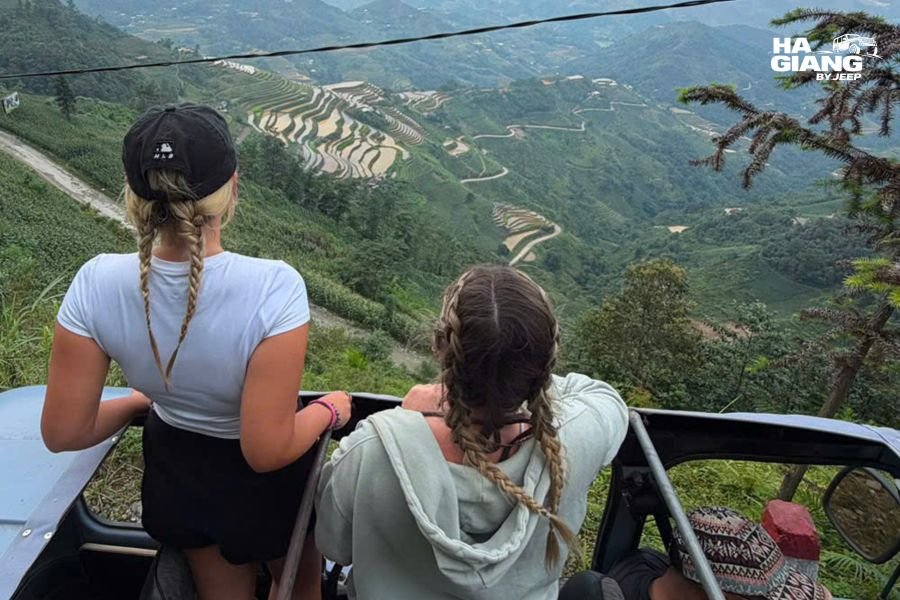
Evenings are quiet in a way that surprises people. Homestays around the Hoang Su Phi rice terraces are simple, warm and family run. Dinner is shared, the corn wine comes out if you want it, and by nine most of the valley is asleep.
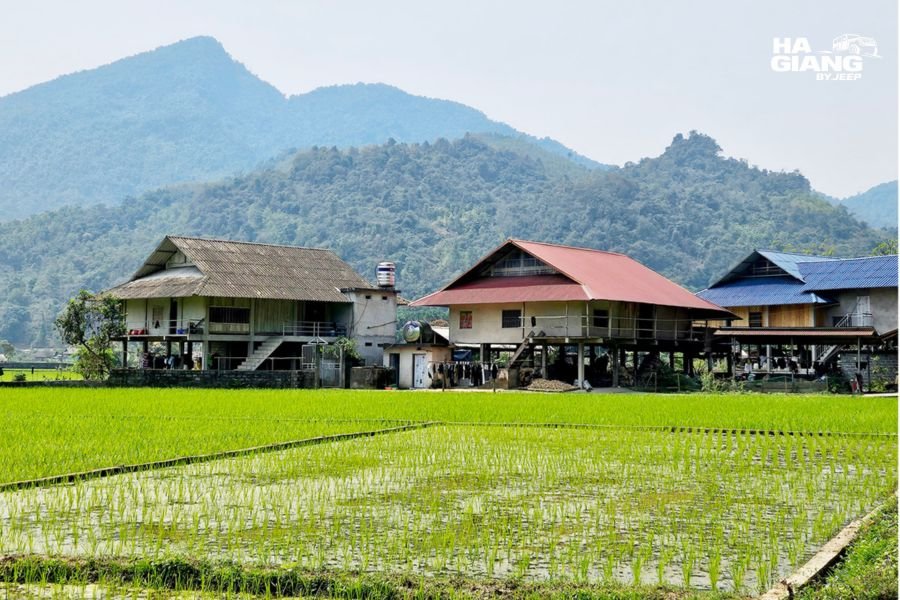
The Best Viewpoints and Photo Stops
The Hoang Su Phi rice terraces have no official list of viewpoints, and any operator who hands you one with exact timings is guessing. These are the areas that consistently deliver.
Ban Phung and Ban Luoc
The postcard valleys. Terraces wrap the bowl of the valley on three sides, so there is good light somewhere for most of the day. Ban Phung sits close to the border region and feels genuinely remote, with La Chi villages scattered through the fields.
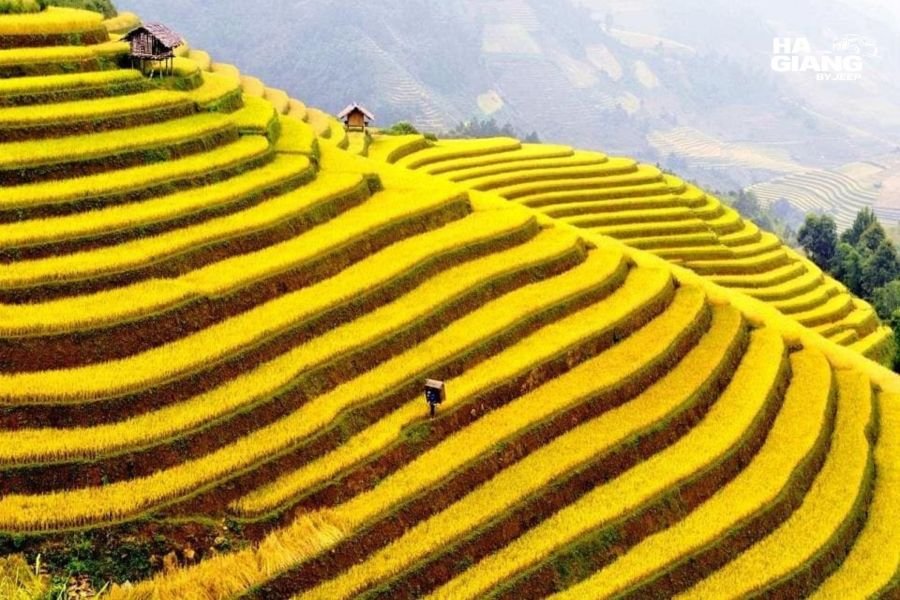
Ho Thau and Chieu Lau Thi
Chieu Lau Thi is the high peak of the district, up around 2,400 metres, and the road toward it climbs through pine and tea. On a clear morning this is the best cloud hunting in the region, with ridgelines floating above a solid white sea. On a bad morning you see fifteen metres of grey. Both are worth the drive, and the weather decides.
Thong Nguyen and the Tea Hills
Ancient Shan Tuyet tea trees grow between the terraces here, some of them old enough that harvesters climb into the branches. The combination of dark tea foliage against bright terraces is the most distinctive photograph you will take in Hoang Su Phi, and almost nobody has it in their album.
The Road Itself
Some of the strongest views are simply pull offs on the provincial road, unmarked and unnamed. This is where a local driver earns their fee. Ours grew up in these mountains and knows which shoulder is wide enough to stop on safely, which matters when you are on a slope with a drop on one side.
People, Markets and Food
The Hoang Su Phi rice terraces are farmed by one of the most ethnically layered populations in the north. Red Dao women in embroidered panels and heavy silver, La Chi families whose villages sit deep in the terraces, Nung, Tay and Hmong communities each farming a different altitude band. Traditional dress here is worn because it is worn, not for visitors.
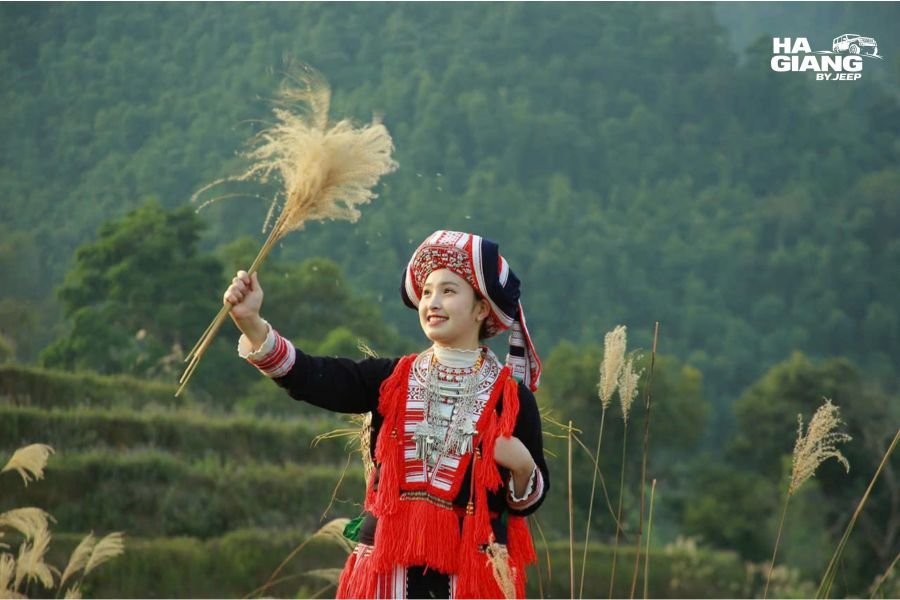
Markets are the best place to see all of this at once. The main market in the district town runs weekly and pulls people in from valleys hours away on foot. Stalls sell tea, corn wine, medicinal roots, dyed cloth, and breakfast to whoever is standing there. If your travel dates line up with a market morning, prioritise it over another viewpoint.

Food worth trying while you are out west:
- Com lam: sticky rice cooked inside bamboo, sold at roadside stalls.
- Thang den: warm glutinous rice balls in ginger syrup, best on a cold evening.
- Banh cuon trung: steamed rice rolls with egg, served with hot broth rather than fish sauce.
- Chao au tau: a thick, slightly bitter porridge that locals eat in cold weather.
- Shan Tuyet tea: buy it at the source in Thong Nguyen, not in a city shop.
- Ruou ngo: corn wine, poured generously at homestay dinners.
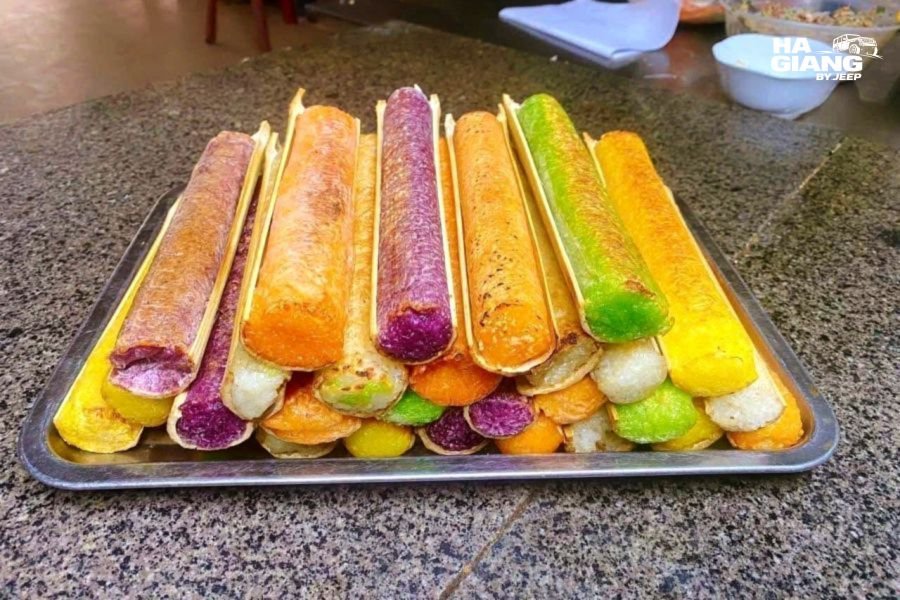
This is one of the quiet advantages of traveling by jeep. You can stop at any roadside stall or market that looks good, leave bags in a locked vehicle, and accept a glass of corn wine at dinner without worrying about who is driving in the morning. Your driver is.
Combining Hoang Su Phi With the Ha Giang Loop
The honest answer is that the Hoang Su Phi rice terraces are a detour, not a stop. West and north are opposite directions from Ha Giang City, and any plan that pretends otherwise is compressing something.
There are three sensible ways to handle it.
- Add days. Give the terraces their own dedicated time before or after the loop, driving out from Ha Giang City and back. This is the version that actually works.
- Choose one. If you have three days total, do the loop properly or do the west properly. Both are excellent. Half of each is neither.
- Go long. Travelers with a week or more can pair the western terraces with the full loop and continue east toward Cao Bang, which is a completely different landscape again.
If you are still deciding how much time to give the region, our team can map the options against your actual arrival and departure dates. The three day Ha Giang Loop jeep tour and the four day version both run as private departures, so extending or reshaping them is a conversation rather than a problem.
Which Jeep Tour Is Right for You?
3 days, 2 nights
Short Loop
For travelers on a tight schedule. Big landscapes, efficient routing, no wasted hours.
See the 3 day tour4 days, 3 nights
Full Loop, Slower
The full loop at a human pace, with more villages, more walking and room for detours like the western terraces.
See the 4 day tour5 days, 4 nights
Ha Giang and Cao Bang
Ending at Ban Gioc Waterfall and Nguom Ngao Cave. Two UNESCO Global Geoparks in one trip.
See the 5 day tour6 days, 5 nights
The Long Version
The slowest and most complete route, with time for Pac Bo, Ngoc Con Valley and the quiet valleys between the provinces.
See the 6 day tourSelf drive
Jeep Wrangler Rubicon Rental
Confident drivers who want the mountains on their own terms. We brief you on conditions before you leave.
See rental detailsNot sure which fits? Tell us your dates, how many nights you have and whether the Hoang Su Phi rice terraces are the priority, and we will say plainly which option we would book ourselves.
What to Pack and How to Prepare
The Hoang Su Phi rice terraces sit at altitude and the weather here is its own thing. Pack for a mountain, not for Hanoi.
- Layers. Mornings at ridge level are cold most of the year, even when the valley is warm by noon.
- Rain shell. Light, packable, better than an umbrella on an exposed slope.
- Shoes with grip. Terrace paths are packed mud and stone, and they get slick within minutes of rain.
- Cash in small notes. Village stalls, homestays and markets are cash economies. Card acceptance is limited outside the towns.
- Offline maps. Signal comes and goes in the valleys. Download the area before you leave the city.
- Power bank. Homestay electricity is reliable enough, but you will take more photographs than you expect.
- Sun protection. Altitude sun is stronger than it feels at 20 degrees.
- A real camera if you own one. Phones handle the wide views poorly when the light is flat.
Paperwork is worth one line. Some communes near the border have their own access rules, and those rules change. Our office handles anything required for the routes we run, but if you are traveling independently, ask locally and check latest updates rather than relying on a blog post.
Common Mistakes Travelers Make Here
Most of the disappointment we hear about the Hoang Su Phi rice terraces comes down to timing and pace rather than bad luck.
- Arriving one week off. The single most common regret. Water season and harvest are short, and a week either side changes the photograph completely.
- Treating it as a half day. People try to squeeze the west into a morning between other plans and end up seeing one valley through a windscreen.
- Trusting exact stop to stop timings. Any source that publishes precise driving times between mountain villages is guessing. Weather, road works and harvest traffic all rewrite the day.
- Chasing one famous viewpoint. The area is a landscape, not a monument. The best light usually lands somewhere nobody has geotagged.
- Skipping the market. Market mornings are the cultural high point and they only happen on certain days.
- Underestimating the cold. Winter and early spring mornings up near Chieu Lau Thi are genuinely cold. Bring a proper jacket.
- Booking too late in high season. Harvest weeks fill early, and vehicle availability is the constraint, not accommodation.
On general caution: as anywhere with visitors, agree on the price before you accept a service, be wary of anyone offering to arrange paperwork informally, and use operators with a physical address you can visit. Ours is in Ha Giang City and the door is open.
Traveling Responsibly in the Terraces
The Hoang Su Phi rice terraces are somebody's income before they are anybody's photograph. A few habits make a real difference.
Stay on established paths and dikes, and if a farmer waves you off a section, take the hint immediately. A collapsed dike means a drained field and a lost crop. Ask before photographing people, especially older women and children, and accept no as an answer. Buy something from the household whose land you are standing on, tea or wine or lunch. Take your rubbish back to town, since village waste collection is minimal. And keep noise down in homestays after dark, because everyone around you is up before dawn to work.
Ready when you are
See the terraces properly
Private jeep, English speaking local driver, soft top and heating for cold mornings, and a route through the Hoang Su Phi rice terraces shaped around the season you are traveling in. We hold your dates with 20% upfront to prepay homestays, driver and permits, and the remaining 80% is cash on arrival.
Office in Ha Giang City. Support 24/7. booking@hagiangbyjeep.com
Hoang Su Phi Rice Terraces FAQ
They are in the far west of Ha Giang, out toward the Lao Cai border, roughly opposite the Dong Van Karst Plateau on the map. The terraces spread across a cluster of communes rather than one single site, so the whole district is the attraction.
Two windows stand out: water pouring season around May into June, and golden harvest around September into early October. Green season in midsummer is beautiful and much quieter. Exact timing shifts each year with the weather, so check latest updates close to your dates.
No. The classic loop runs north and east from Ha Giang City through Quan Ba, Yen Minh, Dong Van and Meo Vac. The Hoang Su Phi rice terraces lie southwest and need their own dedicated time, which is why we treat it as an extension rather than a stop.
Give it a minimum of a full day of driving and stopping, and two days if you want a market morning and a sunrise above the cloud line. Travelers combining the west with the full loop usually need five days or more in the region.
Some communes close to the border have their own access requirements and those rules change over time. Our office arranges whatever is needed for the routes we operate. Independent travelers should ask locally and check latest updates rather than assume.
Yes, and this is one of the main reasons people book a jeep. You can see the best of the landscape from viewpoints and short level walks, with a comfortable vehicle between stops and no long trekking days required.
Families travel with us often. A private 4x4 means flexible timing, room for bags and snacks, and the ability to cut a day short if a child has had enough. Homestay dinners tend to be a hit, since there are usually other kids around.
Mostly in village homestays: simple, clean, family run, with shared dinners and thin walls. There are a few small hotels in the district town. In harvest season the good homestays fill early, so booking ahead matters.
Signal is patchy in the valleys and better on the ridges. Card payment is rare outside the district town, so carry cash in small notes and download offline maps before you leave Ha Giang City.
Shoes with real grip, trousers you do not mind getting muddy, and layers. The paths are packed earth on the edge of flooded fields, and they become slippery within minutes of rain.
Yes, on a longer trip. Travelers with six days or more can take in the western terraces, the full loop and then continue east to Cao Bang for Ban Gioc Waterfall and Nguom Ngao Cave. It is a big journey and it works best at a slow pace.
Send us your travel dates through WhatsApp, the contact page or the booking form, and we will build the route around the season. We hold the vehicle with 20% upfront to prepay homestays, driver and permits, and the remaining 80% is paid in cash on arrival.
A Last Word Before You Go
The Hoang Su Phi rice terraces reward patience more than planning. Give them a whole day, start before the fog lifts, stop when the light is good rather than when the schedule says, and talk to the people whose fields you are photographing. Do that and you will understand why so many travelers who come for the famous loop end up talking about the west instead.
When you are ready, Ha Giang by Jeep is in Ha Giang City with the vehicles, the drivers and the weather reports. Come and see it while the light is right.