
Ha Giang by Jeep · Village Guides
Lo Lo Chai Village Near Lung Cu: What to See, Eat and Do
Some stops on the Ha Giang Loop hit you at full volume. This one whispers.
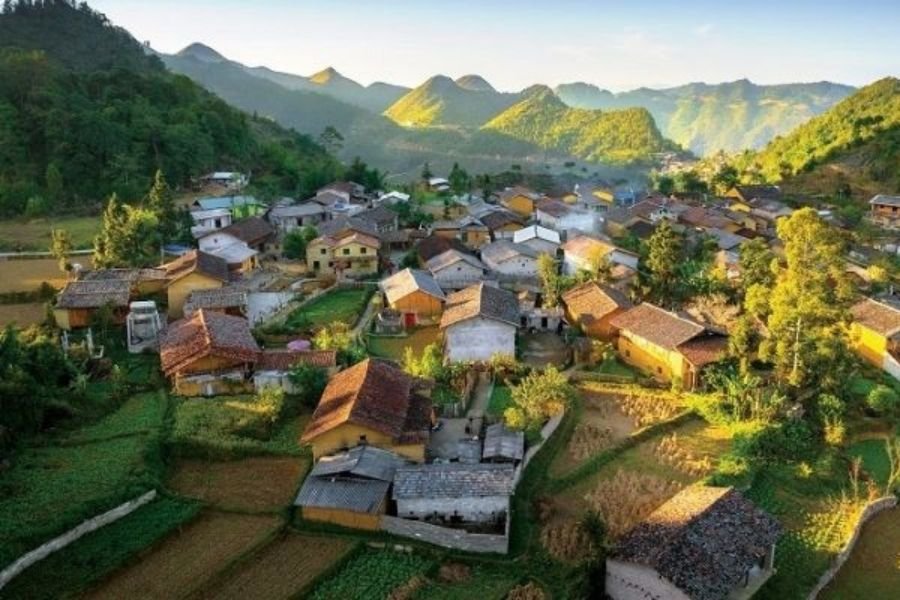
Most travellers meet Lo Lo Chai Village by accident. They head north to Lung Cu because the flag tower sits on every map of northern Vietnam, they climb the steps, they take the photograph, and then, walking back down, someone points at a cluster of ochre walls and grey tiled roofs in the fields below. That cluster is Lo Lo Chai Village, and it repays anyone willing to stop for an hour instead of five minutes.
This guide covers what Lo Lo Chai Village is, who lives there, what there is to see, where to sleep, what to eat nearby, when to come and how it fits into a longer trip across the Dong Van Karst Plateau. No invented driving times and no invented prices: only the things that actually help you plan. Where a detail can change from season to season or year to year, that is said plainly rather than smoothed over.
Why Lo Lo Chai Village Is Worth More Than Ten Minutes
The northern tip of Vietnam has a reputation problem. It gets treated as a box to tick: drive up, climb the tower, photograph the flag, drive back. Plenty of people do exactly that and leave feeling faintly cheated, because a flagpole on a hill is a flagpole on a hill.
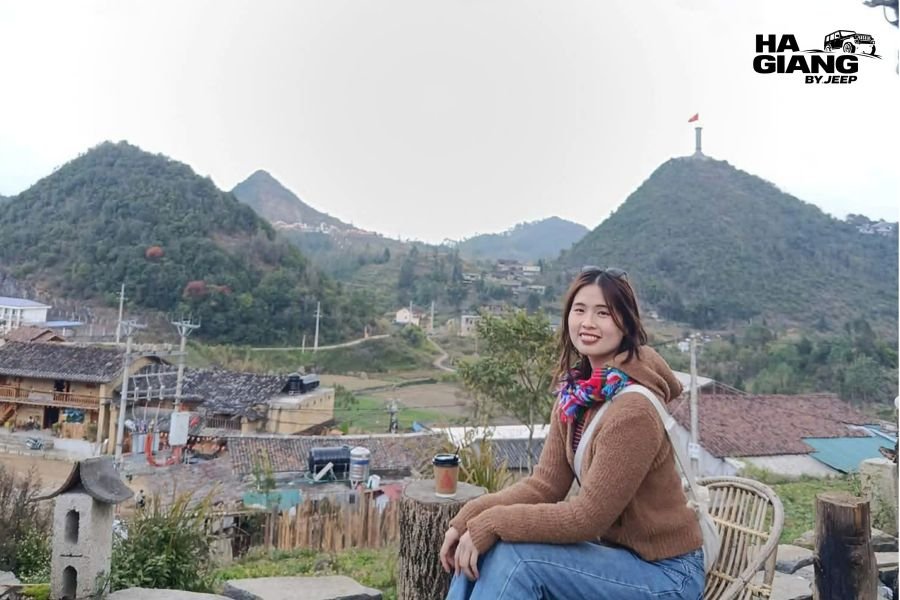
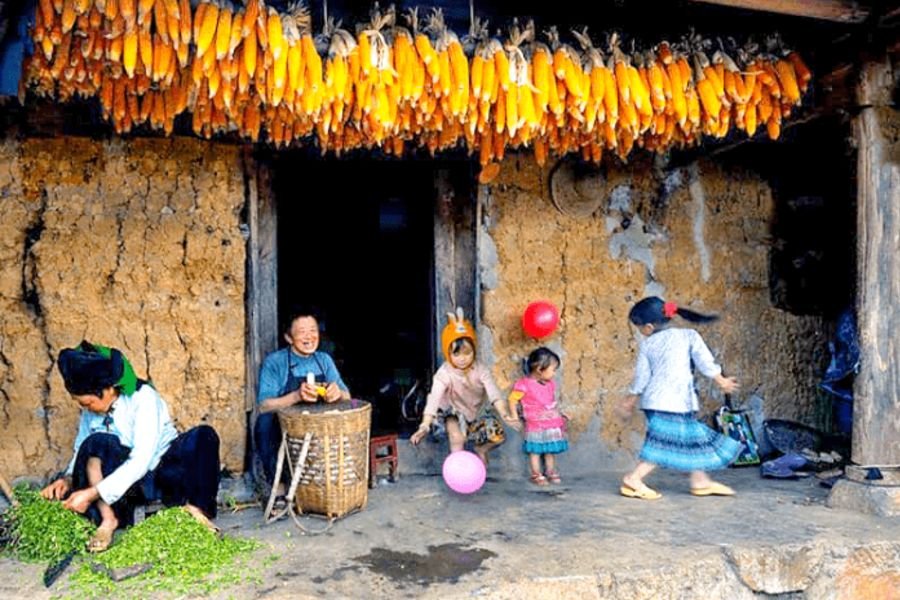
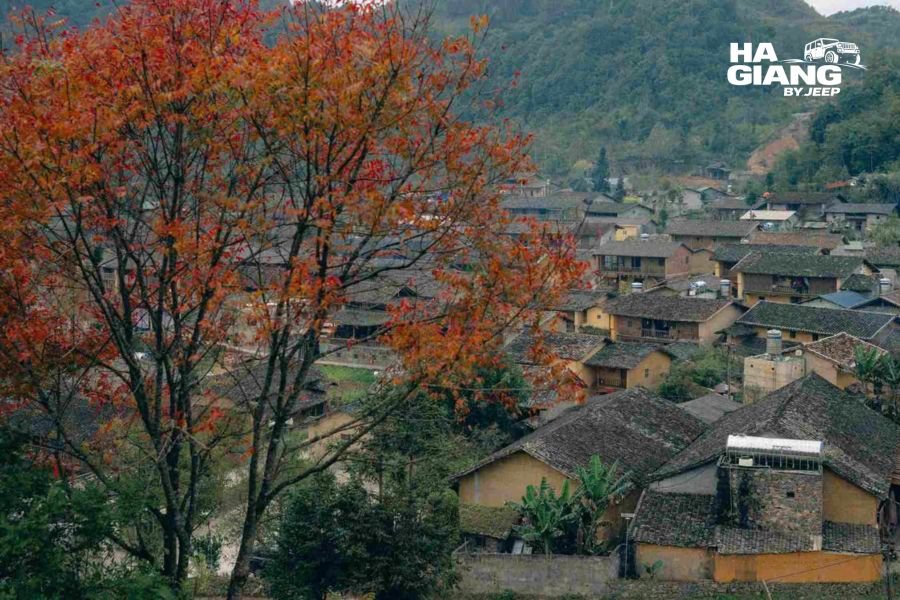
The village below is the part that stays with you. It is a working settlement, not a reconstruction. Corn dries on wooden racks. Water buffalo come home along the lanes at dusk. Someone is always repairing something. The houses are built the way houses here have been built for a very long time, with thick walls of packed earth that hold warmth through the cold months and stay cool when the sun finally burns off the fog.
There is also a quality of light in Lo Lo Chai Village that photographers get slightly obsessive about. The walls are the colour of turmeric and clay. The roof tiles are grey and mossy. When mist moves through the lanes in the early morning, the whole place looks like it has been lit from inside.
None of that shows up in a ten minute stop. It shows up when you sit down with a coffee, let Lo Lo Chai Village get on with its day and stop treating it as a backdrop.
Where Lo Lo Chai Village Sits, and Why That Matters
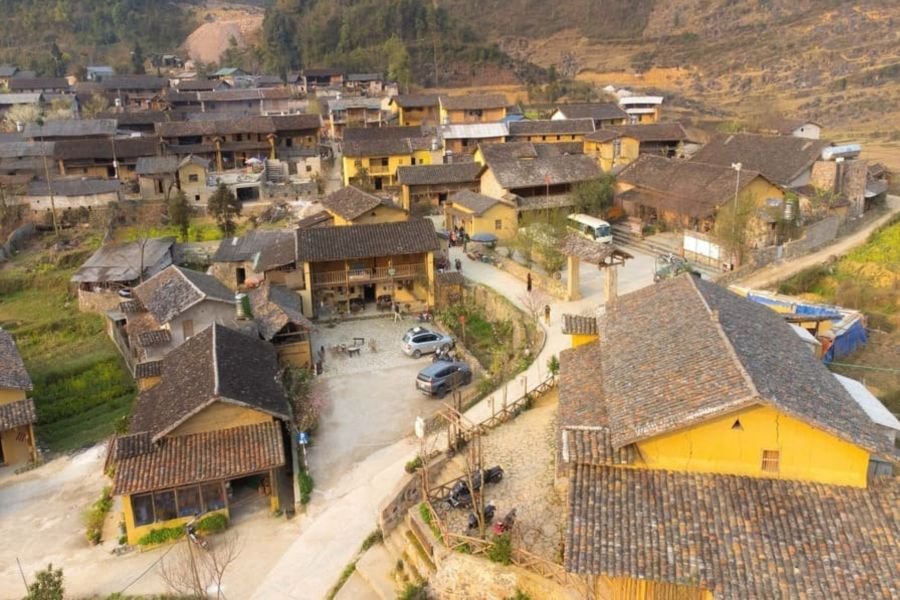
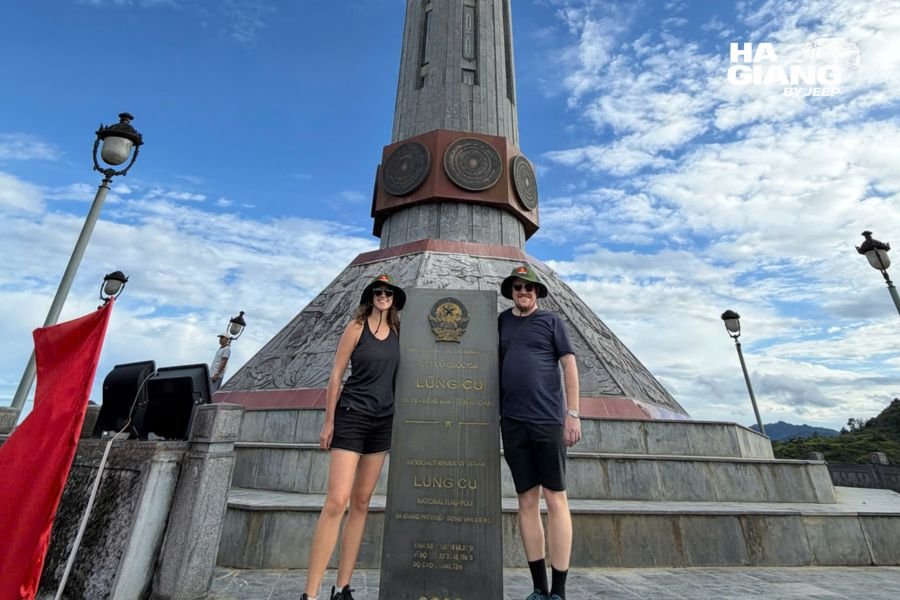
Lo Lo Chai Village sits at the foot of Lung Cu Flag Tower, in the Lung Cu area at the far northern end of Ha Giang, close to the frontier with China. It is the last real village before the country runs out of Vietnam.
Geographically this is the top edge of the Dong Van Karst Plateau, a UNESCO Global Geopark of grey limestone spires, sinkholes and thin ribbons of farmland squeezed between the rock. The landscape around Lung Cu is gentler than the vertical drama of Ma Pi Leng Pass further east, more rolling and open, with fields of corn and buckwheat instead of sheer cliff.
Practically, Lo Lo Chai Village sits on a spur off the main circuit. The classic loop route runs Ha Giang City to Quan Ba to Yen Minh to Dong Van to Meo Vac, and Lung Cu hangs above Dong Van as a detour rather than a waypoint. That is exactly why some short itineraries skip it, and exactly why it stays quieter than Dong Van Old Quarter or the viewpoints along Ma Pi Leng.
Places you are likely to pass on the same stretch of the plateau:
- Sung La Valley, the flower filled bowl on the road up from Yen Minh
- Pho Bang, a faded old town of ochre walls behind a low ridge
- Vuong Family Palace, the former residence of the Hmong king in Sa Phin
- Dong Van Old Quarter, the stone and timber core of Dong Van town
- Ma Pi Leng Pass and the Nho Que River gorge, east of Dong Van
- Meo Vac, the market town at the far end of the pass
If your itinerary is tight, Lung Cu and Lo Lo Chai Village are the first things a rushed schedule drops. If your itinerary has room, they are the reason the trip feels different from everyone else's photographs.
The detour to Lung Cu is the clearest argument for taking four days instead of three. The Ha Giang Loop Jeep Tour 4 Days has the slack to include the northern tip without turning the day into a race.
Who the Lo Lo People Are
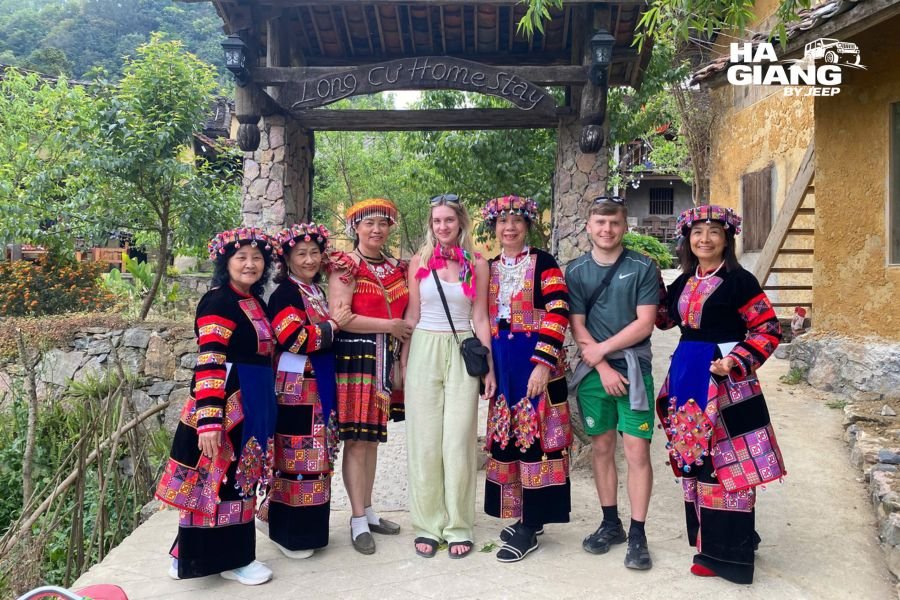
Lo Lo Chai Village takes its name from the Lo Lo ethnic minority, one of the smallest recognised ethnic groups in Vietnam. Most of the households here are Lo Lo, with some Hmong families alongside them.
Two things tend to surprise visitors. The first is the clothing. Lo Lo dress is some of the most elaborate in the north: dense geometric embroidery, patchwork panels stitched in triangles and squares, silver ornament, headwraps that take real skill to tie. It is not a costume kept in a cupboard for tourists. You will see the everyday versions worn while someone sweeps a courtyard, and the full versions come out for weddings, funerals and festival days.
The second is the bronze drums. Lo Lo communities have kept bronze drum traditions alive far longer than most groups in the region, and the drums carry ritual weight rather than decorative value. They are used at specific ceremonies, kept carefully, and treated as belonging to the community rather than to an individual. If you are lucky enough to be around when they are played, listen and stay out of the way.
Lo Lo households in this area farm corn and vegetables on very thin soil, keep small livestock and, increasingly, host visitors. Community based tourism has arrived here in a measured way, which is part of the reason Lo Lo Chai Village still looks like itself.
What Lo Lo Chai Village Actually Looks Like
The houses
The signature building style is the rammed earth house, walls built by packing damp earth into wooden forms in layers, then removing the forms and letting the sun do the rest. The result is a wall thick enough to stand on the windowsill of, coloured somewhere between mustard and dry clay, topped with yin and yang roof tiles that curve and interlock without mortar.
These walls are the reason Lo Lo Chai Village photographs so well and the reason the houses are comfortable in a climate that swings from frost to full sun. They are also slow and expensive to build, which is why you will see newer brick and concrete construction appearing at the edges. Look for the difference: it tells you something honest about how life here is changing.
The lanes and the fences
Between the houses run narrow lanes edged with dry stone walls, stacked without cement, following whatever line the ground allowed. Every courtyard has a job to do. Corn hangs in bundles under the eaves. Firewood is stacked with unreasonable neatness. Peach or plum trees stand in the corners of the yards, which is why the village looks completely different for two or three weeks in early spring.
The coffee house
There is a small coffee house in Lo Lo Chai Village, set up inside a restored earth home, that has become the reason a lot of people extend their stop. The Lo Lo Chai coffee operation is modest by design: a few tables, a wood fire, and no attempt to look like anywhere else. It is associated with a Japanese resident who settled here and worked with local families on the restoration, and it serves as a quiet meeting point between visitors and villagers rather than a tourist trap. Opening hours are informal and can change, so treat it as a bonus rather than a fixed plan.
Sitting there with a coffee, watching the fog move through the lane outside, is the single best argument for building slack into your northern Ha Giang schedule.
Lung Cu Flag Tower: The Climb Above the Village
The flag tower stands on Dragon Mountain directly above the village. It is an octagonal tower faced with reliefs drawn from Dong Son bronze drum motifs, and the flag it flies is a large one, commonly described as fifty four square metres, one square metre for each of Vietnam's recognised ethnic groups. Below the hill lie two ponds that local stories describe as the dragon's eyes, said never to run dry.
Getting up there means a staircase, then a second, tighter spiral staircase inside the tower itself to reach the viewing balcony. The step count gets quoted confidently on the internet and the access arrangement has changed more than once, so check current conditions locally rather than planning around a number you read somewhere. Ticketing and vehicle access at the base can also change.
Two honest observations:
- The view is better than the tower. From the balcony you get the plateau in every direction, the border ridge to the north, and Lo Lo Chai Village laid out below you like a model. On a clear day it is genuinely worth the steps. In heavy fog you will see about twelve metres of white.
- The climb is manageable but not trivial. It is a stair climb at altitude, often in cold damp air. Guests in their sixties and seventies do it regularly, at their own pace, with a rest partway. If steps are a problem, the village below is flat, and the view of the tower from the lanes is arguably the better photograph anyway.
Things to Do in Lo Lo Chai Village
This is not a place with an attractions list. It is a place with a rhythm. The things worth doing are mostly about matching it.
Walk the full loop of lanes. It takes maybe thirty to forty minutes at a slow pace and it is the whole point. Go beyond the first two lanes where everyone stops. The far side of the village is quieter and the walls are older.
Sit down for coffee or tea. Not to consume it quickly. To be stationary long enough that the village stops noticing you.
Look at textiles properly. Several households sell embroidery and stitched panels made in the village. Buying directly from the person who made a piece puts money exactly where it should go, and the work is extraordinary when you see it up close.
Climb the tower early or late. Mid morning tends to bring the largest groups. Early light and late afternoon light are both better, and the crowd is thinner at both ends of the day.
Watch the courtyards. Corn being shelled, tobacco drying, someone weaving. None of it is staged, which is precisely why it is interesting.
Sleep here if your schedule allows. More on that below, but Lo Lo Chai Village after the day visitors leave is a completely different experience.
Photograph the fields, not just the houses. Depending on season you get corn, buckwheat flowers, mustard greens or bare terraces with fog pouring over the ridge behind them.
Take the Northern Tip Slowly
A private jeep changes what a stop at Lo Lo Chai Village can be. No parking hassle at the tower, no schedule dictated by anyone else's group, warm dry seats waiting when the fog closes in, and the freedom to say "let's stay another half hour" without anybody minding.
Tell us your dates and we will say honestly whether Lung Cu fits your trip, or whether you would enjoy the plateau more without it.
Staying Overnight: Homestays in Lo Lo Chai Village
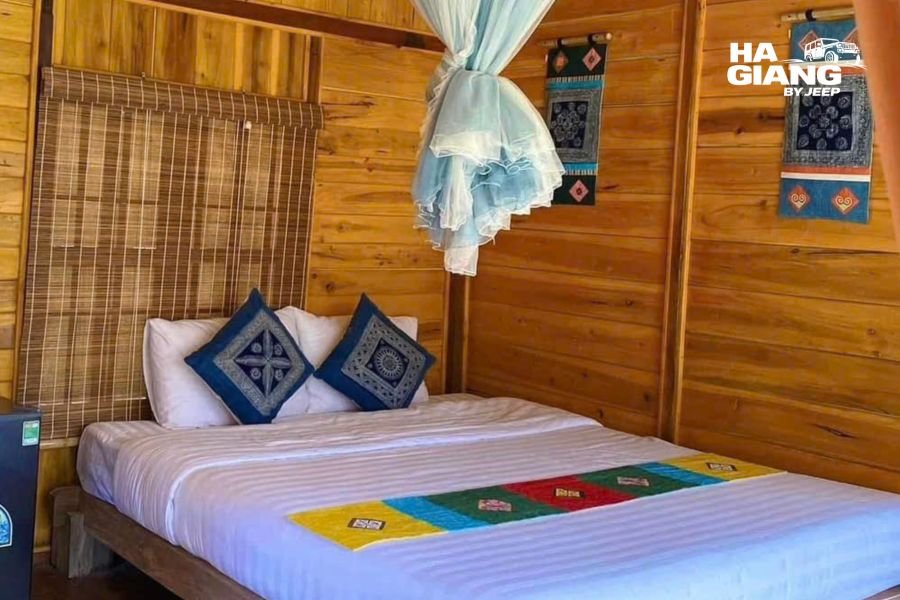
Several families in Lo Lo Chai Village host guests in restored earth houses. A Lo Lo Chai homestay is a family home first and accommodation second, so standards vary between households. That is not a criticism: it is a village, not a hotel district.
What to expect in general terms:
| What | Typically the case |
|---|---|
| Rooms | Simple. Firm mattress or futon style bedding, thick blankets, sometimes shared rooms and sometimes private ones |
| Bathrooms | Usually a shared bathroom in a separate structure. Hot water is common but not universal |
| Heating | Wood or charcoal warmth in communal areas rather than central heating. The earth walls do most of the work |
| Food | Home cooked dinner and breakfast, often eaten together with the family |
| Language | Basic English at best in most households. This is where having a local driver who speaks both languages changes the evening completely |
| Payment | Cash. Do not count on cards or reliable machines this far north |
Two practical notes. First, in the coldest months bring genuinely warm layers, including something to sleep in. The altitude and the damp make it feel colder than a thermometer suggests. Second, if you have specific dietary needs, say so well ahead rather than at the table, because ingredients here are bought locally and not always substitutable at short notice.
Booking arrangements, capacity and availability change constantly, particularly around festivals and Vietnamese public holidays. If an overnight in the far north matters to you, it needs to be arranged in advance rather than improvised on the day.
What to Eat Around Lung Cu and Dong Van
Lo Lo Chai Village itself has limited eating options beyond homestay meals and the coffee house. The food story of this region really plays out in the markets and small kitchens of the surrounding towns, most of which sit within comfortable reach on the same day.
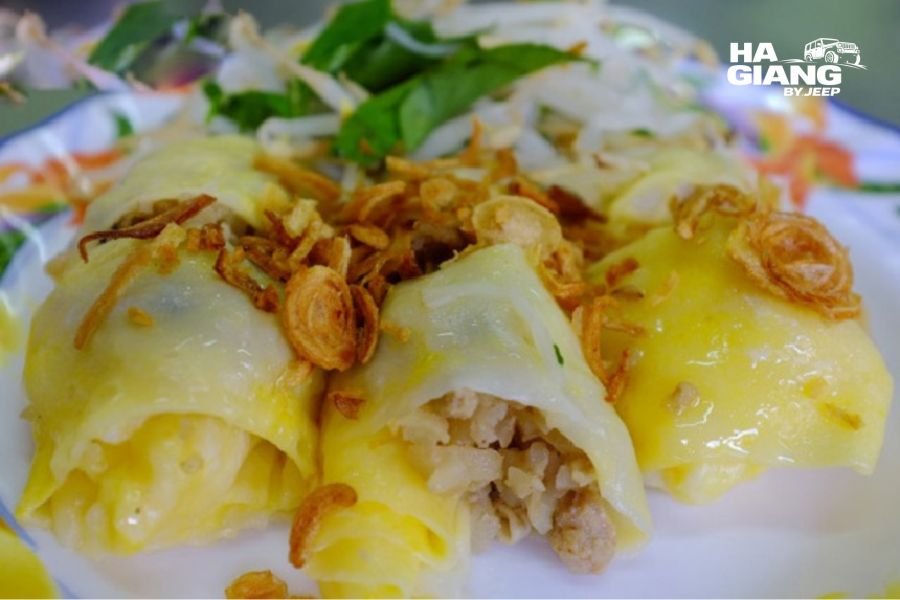
- Banh cuon trung, steamed rice rolls filled with egg and pork, served with a bowl of hot broth rather than a dipping saucer. Dong Van does this exceptionally well and it is the regional breakfast worth setting an alarm for.
- Thang co, the traditional highland stew found at markets. It is the most authentic dish in the region and also the one most likely to divide a group. Try it at a market, not at a restaurant catering to visitors.
- Chao au tau, a savoury porridge made with a mountain tuber, eaten mainly in the cold months. Warming, slightly bitter, completely local.
- Com lam, sticky rice cooked inside bamboo tubes over a fire, sold at roadside stops and markets.
- Thang den, glutinous rice balls in hot ginger syrup. A winter evening habit in Ha Giang City.
- Men men, steamed corn grits, the everyday staple of Hmong households across the plateau.
- Ruou ngo, corn wine distilled at village level, poured generously at homestay dinners.
That last one deserves a practical note. Corn wine is part of highland hospitality and refusing it outright can feel awkward. With a private jeep and a driver, an evening at a homestay stays an evening at a homestay, because nobody at the table has to worry about being fit to drive in the morning. It is a small thing that changes the whole texture of a trip.
Market days shape the region's calendar. Dong Van Sunday Market is the big one, and Meo Vac holds its own large market on Sundays too. Khau Vai, east of Meo Vac, is famous for its annual love market, which follows the lunar calendar and draws crowds from across the region. Dates shift, so confirm locally before building a plan around any of them.
Best Time of Year to Visit
The northern tip has its own weather, colder and foggier than the rest of the plateau. Here is the honest version by season.
| Season | Months | What it looks like | Watch out for |
|---|---|---|---|
| Late winter and spring | February to April | Peach and plum blossom in the courtyards, fresh green on the terraces, soft light | Persistent fog, cold mornings, blossom timing shifts every year |
| Early summer | May to June | Deep green everywhere, water in the fields, long daylight | Heat in the valleys, rising rainfall |
| Rainy season | June to August | Dramatic cloud, waterfalls at full strength, very few visitors | Heavy rain, slippery surfaces, occasional landslides and road repairs |
| Autumn | September to November | The best all round window. Clear air, gold rice in the valleys, buckwheat flowers usually late October into November | Buckwheat timing varies with weather and planting, so never guarantee it to yourself |
| Winter | December to January | Atmospheric fog, empty lanes, wood smoke, occasional frost on the highest ground | Genuinely cold, short days, long grey stretches with no view from the tower |
Two things worth internalising. Buckwheat flower season is the single most over promised thing in Ha Giang marketing. It is beautiful when it happens and it does not happen on a fixed date. Ask locally, and treat it as a bonus rather than the reason for the trip.
And fog is not a failure. Some of the best hours in Lo Lo Chai Village happen when visibility drops to nothing and the village becomes a sequence of shapes emerging from white. A closed top and a heater simply mean you can enjoy that instead of enduring it.

Getting There: Roads, Papers and Practicalities
The route. Lung Cu and Lo Lo Chai Village sit north of Dong Van on a spur road that climbs and winds. Surfaces on the main plateau roads are generally in reasonable condition and are actively maintained, but conditions genuinely change: repairs, weather damage and construction all happen, sometimes at short notice. Anyone who publishes exact journey times between individual stops in this region is guessing, and that guess falls apart the first time you meet a road crew or a herd of goats.
Border area rules. Lung Cu is close to the frontier. Border area regulations exist, they are applied at official discretion, and they can change. Carry your passport, keep it accessible, and use an operator who handles the paperwork side rather than finding out about a requirement at a checkpoint. Our office in Ha Giang City deals with permits as standard, which removes the question entirely.
Money. Bring cash in small notes. Card acceptance is minimal and machines are unreliable this far from the towns.
Connectivity. Mobile signal exists in most of the village but is not dependable. Download offline maps before you leave Dong Van.
Altitude and cold. Layers, a windproof outer shell and warm socks, even in shoulder season. Add a hat and gloves from November through February. Shoes with grip matter on wet stone lanes.
Accessibility. The lanes of Lo Lo Chai Village are uneven stone and packed earth with gentle slopes. Most reasonably mobile visitors manage comfortably. The tower staircase is the limiting factor for anyone with knee or breathing issues, and skipping it costs you very little.
The drive north to Lung Cu is exposed and often cold and wet. A 4x4 with a soft top and a heater means you arrive warm and dry rather than needing twenty minutes to recover. That is what "adventure without exhaustion" actually means in practice. See the Ha Giang Loop Jeep Tour 3 Days for the short version of the loop, or get in touch to talk through timings.

Photography and Etiquette in a Living Village
People live here. That single fact should shape everything about how you behave, and most visitors get it right instinctively. A short list anyway, because the details matter:
- Ask before photographing a person. A gesture at the camera and a smile is understood everywhere. If the answer is no, that is the end of it.
- Do not photograph inside houses uninvited, and never photograph an ancestral altar without explicit permission. Altars are the most sacred object in the home.
- Do not walk into courtyards that are clearly private space unless you have been asked in.
- Skip the sweets and the money for children. It creates dependence and turns visitors into a resource. If you want to contribute, buy something made in the village or stay the night.
- Keep the volume down. Speakers and drones both carry a very long way in a quiet valley.
- Dress normally. Nobody expects formal clothing, but this is a conservative rural community.
- Buy directly. Embroidery bought from the woman who stitched it is worth more to the village than anything else you will spend that day.
Lo Lo Chai Village looks the way it does because families chose to keep it that way and to restore rather than replace. Visiting respectfully is the reason that choice keeps making sense.
Mistakes Travellers Make at Lo Lo Chai Village
Treating it as a car park with a view. Lung Cu is not the destination. Lo Lo Chai Village at the bottom of the hill is.
Arriving at the wrong hour. Late morning and early afternoon bring the largest groups, and much of Lo Lo Chai Village is out working. Early morning and the hour before dusk are when it comes alive.
Building the plan around buckwheat flowers. See above. Great if you get it, disappointing if you have promised yourself.
Underestimating the cold. People arrive from Hanoi in a t shirt and spend the visit shivering. The northern tip runs several degrees colder than anywhere they have been so far.
Cramming Lung Cu into a schedule that cannot absorb it. Adding the northern spur to an itinerary already full of stops turns the whole day into transit. Either give it space or leave it for the next trip.
Expecting a performance. No shows, no scheduled dancing, no costumed greeters. That absence is the point.
Assuming everything is fixed. Opening hours, ticket arrangements, market dates and access rules all move. Check locally on the day. Anyone who tells you the northern tip runs on a fixed timetable has not been recently.
Which Jeep Tour Is Right for You?
Lo Lo Chai Village fits comfortably into most of our routes. The question is really how much room you want around it.
Ha Giang Loop Jeep Tour 3 Days
Quan Ba, Yen Minh, Dong Van, Ma Pi Leng, Meo Vac. Right for travellers on a tight schedule who want the headline landscapes done well. The northern spur to Lung Cu is possible but tightens the day, so we will be straight with you about the trade off when you ask.
View the 3 days tourHa Giang Loop Jeep Tour 4 Days
The version we recommend for anyone who wants the north properly. The extra day is what turns Lung Cu and Lo Lo Chai Village from a rushed detour into a real stop, with time for the village lanes, the coffee house and the tower without watching the clock.
View the 4 days tourHa Giang to Cao Bang Jeep Tour 5 Days
The loop plus the road east into Cao Bang, ending at Ban Gioc Waterfall. Two UNESCO Global Geoparks on one trip, and a landscape that changes character completely once you cross out of the limestone.
View the 5 days tourHa Giang to Cao Bang Jeep Tour 6 Days
The slower version of the same route, with room for Pac Bo, Ngoc Con Valley and the quieter corners around Ban Gioc that the five days version passes.
View the 6 days tourJeep Wrangler Rubicon Rental
For confident drivers who want the vehicle and the freedom without a driver. Best suited to travellers with real experience of mountain roads and enough time to be flexible about the weather.
View jeep rentalNot sure? Send us your dates and who is travelling and we will recommend honestly, including telling you when a shorter trip is the better call.
Frequently Asked Questions
Lo Lo Chai Village sits directly below Lung Cu Flag Tower at the far northern end of Ha Giang, near the frontier with China. It is roughly north of Dong Van town, reached by a spur road off the main loop circuit.
Yes, if you give it time. As a five minute photo stop it is unremarkable. As an hour of walking the lanes, sitting with a coffee and watching a working village go about its day, it is one of the most memorable stops on the plateau.
Plan for at least one hour in Lo Lo Chai Village on top of the time you spend at the flag tower. Two hours is better. An overnight stay is a different experience again, because the village empties of day visitors in the late afternoon.
Yes. Several families run homestays in restored earth houses, and a Lo Lo Chai homestay usually means sleeping inside a house built the traditional way. Expect simple rooms, shared bathrooms, home cooked meals and warm blankets rather than hotel amenities. Arrange it in advance, especially around holidays and festivals.
There is a small coffee house set inside a restored traditional home, connected to a Japanese resident who has worked with local families on restoration. Hours are informal and can change, so treat it as a happy bonus rather than a fixed appointment.
Lung Cu lies in a border area, and border area rules exist and can change. Always carry your passport. Booking through an operator based in Ha Giang City means the paperwork side is handled for you rather than discovered at a checkpoint.
The village itself is flat enough and easy to walk, which makes it one of the friendlier stops for older travellers and for families. The staircase up the flag tower is the demanding part, and it is entirely optional.
Warm layers, a windproof and waterproof outer shell, shoes with grip for wet stone, and cash in small notes. Add a hat and gloves between November and February. The northern tip runs colder and foggier than anywhere else on the loop.
Ask first, every time. A gesture at your camera and a smile works. Never photograph inside a home or near an ancestral altar without clear permission, and skip the drone unless you have genuinely established that it is welcome.
September to November is the strongest all round window for clear air and harvest colour, with buckwheat flowers usually appearing late October into November. February to April brings blossom in the courtyards. Timing shifts every year, so check current conditions before committing.
Yes. Our five and six days itineraries run the Ha Giang Loop first and then continue east into Cao Bang, finishing at Ban Gioc Waterfall inside the Non Nuoc Cao Bang UNESCO Global Geopark.
Send us your travel dates, group size and how much time you have, either through the contact page or on WhatsApp. We will tell you which itinerary fits and whether Lung Cu can be included without spoiling the rest of the trip.
Plan Your Visit
Lo Lo Chai Village rewards patience more than planning. Arrive with time you are willing to lose track of, treat it as somebody's home rather than a viewpoint, and it will be the stop your group talks about long after the big passes have blurred together.
If you want it in your itinerary, the practical part is simple. Tell us your dates and who is travelling. We will put together a route that reaches the northern tip without turning the day into a sprint, with a private 4x4, a driver who was born in these mountains, border paperwork handled and 24/7 support from our office in Ha Giang City.
Secure Your Spot: we take 20% upfront to prepay homestays, driver and permits; 80% cash on arrival. That is how the families and drivers up here get paid on time, and it is why the arrangements hold when you turn up.