
Lung Tam Linen Village: Inside H'Mong Weaving in Ha Giang
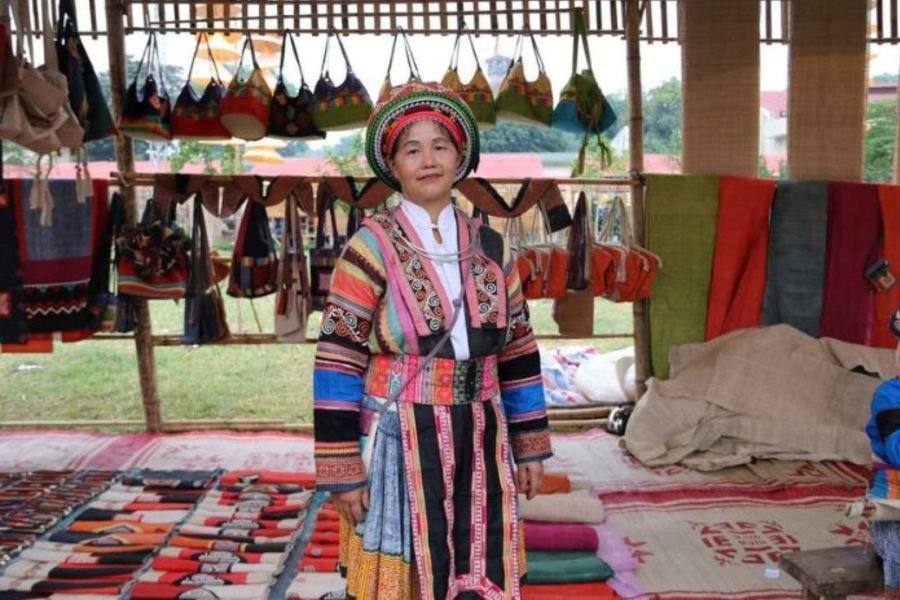
Most travellers drive straight past the turning. The road out of Quan Ba climbs, the valley opens up, and somewhere below sits a green bowl of rice terraces where the loudest sound is a wooden loom.
Lung Tam Linen Village is the reason a lot of people slow down on their second day in the mountains. It is a working H'Mong commune in Quan Ba district, roughly an hour of mountain driving north of Ha Giang City, and it produces some of the finest handmade hemp cloth in northern Vietnam. Not a museum. Not a staged performance. Women sit in courtyards splitting fibre with their thumbnails because that is how the thread gets made, and it has been made that way for a very long time.
This guide covers what the village is, how the cloth is actually produced, what you will realistically see on the day you turn up, what is worth buying, and how to fit it into a Ha Giang Loop trip without turning your morning into a rush.
What Lung Tam Linen Village Actually Is
Lung Tam is a commune, not a single building. It sits in a flat valley floor beside the Mien River, ringed by limestone hills, inside the Dong Van Karst Plateau UNESCO Global Geopark. The community here is mostly White H'Mong, and the thing that made the name travel beyond Vietnam is a weaving cooperative that turned a household skill into a livelihood.
What you find on the ground is a cluster of workshops, courtyards and drying racks. Hemp stalks stacked against walls. Skeins of pale thread hanging in the sun. A room at the end with finished pieces folded on shelves. Somewhere behind it, a vat of indigo that smells like wet earth and something faintly sour.

Where Lung Tam Sits on the Ha Giang Loop
Geographically this is an early stop. Coming north from Ha Giang City you pass Quan Ba, the Twin Mountains viewpoint and Heaven's Gate, then the road drops toward Yen Minh. Lung Tam is off that main artery, down in the valley, which is exactly why so many people skip it: you have to deliberately turn off and come back up again.
That detour is the whole point. Almost everything else on the northern loop is a viewpoint. This is one of the few stops where you watch people work.
Hemp, Not Flax: Why Locals Call It Linen
A small clarification that saves confusion later. Everything here is woven from hemp, the tall fibrous plant the H'Mong have grown for generations for cloth. True linen comes from flax. Both are bast fibres, both are stripped from the stalk, both are processed in broadly similar ways, and the English signage in Ha Giang settled on the word "linen" decades ago.
So when you see "Lung Tam Linen Village" on a sign or a shop label, read it as H'Mong hemp cloth. The fabric behaves like a heavy raw linen: stiff at first, cool in heat, and softer every time you wash it.
The Women Who Kept H'Mong Weaving Alive
By the late 1990s the skill was fading. Cheap machine cloth arrived, young women had better paid options, and the full hemp process takes an absurd amount of labour for the amount of fabric it yields. The cooperative in Lung Tam was founded in the early 2000s by a local H'Mong woman, Vang Thi Mai, who pulled a group of neighbours together and built a business around the one thing they all already knew how to do.
It worked. The cooperative gave village women a reason to keep growing hemp, an income that did not require leaving the valley, and a market beyond the weekly local one. Over the years the group has picked up recognition well outside Ha Giang, and its cloth has ended up in shops in Hanoi and further afield.
Membership, leadership and the size of the operation have shifted over the years. Ask on the day rather than trusting an old blog post, this one included.
How H'Mong Hemp Linen Is Made, Step by Step
This is the part worth understanding before you arrive, because once you know the sequence, a courtyard that looked like people sitting around suddenly reads as a production line. There are dozens of separate operations between a seed and a scarf. Here are the ones you can actually see.
1. Growing and Harvesting the Hemp
Hemp goes in during spring and grows fast and straight, planted densely so the stalks stay thin and the fibre stays long. Harvest comes in summer. The stalks are cut, stripped of leaves, and stood in bundles to dry until they rattle.
2. Splitting the Fibre
Dried stalks are cracked and the outer bark peeled away in long ribbons. Those ribbons are then split down by hand into threads barely thicker than a hair. Women do this while walking, while talking, while waiting for something else to finish. You will see bundles of raw fibre tucked into waistbands all over the village.
3. Joining the Thread
Each fibre is only as long as a stalk, so ends are twisted and spliced together into one continuous thread and coiled into a basket. No knots. A knot would show in the weave and catch in the loom. This single step consumes more hours than anything else in the process, and it is the reason a genuine handmade piece costs what it costs.
4. The Stone Roller
Raw hemp thread is stiff and rough. The fix is a curved stone slab that a woman stands on, balancing with her arms out, rocking it back and forth over a coil of thread laid on a flat rock. It looks like a balance exercise. It is mechanical softening, and it is very hard on the legs.
5. Boiling and Whitening
The thread is boiled repeatedly with wood ash, then rinsed in the river and dried in the sun. Each cycle strips out gum and lightens the colour from grey brown toward off white. It gets repeated until the weaver is satisfied, which can be many rounds.
6. Spinning and Warping
The softened thread is wound onto spindles and then measured out onto a warping frame, thread by thread, to set the length and width of the finished cloth. Get this wrong and the whole piece is wrong.
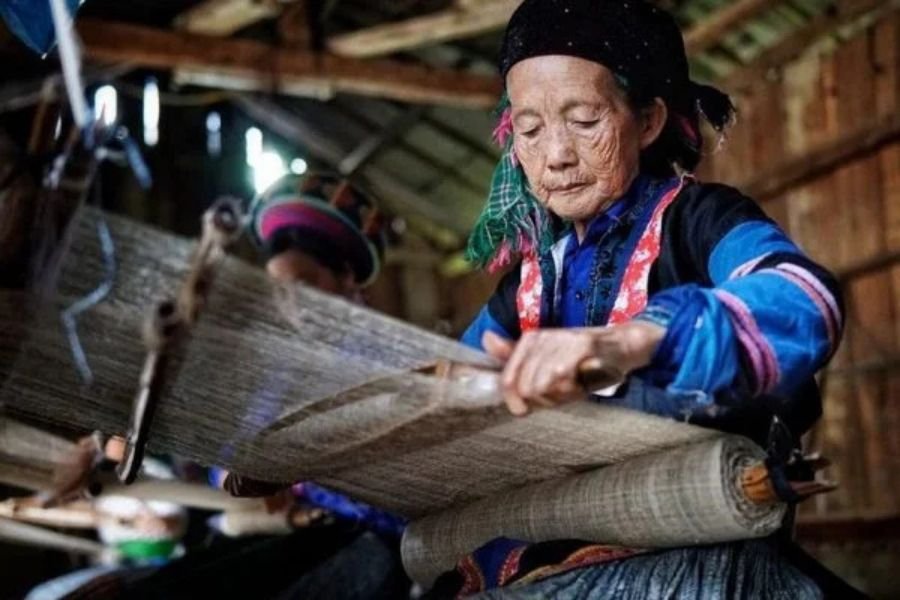
7. Weaving
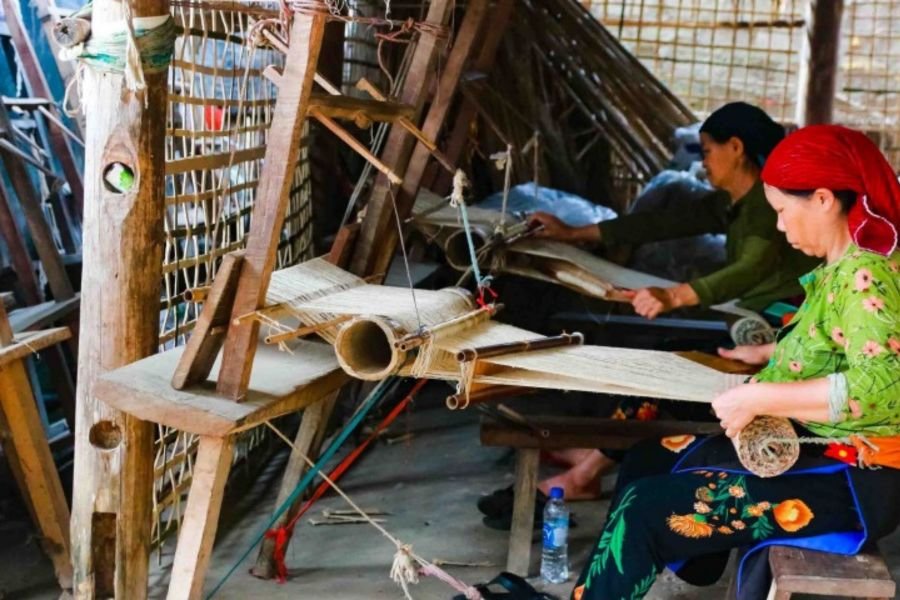
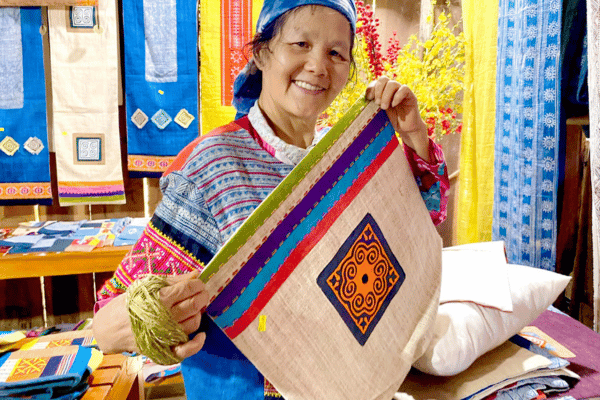
The loom is wooden, foot operated, and usually built by someone in the family. Cloth comes off it in narrow widths, which is why traditional H'Mong garments and modern products alike are often assembled from panels joined edge to edge. Sit and watch for five minutes and you will understand why the cloth is not cheap.
8. Beeswax Batik
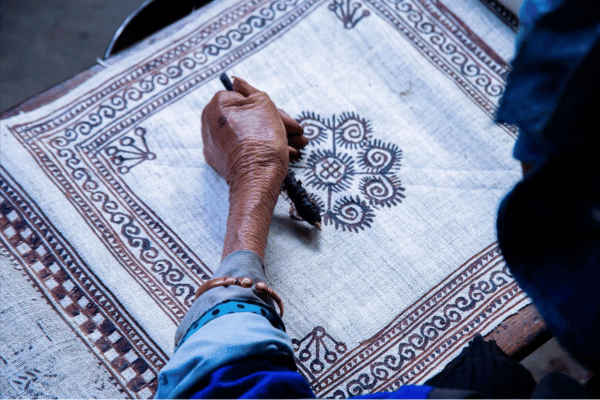
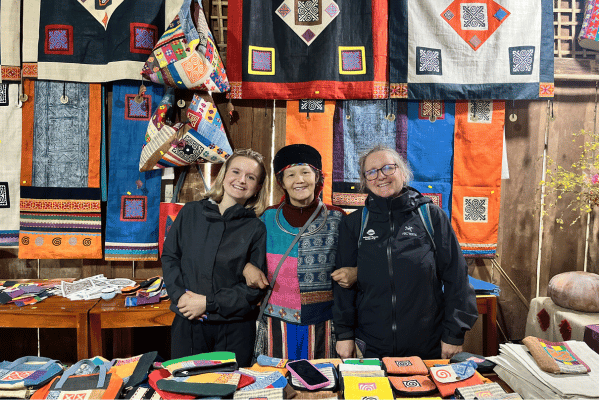
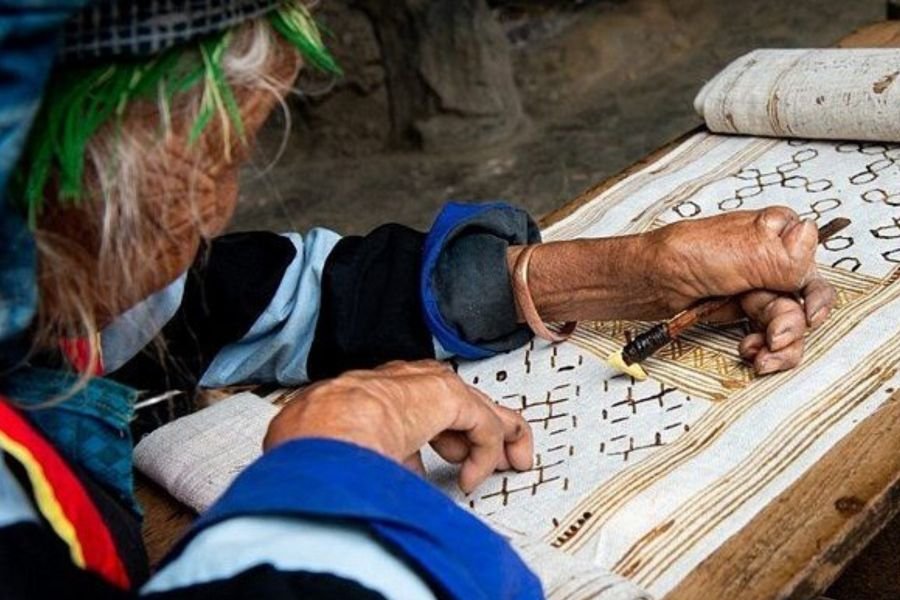
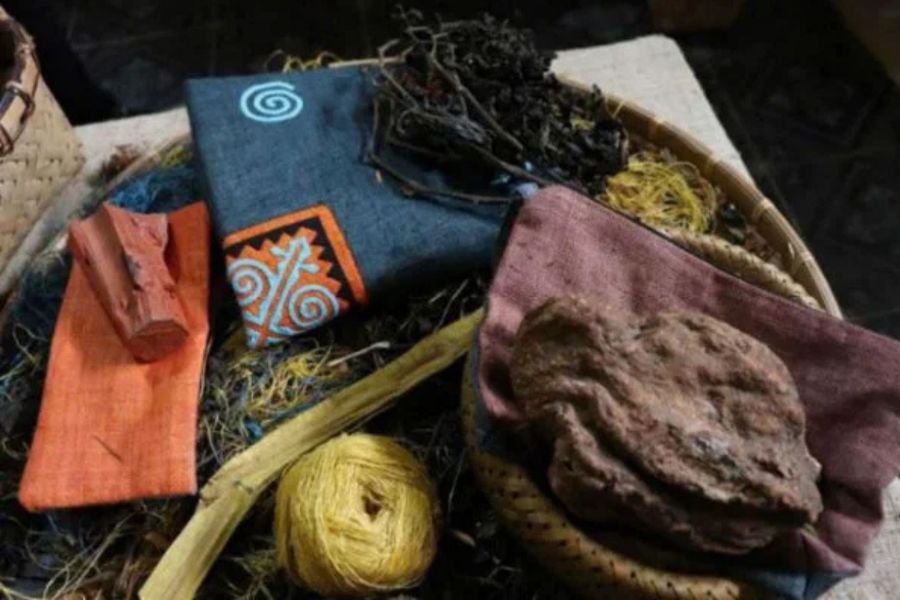
The patterned pieces start here. Hot beeswax is drawn onto white cloth with a small metal pen, freehand, in geometric motifs passed down through families. The wax seals the fibre so dye cannot reach it. There is no pencil guide and no eraser.
9. Indigo Dyeing
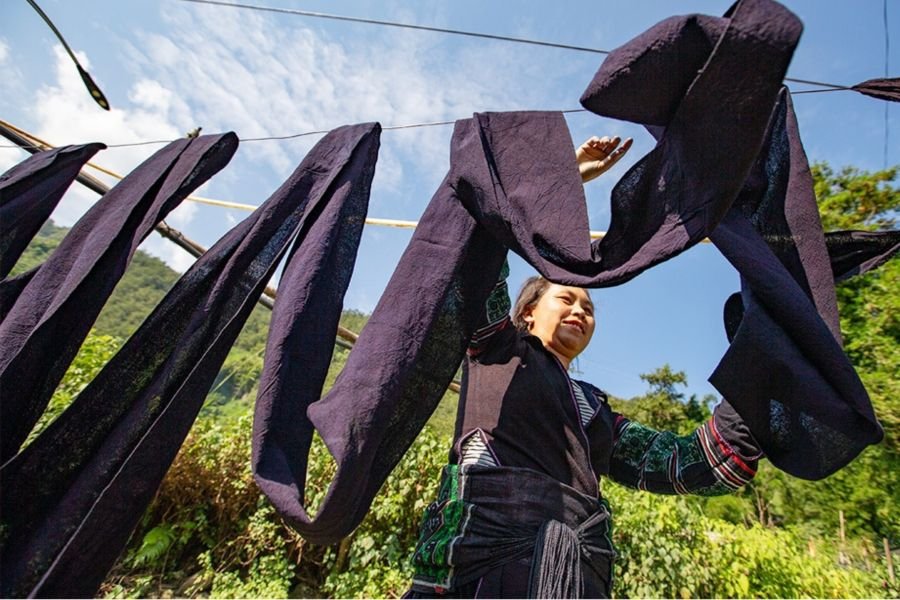
Cloth goes into a fermented indigo vat, comes out green, and turns blue in the air. One dip gives a pale wash. Deep H'Mong indigo, the near black blue you see on traditional skirts, comes from many dips over many days with drying in between. Afterwards the cloth is boiled to melt out the wax, revealing white pattern against blue.
10. Finishing
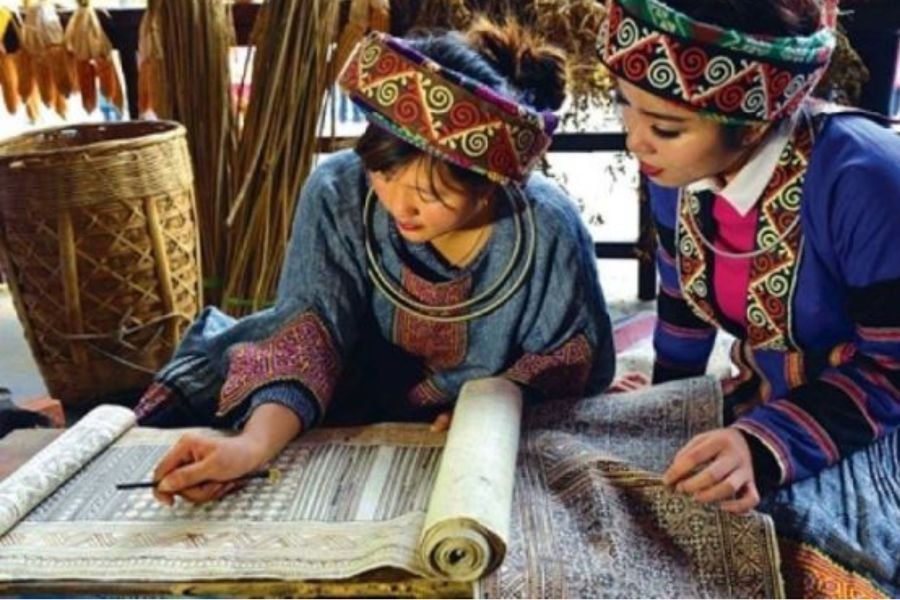
Last comes embroidery, appliqué in bright cotton, hemming and assembly into whatever the piece is going to be. Then it hangs on bamboo poles to air.
What You Actually See When You Visit
Set expectations honestly, because this matters more here than at a viewpoint.
Lung Tam is a working village. On a good morning you may see four or five stages happening at once: someone splitting fibre in a doorway, someone on the stone roller, two looms going, cloth drying outside. On a quiet afternoon in the middle of the rice harvest, you may find the courtyards mostly empty because everyone is in the fields. Both are the real village.
The cooperative building typically has a demonstration area and a shop room. Staff will often walk you through the stages if the workshop is active, and someone can usually explain in Vietnamese while your driver or guide translates. Opening hours, entrance arrangements and whether a demonstration runs on a given day can change, so treat any fixed schedule you read online with suspicion and have someone check ahead for you.
What you will not get is a polished ticketed attraction with a scripted tour. That is a feature, not a fault.
What to Buy, and How to Buy Well
The shop room is small and the range is narrower than a Hanoi boutique, which is the point. Common pieces:
- Scarves and shawls, plain indigo or batik patterned
- Table runners and placemats
- Cushion covers
- Shoulder bags and pouches
- Uncut lengths of cloth by the metre
- Small purses and phone sleeves, the easiest gifts to pack
How to tell what you are holding:
| What to check | Handmade hemp | Machine made substitute |
|---|---|---|
| Surface | Slightly uneven, visible slubs and thread joins | Perfectly regular |
| Edges | Narrow loom width, panels joined | Wide continuous cloth |
| Feel | Stiff and dry at first, softens with washing | Soft and smooth immediately |
| Pattern | Small wobbles in the batik lines | Identical repeats |
| Colour | Slight variation across the piece | Flat and uniform |
Prices change and vary by size and complexity, so nothing useful can be published here. Ask, compare two or three pieces, and buy the one you actually want. Hard bargaining is out of place in a cooperative where the price supports the women who made the thing. A polite question about a bundle price for several items is fine.
Wash new indigo separately the first few times. It will bleed. That is real dye behaving normally.
Best Time to Visit Lung Tam Linen Village
The village works year round, but different stages dominate different seasons.
| Season | What you are most likely to see | Conditions to plan around |
|---|---|---|
| Spring | Hemp planting, weaving indoors, valley turning green | Mist and light rain common, cool mornings |
| Summer | Hemp harvest, stalks drying, fibre splitting everywhere | Hot in the valley, heaviest rain of the year |
| Autumn | Full production, dyeing, golden rice terraces around the village | The most reliable weather window |
| Winter | Weaving and embroidery indoors, quiet courtyards | Genuinely cold at altitude, damp fog possible |
Autumn is the popular answer and it deserves the reputation, though the valley is beautiful in a completely different way under spring mist. Weather in these mountains changes quickly at any time of year, so check a current forecast rather than an average.
A practical note on time of day: mornings are more active than late afternoons, and the light in the workshops is better before the middle of the day.
A quiet stop deserves an unhurried morning
The difference between enjoying Lung Tam and ticking it off is having thirty spare minutes. In a private jeep those minutes exist, because the vehicle waits for you rather than the other way around, and there is no group of strangers behind you glancing at their watch.
Have a look at the Ha Giang Loop jeep tour 4 days if a slower northern loop with more village time sounds right, or send a question on WhatsApp and we will tell you honestly whether it fits your dates.
How to Reach Lung Tam Linen Village
The route is simple in principle. Head north from Ha Giang City on the main mountain road through Quan Ba, then turn off and descend into the valley on a narrower local road toward the commune. Signage exists but is modest, and the turning is easy to miss at speed.
Deliberately not published here: how long the drive takes. Mountain travel times in Ha Giang depend on weather, roadworks, market day traffic, livestock and how many times you stop for a photograph. Any article giving you a precise figure between two points up here is guessing, and planning around a guess is how people end up driving passes after dark. Ask someone local on the day.
Two things that make the detour easier:
- A vehicle that handles a narrow valley road comfortably. The descent is fine but it is not a highway, and it can be slick after rain.
- Someone who can ask. Half of what makes this stop worthwhile is being able to ask what a woman is doing and get an answer. A local English speaking driver turns a photo stop into a conversation.
If you prefer to be behind the wheel yourself, the Jeep Wrangler Rubicon rental covers the self drive option, and the office in Ha Giang City can brief you on the turning before you leave.

Stops That Pair Well With Lung Tam
Lung Tam sits early on the northern route, so it slots naturally into a first or second day alongside:
- Quan Ba Twin Mountains and Heaven's Gate, the viewpoint directly above the valley
- Yen Minh, and the pine road that follows it
- Pho Bang, a quiet old town of clay walled houses
- Sung La, the valley village with the well known H'Mong house
- Dong Van Old Quarter, best in the early evening
- Dong Van Sunday Market, if your dates line up
- Ma Pi Leng Pass, the headline drive of the whole region
- Meo Vac, and Khau Vai further out
- Lung Cu, at the northern tip
- Du Gia, on the eastern return
On the longer combined routes the trip carries on into the Non Nuoc Cao Bang UNESCO Global Geopark for Ban Gioc Waterfall, Pac Bo, the Ngoc Con valley, God's Eye Mountain and the 15 step pass. Those appear on the Ha Giang and Cao Bang jeep tour 5 days and the slower 6 days version.
Visiting Respectfully
None of this is complicated, but it changes how you are received.
- Ask before photographing faces. A gesture at your camera and a nod is enough. Some women will wave you off, and that is their call.
- Do not photograph over someone's shoulder while they work unless they have said yes. The wax pen and the splitting work both need concentration.
- Buy something rather than tipping. The cooperative model is the income. A purchase supports it directly.
- Skip the sweets and pens for children. Handing out gifts on the roadside encourages kids to approach vehicles. If you want to give, give at the shop.
- Do not touch cloth in the dye vat or handle drying pieces with sunscreen on your hands.
- Take your shoes off if you are invited into a home, and accept the tea.
Mistakes Travellers Make Here
- Arriving with fifteen minutes. You will see a shop and nothing else. Allow enough time to walk into the courtyards.
- Assuming a demonstration is guaranteed. It depends on the day, the season and the harvest.
- Confusing Lung Tam with roadside stalls. Similar looking textiles are sold at viewpoints all over the region and much of it is machine made and imported. The village is where you see the process.
- Expecting museum labelling. There is very little written explanation. The value comes from asking questions.
- Booking a schedule with no slack. A tight plan turns every good stop into a source of stress.
- Trusting posted opening hours online. Have someone confirm on the day.
Which Jeep Tour Is Right for You?
Lung Tam fits into every northern route, but how much time you get there depends on the length of the trip.
| Trip | Best for | Village time |
|---|---|---|
| Ha Giang Loop 3 days | Limited days, still want the full headline route including Ma Pi Leng | Focused, one or two cultural stops chosen well |
| Ha Giang Loop 4 days | A slower loop with more villages and Du Gia | Comfortable, unhurried |
| Ha Giang and Cao Bang 5 days | Adding Ban Gioc and a second UNESCO geopark | Good, with a longer overall arc |
| Ha Giang and Cao Bang 6 days | The most relaxed pace across both regions | The most generous |
| Jeep Wrangler Rubicon rental | Confident drivers who want full control of the day | Entirely yours |
Every jeep on these trips is private. You are never grouped with strangers, the soft top goes up when the weather turns, and the cabin has heating for the cold months at altitude, which matters more in Quan Ba in January than most people expect.
There is a food argument too. A private vehicle means you stop where you want: a roadside pot of chao au tau, banh cuon trung in Dong Van in the morning, com lam cooked in bamboo, thang den after dark. If someone pours you a glass of ruou ngo, the corn wine, nobody in your group has to worry about driving afterwards. That single detail changes how a market day feels.
FAQ
Yes, if you want to see how something is made rather than just look at scenery. It is one of the few genuine working craft stops on the northern route. If you only care about passes and viewpoints, you can skip it without regret.
Handmade hemp cloth produced by H'Mong women, from growing and splitting the fibre through beeswax batik and natural indigo dyeing, organised through a village weaving cooperative founded in the early 2000s.
In Quan Ba district, Ha Giang province, in a valley beside the Mien River below the main road north from Ha Giang City, inside the Dong Van Karst Plateau UNESCO Global Geopark.
Hemp. The English word "linen" is the local convention and has stuck. True linen comes from flax, but the two fibres are processed and behave in similar ways.
Plan for around an hour if you want to walk through the courtyards, watch a stage or two and look properly at the shop. A quick stop of fifteen minutes shows you very little.
Arrangements vary and can change. Ask your driver or guide to confirm on the day rather than relying on a figure published online.
Yes. The valley floor is flat, the walking is short and gentle, and there are no steps or climbs involved. It is one of the easier stops on the whole route.
Some staff do, in varying amounts. Most of the value comes through a driver or guide who can translate, which is why arriving with a local English speaking driver makes a real difference here.
Scarves, table runners, cushion covers and bags travel best. Prices support the makers directly, so hard bargaining is out of place. Asking about a price for several items together is normal.
It sits early on the northern route, so it fits into the 3 days and 4 days loop trips and both combined Ha Giang and Cao Bang trips. On a private jeep the stop can be lengthened or dropped based on how the day is running.
Ready to See It Properly?
Lung Tam rewards the travellers who are not in a hurry. If that sounds like your kind of trip, tell us your dates and we will tell you honestly which route fits.
Secure Your Spot with a 20% deposit. That deposit goes straight out again: it pre pays your homestays, your driver and your border area permits so everything is confirmed before you land. The remaining 80% is paid in cash when you arrive in Ha Giang City.
Once you have confirmed travel dates, book as early as you can. Most guests book one to three months ahead, and jeep availability is limited, so early booking lets us arrange everything properly.
WhatsApp +84 938 988 593 or +84 862 379 288 · booking@hagiangbyjeep.com · office in Ha Giang City