
Ha Giang Loop · Planning Guide
Ha Giang Loop 2 Days: Is It Enough?
Two days is the number most people arrive with. Not because they planned it that way, but because that is what the calendar left them.
You have a flight out of Hanoi. You have a week in Vietnam that is already half spoken for. And somewhere in the middle of the planning you saw a photograph of a road carved into a limestone wall above a green river, and now you cannot let it go.
So: is the Ha Giang Loop 2 days enough?
The honest answer is that it depends entirely on what you are trying to get out of it, and on how you travel those two days. Some people finish a compressed loop feeling like they stole something wonderful from a tight schedule. Others finish it feeling like they watched northern Vietnam through a car window at speed. The difference is rarely luck. It is planning, and it is the vehicle you are sitting in.
Here is what two days actually gives you, what it takes away, and how to make the trade well.
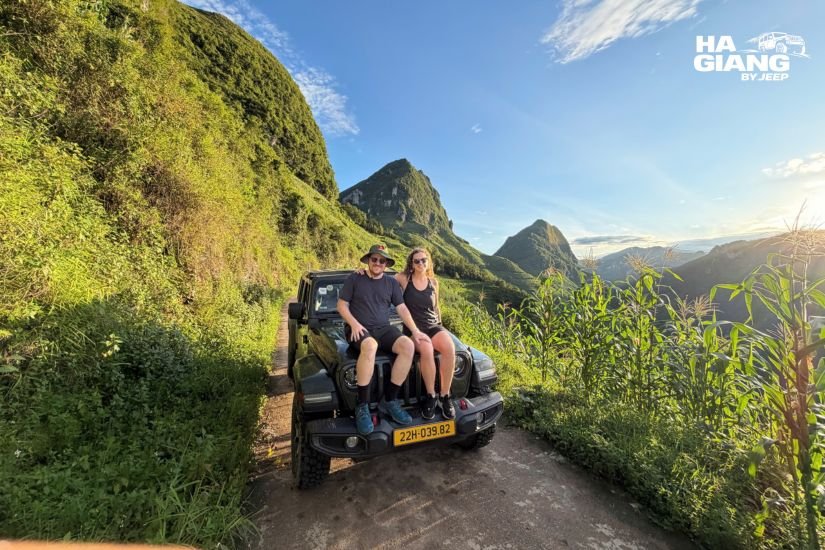
The short answer
Yes, the Ha Giang Loop 2 days is possible, and it is worth doing.
You can see Quan Ba, you can climb through Yen Minh, you can sleep in Dong Van, and you can cross Ma Pi Leng Pass, which is the reason most people come here in the first place. That is not a consolation prize. That is the spine of the whole route.
What you cannot do in two days is linger. There is no afternoon spent doing nothing in a village because the light was good and nobody felt like moving. There is no detour to Du Gia. There is very little margin if the weather turns, and in these mountains the weather turns often.
A two days loop is a real trip with a tight edit. A three days loop is the same trip with room to breathe.
Both are good. Only one of them is honest about being rushed, and that is the one you should walk into with your eyes open.
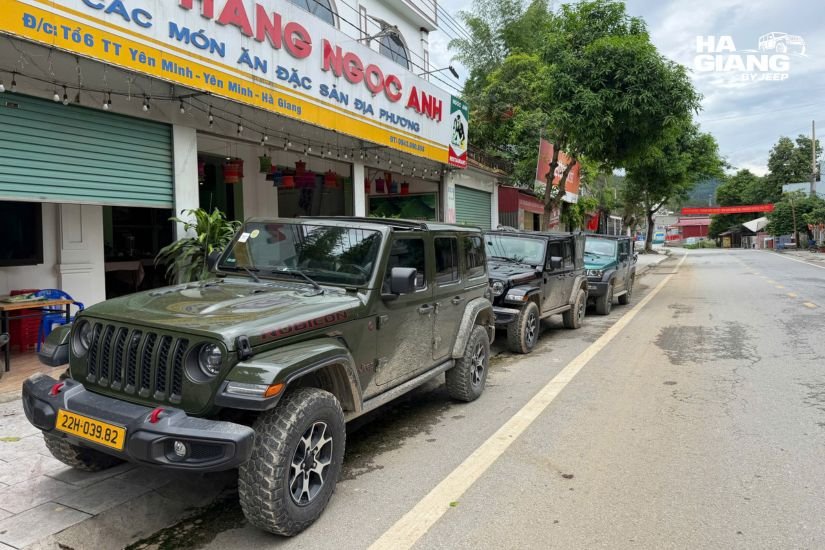
What the Ha Giang Loop actually covers
The loop is not long on paper. It is long in practice, and the reason is the road itself.
The classic route runs north from Ha Giang City, over the pass at Quan Ba, through the pine covered hills around Yen Minh, up onto the Dong Van Karst Plateau, and then east along Ma Pi Leng Pass toward Meo Vac before it turns back. Almost none of that is straight. The road climbs, folds back on itself, drops into a valley, and climbs again. You do not cover ground here at the speed the map suggests.
That is the first thing to understand about squeezing the loop into two days. The constraint is not distance. It is that every kilometre asks something of the road, and the road asks something of you.
The places that give the route its character, roughly in the order you meet them:
- Quan Ba, where the plateau announces itself and the valley opens up beneath the viewpoint
- Lung Tam, the linen village where indigo dyeing is still done by hand
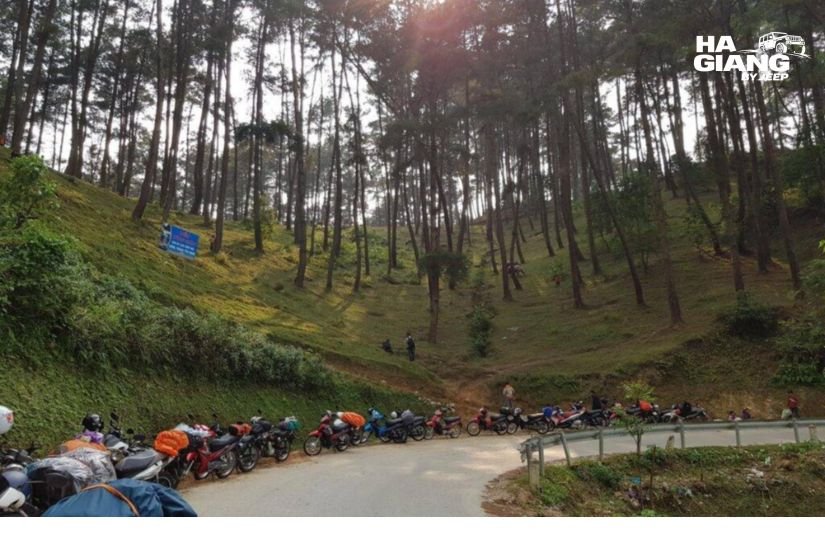
- Yen Minh, pine forest and switchbacks, a change of climate you can feel on your skin
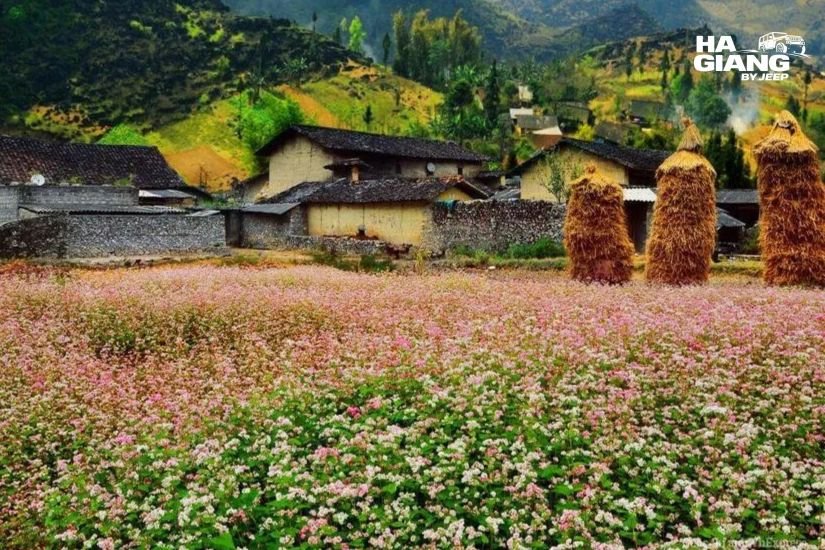
- Sung La, a valley of stone walls and earth walled Hmong houses
- Pho Bang, a quiet town that most convoys skip entirely
- Dong Van Old Quarter, the stone town where nearly everyone spends the night
- Lung Cu, the northernmost point, a detour that costs real time
- Ma Pi Leng Pass, the road above the Nho Que river, and the reason for the whole thing
- Meo Vac, market town, gateway to the eastern side of the plateau
All of this sits inside the Dong Van Karst Plateau UNESCO Global Geopark, which is not a marketing line. It is a designated geological landscape, and it explains why the rock behaves the way it does here: the towers, the sinkholes, the sudden vertical drops.

A realistic Ha Giang Loop 2 days itinerary
This is the version that works. Not the version that looks good in a spreadsheet.
Day 1: Ha Giang City to Dong Van
Leave early. This is the single most important decision of the whole trip, and it is the one people get wrong. An early start on day one is what turns a rushed two days into a good two days.
The morning is a climb. You come out of Ha Giang City and the road starts working immediately, lifting you through farmland and then into the folds of the plateau. Quan Ba is the first stop where you genuinely need to get out of the vehicle, because the view does something to the sense of scale that photographs do not.
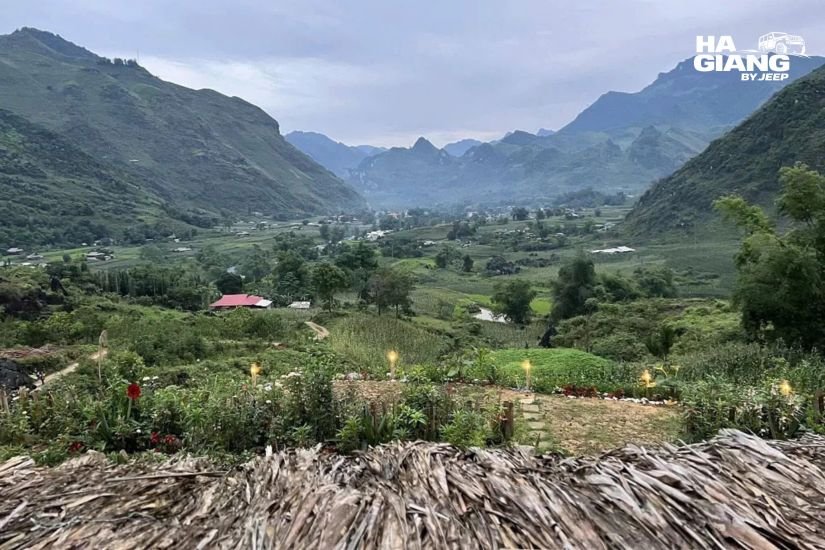
From there the character shifts. Yen Minh brings pine trees and cooler air. Then the plateau proper: bare grey rock, terraced maize planted in pockets of soil between the stones, and villages that look like they grew out of the hillside rather than being built on it.
Sung La is worth the stop. So is Lung Tam if you have any interest at all in how the indigo linen is actually made, and if the workshop is open, which varies. On a two days schedule, you will likely choose one of these rather than both. That choice is the whole point of having a driver who knows what is happening in each village on that particular day.
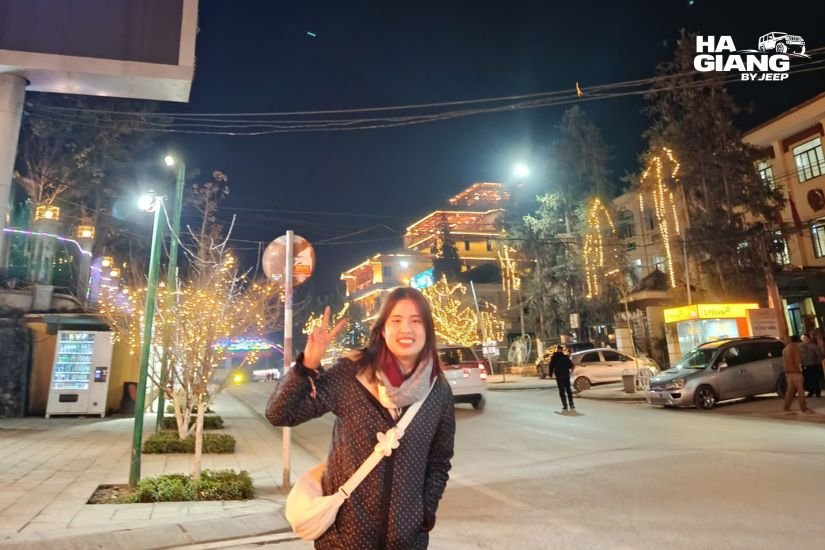
Arrive in Dong Van in the late afternoon with enough daylight to walk the old quarter before dinner. Stone houses, tiled roofs, a square that fills up in the evening. Eat well. Sleep properly. Day two is the big one.
Realistic edit for day 1: skip Lung Cu. It is the northernmost point of Vietnam and there is a flagpole and a view, and it is a genuine detour that eats a serious chunk of daylight. On a two days loop, Lung Cu is what you sacrifice to protect Ma Pi Leng.
Day 2: Ma Pi Leng, Meo Vac, and back
Again: leave early. Not because you are behind, but because Ma Pi Leng in the morning light, before the cloud burns off the canyon, is a different pass than Ma Pi Leng at midday.
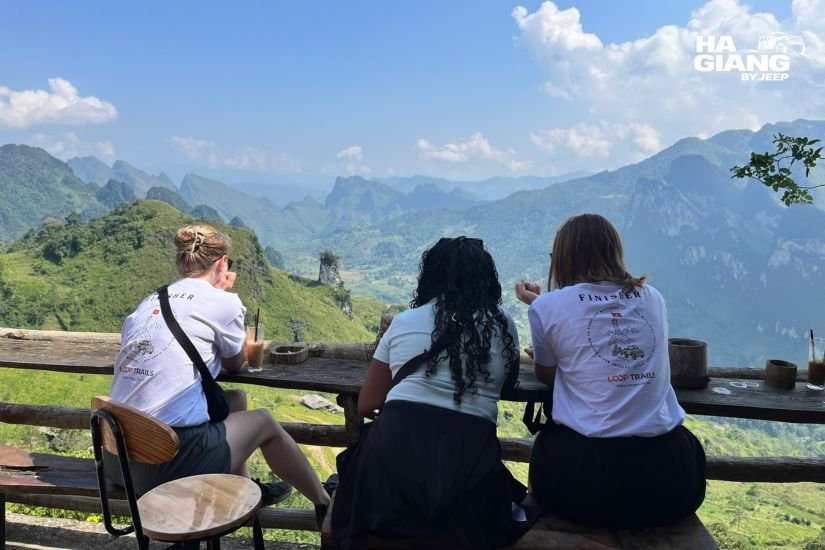
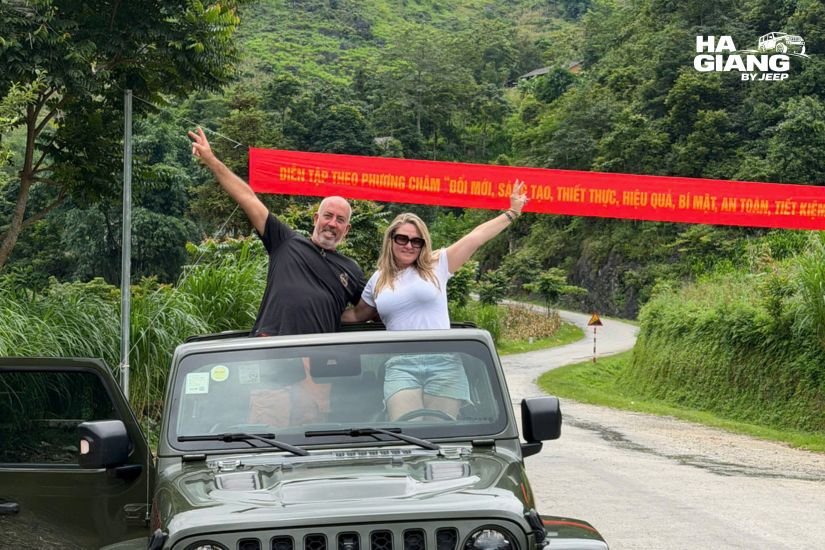
The road out of Dong Van climbs and then delivers you onto the pass. The Nho Que river sits far below, a strip of green so saturated it looks wrong. There are pullouts. Use them. This is the section of the entire loop where you should be stopping every time something opens up in front of you, and it is precisely why the vehicle matters. A private jeep can pull over wherever the view is, not wherever the group schedule allows.
Some travelers add a boat trip on the Nho Que through the Tu San canyon. On a two days schedule this is a real decision, not a free add on, because it takes a meaningful bite out of the day. It is worth asking your driver whether the timing works before committing, and being prepared to let it go.
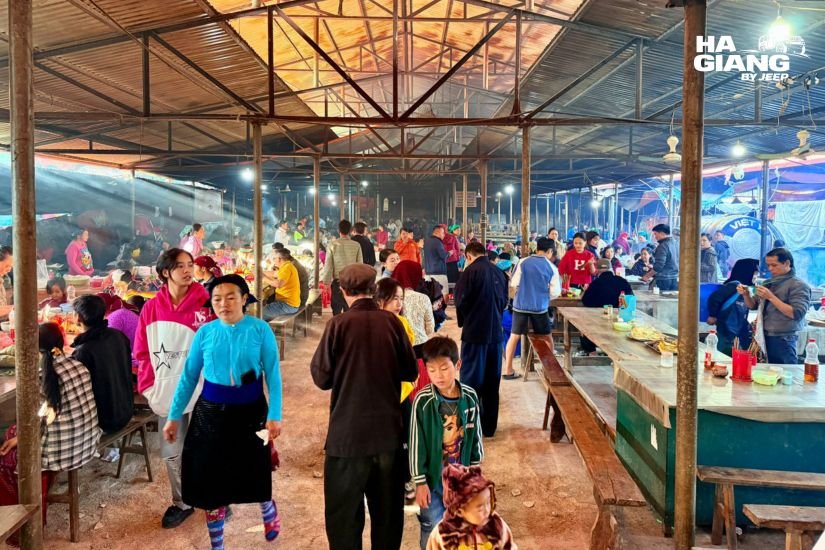
Meo Vac comes next. If your day two happens to land on a market day, take the market over almost anything else on the list. The markets here are not staged for visitors. They are where people from the surrounding villages actually come to trade, and they are the most direct window you will get into life on the plateau.
Then the road turns back toward Ha Giang City. The return leg is long. Plan for it, and plan to be tired at the end of it in the good way.
What you give up in 2 days
Being straight about this is more useful than selling you a fantasy.
- Du Gia. The village on the eastern arm of the loop, the waterfall, the slow evening. One of the most loved parts of the full route, and it simply does not fit in two days.
- Lung Cu. The flag tower at the northern tip. Beautiful, symbolic, and expensive in daylight.
- Khau Vai and the Sunday market at Dong Van. Markets run on their own calendar, not yours. On a two days trip you take whichever market your dates happen to hand you, and there is a decent chance that is none of them.
- Pho Bang, and towns like it. The places that reward you for having no particular reason to be there.
- Weather margin. This is the one that actually hurts. Ha Giang gets fog, cold rain, and low cloud that can erase a viewpoint completely. On a three days loop, a bad morning is an inconvenience. On a two days loop, a bad morning can cost you Ma Pi Leng.
- Rest. Two days on this road is a lot of road. If you are traveling with children, with parents, or with anyone who does not enjoy being in a moving vehicle for long stretches, the compression is felt.
None of this makes two days a bad decision. It makes two days a decision with a shape, and knowing the shape is how you make peace with it.
Not sure two days is the right call?
Send us your dates and your flight times and we will tell you honestly whether the loop fits, or whether a different route serves you better. We would rather talk you into the right trip than sell you the wrong one.
The travel day nobody counts
Here is the thing that quietly ruins two days trips.
Ha Giang City is not next door to Hanoi. Getting there is its own journey, and it is not a short one. Most travelers make the trip overnight, arriving in the early morning, or they travel up during the day and start the loop the following morning. Both work. Both consume time that people forget to put in the plan.
So when you say "two days in Ha Giang," ask yourself what you actually mean:
- Two days on the loop, plus travel is realistic. It usually means an overnight journey up, two full days driving the loop, and a return journey afterwards. Call it four days of your life.
- Two days total, including getting there and back is not really a loop. It is a long journey with a short look at the mountains in the middle, and you will spend more time in transit than on the plateau.
If your total window is genuinely two days door to door from Hanoi, be honest with yourself about it and consider whether a different plan serves you better. If your window is two days on the ground in Ha Giang, you have a real trip.
Schedules, road conditions, and transport options change. Check the latest updates before you lock anything in, and if you are unsure how the timing stacks up against your flights, ask someone based in Ha Giang City rather than guessing from a map.
2 days vs 3 days vs 4 days: what each one buys you
| 2 days | 3 days | 4 days | |
|---|---|---|---|
| Quan Ba, Yen Minh, Dong Van | Yes | Yes | Yes |
| Ma Pi Leng Pass | Yes | Yes, with time to stop properly | Yes, with time to stop properly |
| Meo Vac | Yes, briefly | Yes | Yes |
| Lung Cu | Usually skipped | Possible | Yes |
| Du Gia | No | Sometimes | Yes |
| Village and market time | Minimal | Reasonable | Generous |
| Weather margin | Almost none | Some | Comfortable |
| Pace | Fast | Balanced | Unhurried |
| Best for | Tight schedules, highlights | Most people | Photographers, families, slow travelers |
The Ha Giang Loop Jeep Tour 3 Days is the version we recommend most often, and it is not a coincidence. Three days is roughly where the route stops feeling like a checklist and starts feeling like a place.
The Ha Giang Loop Jeep Tour 4 Days is for people who came here for the villages rather than the viewpoints, and who would rather spend an afternoon somewhere than drive past it.
And if you have longer, the road east does not end at Meo Vac. The Ha Giang and Cao Bang Jeep Tour 5 Days carries on into the second UNESCO Global Geopark in the region, Non Nuoc Cao Bang, toward Ban Gioc Waterfall, the Ngoc Con valley, and the Pac Bo historical site.
Why a jeep changes the math on a short trip
When time is the scarce resource, the vehicle stops being a comfort question and becomes a logistics question.
You stop where the view is, not where the plan is
A private 4x4 with a driver who knows every pullout on Ma Pi Leng means the time you spend on that pass is time actually spent looking at it. On a two days trip, that is a meaningful fraction of the whole thing.
Weather does not end your day
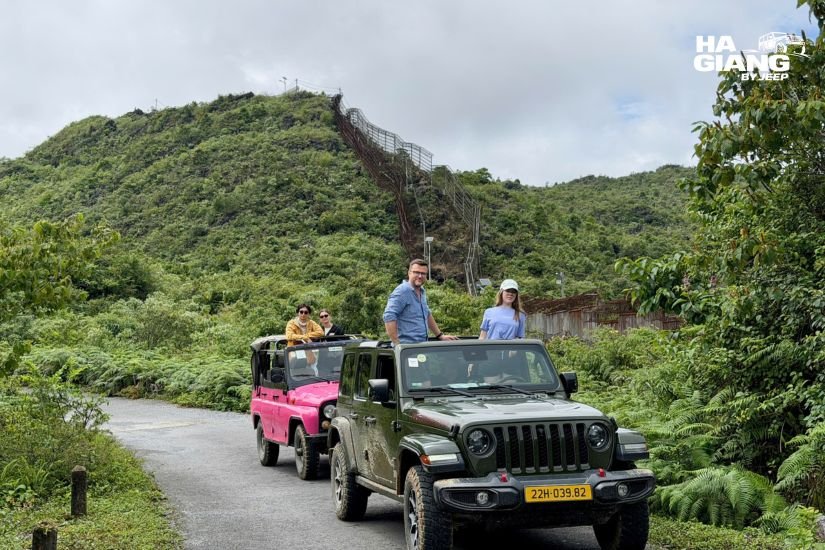
The jeeps are open air, which is the entire point on a clear morning above the Nho Que. They also have a soft top and heating, which is the entire point when the cloud drops onto the plateau and the temperature falls with it. On a two days schedule you cannot afford to lose a morning to rain. With a closed cabin, you do not have to.
You arrive able to enjoy the evening
There is a version of this trip where you reach Dong Van physically wrecked, eat something quickly, and sleep. There is another version where you reach Dong Van tired in the pleasant way, walk the old quarter, eat properly, and have a conversation. Two days is short enough that the second version matters.
Everyone in the vehicle gets the view
Nobody is concentrating on the road. Nobody is missing the valley because they are watching for gravel. On a compressed itinerary, that is the difference between seeing Ha Giang and driving through it.
This is what we mean when we say adventure without exhaustion, and on a two days loop it stops being a slogan and starts being the operating principle. If you want the full picture of how a day on the road actually runs, we wrote that up separately in our guide to what to expect on a Ha Giang jeep tour.
Eating your way around the loop without watching the clock
Food is where a short trip usually suffers first, and it does not have to.
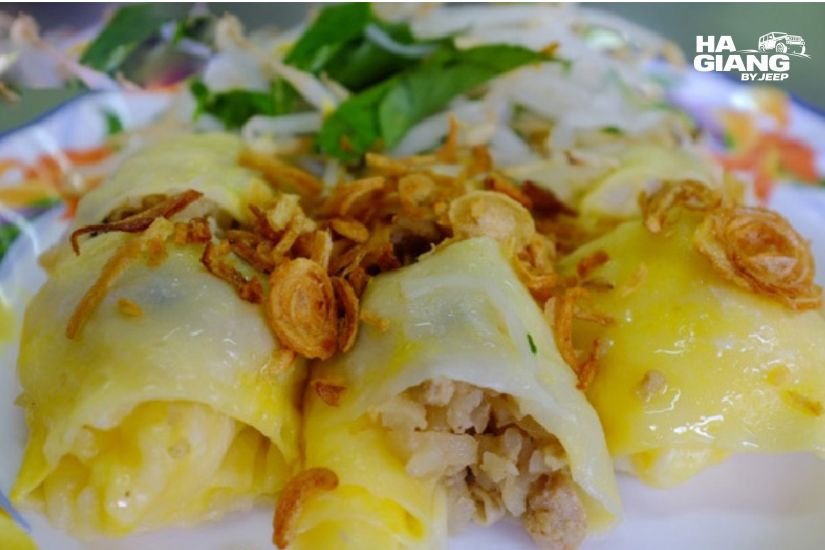
The plateau eats well, and it eats specifically. Com lam, sticky rice cooked inside bamboo over a fire, sold at roadside stalls and markets. Thang den, warm glutinous rice balls in ginger syrup, which is exactly what you want when the temperature drops in Dong Van after dark. Banh cuon trung, steamed rice rolls with egg, served with a bowl of hot broth rather than dipping sauce, which is the Ha Giang way and is better. Chao au tau, a thick, slightly bitter porridge made with a local tuber, eaten in the evening and considered warming.
And ruou ngo, corn wine, which will be offered to you, probably more than once, and which is genuinely part of the culture here rather than a tourist ritual.
Here is the practical point. With a private jeep and a driver, you stop at the stall that smells right. You sit down at the market because there is a woman ladling something out of a pot and you want to know what it is. You accept the corn wine when a homestay host pours it, because you are not the one driving afterwards.
On a two days trip, where every stop competes with every other stop, having a local driver who knows which roadside place is worth pulling over for is not a small thing. It is how you get a food experience out of a schedule that supposedly has no room for one.
Who a 2 days loop works for
- Travelers on a fixed schedule who would rather see Ma Pi Leng properly than not see it at all
- Couples with a tight window in a longer Vietnam itinerary
- Anyone whose priority is the road and the passes rather than deep village time
- Repeat visitors who have already done the full loop and want the highlights again
- People comfortable with a full, driving heavy pair of days who would rather earn the view than skip it
Who should not compress it
- Families with young children. Two days of mountain road is a long time in a car seat. Three days, with a real break in the middle, is a much kinder trip.
- Travelers in their sixties and above who want to arrive at each stop feeling good rather than merely arriving. The jeep removes most of the physical strain, but it cannot add hours to the day.
- Photographers. You will spend the whole trip watching light you do not have time to wait for.
- Anyone traveling in the wet season who cannot afford to lose a morning. Fog and rain do not negotiate.
- First time visitors who want to understand the place, not just photograph it. The plateau opens up slowly. Two days is not slow.
Packing and preparation for a fast loop
Weather and layers
The plateau is colder than the rest of northern Vietnam, and it is colder than travelers expect. It is also unpredictable. A clear morning at Quan Ba does not promise a clear afternoon at Dong Van.
Bring layers, a proper waterproof jacket, and something warm for the evening even in the warmer months. If you are traveling in the winter, bring more than you think. The jeeps have heating and a soft top, so you will be fine while you are moving. It is the standing around at viewpoints where the cold finds you.
Paperwork and permits
Parts of the region sit close to the border and have historically required permits. Requirements can change, and enforcement can change without much notice. Do not treat anything you read online, including this, as the final word.
Book with an operator based in Ha Giang City and let them handle the border area paperwork. That is what a local office is for. Bring your passport, keep it with you, and check the latest updates before you travel.
Money and connectivity
Cash is useful in the villages and at the markets. Signal exists across most of the route but is not universal. Download an offline map before you leave Ha Giang City.
A short checklist
- Passport, with a copy stored separately
- Warm layer plus a waterproof outer layer
- Comfortable shoes with grip, viewpoints are often uneven rock
- Sunglasses and sun protection, the light on the plateau is strong even when it is cold
- Motion comfort remedies if you are sensitive to winding roads, this route is nothing but winding roads
- Cash in small notes
- A power bank
Common mistakes on a short Ha Giang Loop
- Starting late on day one. The single most common way a two days loop goes wrong. Every hour lost in the morning is an hour taken off the plateau in the afternoon.
- Trying to keep Lung Cu. It is a lovely place and it does not fit. Keeping it usually means arriving at Ma Pi Leng in flat midday light and rushing the best part of the route.
- Underestimating the road. People look at the map, see the distances, and assume a comfortable schedule. The road disagrees.
- Booking transport and tour separately, badly. The overnight journey up and the loop itself need to fit together. Arriving at an awkward hour and losing half a morning to logistics is a self inflicted wound on a two days trip.
- Assuming markets happen when you want them to. They run on their own schedule. Check before you build a plan around one.
- Booking too late. Jeep availability is limited. Once you have a confirmed travel date, book as soon as you reasonably can. Most guests book one to three months in advance, and on peak weekends the short notice options run out first.
- Believing anyone who gives you exact driving times. Weather, road works, and landslides all have a vote. Any operator who will not caveat their timings is selling you certainty they do not have.
Which jeep tour is right for you?
Choose 2 days if your schedule is genuinely fixed and you want the passes above everything else. You will see Quan Ba, Dong Van, and Ma Pi Leng. You will move quickly. It is a real trip.
Choose 3 days if you have any flexibility at all. The Ha Giang Loop Jeep Tour 3 Days is the sweet spot: the full classic route, time at the viewpoints, and enough margin that a foggy morning does not ruin the trip.
Choose 4 days if you want the villages, the markets, and Du Gia. The Ha Giang Loop Jeep Tour 4 Days is the version people wish they had booked once they see what the plateau is actually like.
Choose 5 or 6 days if the mountains are the reason you came to Vietnam. The Ha Giang and Cao Bang Jeep Tour 5 Days and the Ha Giang and Cao Bang Jeep Tour 6 Days run east from Meo Vac into Cao Bang: Ban Gioc Waterfall on the border, the Ngoc Con valley, God's Eye Mountain, and the Pac Bo historical site. Two UNESCO Global Geoparks in one route.
Choose the rental if you are a confident driver who wants the road to yourself. The Jeep Wrangler Rubicon rental is available by the day, with route advice from people who drive these passes for a living.
Ready to make two days count?
Every jeep is private. You are never grouped with strangers. Your driver was born in these mountains, speaks English, and knows which viewpoint has cleared and which one is still under cloud.
We are based in Ha Giang City, we are on WhatsApp 24 hours a day, and we handle the border area paperwork so you do not have to think about it.
booking@hagiangbyjeep.com · +84 862 379 288 · +84 938 988 593
FAQ
Two days is enough to drive the core route: Quan Ba, Yen Minh, Dong Van, Ma Pi Leng Pass, and Meo Vac. It is not enough for Du Gia, Lung Cu, or unhurried village time, and it leaves almost no margin if the weather turns. If your schedule is fixed, it is a genuinely good trip. If you have any flexibility, three days is better.
Day one runs from Ha Giang City north through Quan Ba and Yen Minh onto the Dong Van Karst Plateau, with an overnight in Dong Van Old Quarter. Day two crosses Ma Pi Leng Pass to Meo Vac and returns to Ha Giang City. Early starts on both days are what make it work.
Most travelers make the journey overnight and start the loop the following morning, though daytime transport is also available. This travel time sits outside the two days on the loop, so build it into your plan separately. Schedules change, so check the latest updates when you book.
It is possible, but three days is a much better experience for families. Two days means long stretches of winding mountain road with little downtime. A private jeep removes the physical strain, but it cannot shorten the road.
Yes, and it is one of the reasons the jeep exists. You sit in a proper seat, in a cabin that can be closed and heated, and you get out at the viewpoints. Many of our guests are in their fifties, sixties, and beyond. That said, an older traveler on a two days schedule will feel the pace, so consider three days.
Ma Pi Leng is the priority on day two and a well planned two days itinerary is built around it. What nobody can promise is the view, because low cloud and fog can obscure the canyon. An early start gives you the best chance.
Some parts of the region sit near the border and have required permits historically. Rules can change, so do not rely on secondhand information. When you book with us, we handle the border area paperwork from our office in Ha Giang City. Bring your passport.
Every season looks different: green terraces, golden harvest, buckwheat flowers, and dry cool months with clearer air. There is no single best month, only trade offs between crowds, temperature, and rain. Tell us your dates and we will tell you what to expect.
Because on a short trip, control of your own schedule is the most valuable thing you can buy. A private jeep stops where you want, waits while you take the photograph, and pulls over at the roadside stall that smells good. You are never grouped with strangers, and the itinerary bends to your day rather than the other way around.